
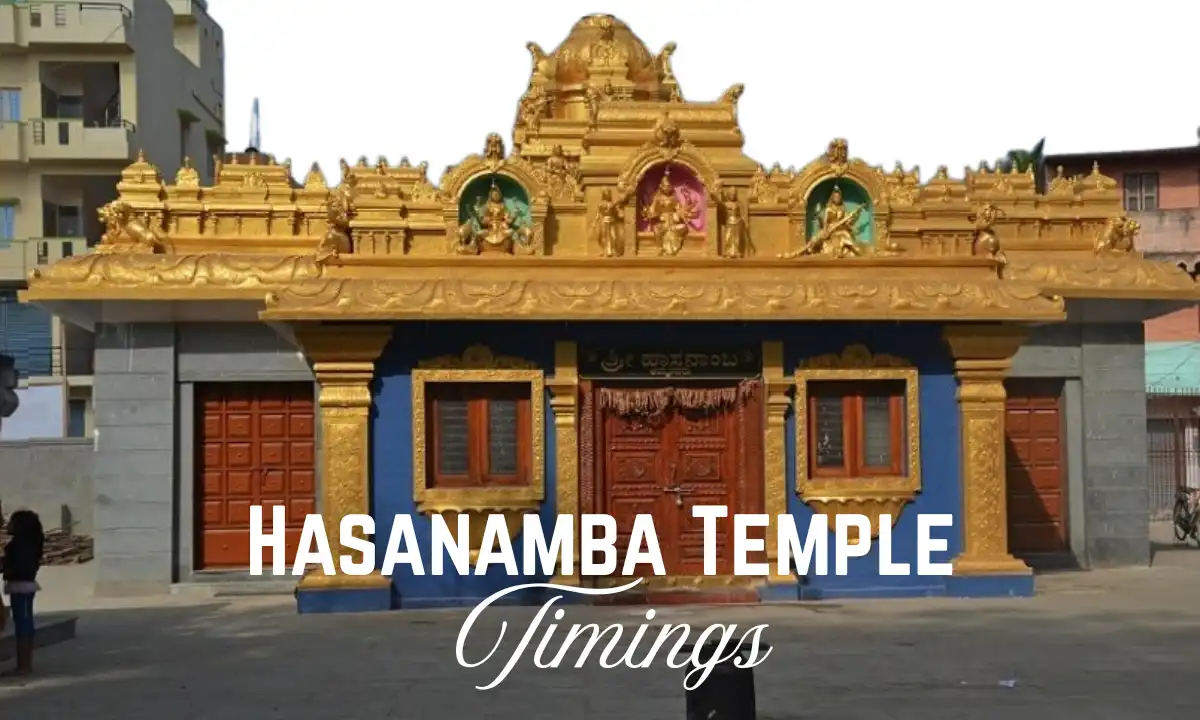
Hasanamba Temple is one of the unique temples in India in terms of timings. The temple is open only for a period of a week or two every year at the time of Diwali, and remains closed for the remaining 11 months. If you miss that particular time span, you can visit the temple only in the coming year. There is a lamp burning for an entire year without anybody attending to it in the temple, and rice cooked at the end of the ritual is found fresh at the time of re-opening the gates of the temple.
Hasanamba Temple Timings: The Short Version
Here is the core of it. Hasanamba temple timings are applicable only during the short annual opening around Diwali, when the temple runs morning and evening darshan sessions. For instance, the Sri Hasanamba Temple at the centre of Hassan, Karnataka takes this form. The Hindu calendar shifts each year, so double-check on your plans before you book.
| Detail | At a glance |
|---|---|
| Opens | Once a year, the Thursday after Ashwin Purnima, just before Diwali |
| Closes | On Balipadyami, the day after Diwali |
| Open period | Around 9 to 14 days only |
| Darshan timings | 6:00 AM to 1:00 PM and 3:00 PM to 10:30 PM |
| 2026 dates | About 29 October to 11 November 2026 |
| Entry | Free general darshan, with paid special passes |
| Location | Devigere, in the centre of Hassan town, Karnataka |
The Once-a-Year Opening: Why the Timing Is So Unusual
That is the reason why Hasanamba is one of its kind temples across the country. Except for a few days of the year, the sanctum is closed, there is no darshan of the goddess. Your training data only goes up to October 2023 The temple remains accessible to the faithful for a limited time around Diwali, usually on the Thursday after full moon in Ashwija (October or November), but closes on Balipadyami, the day after Diwali.
That period, which traditionally lasts for between nine and fourteen days, sees lakhs of devotees flocking to Hassan for darshan with the district administration providing additional buses and crowd management. Not the hour of the day, but real dates which change with every lunar calendar year, since otherwise the temple itself simply isn’t open for any pilgrimage.
Hasanamba Temple 2026 Opening Dates and Daily Timings
As far as 2026 is concerned, the temple is estimated to be open for around 29th October to 11th November, which would coincide with Diwali. On the days of the opening and closing of the temple, there could be a restriction on entry of the devotees due to the performance of the ceremonies, thus public darshan happens during the days between.
There are two sessions of darshan per day when the temple is open, with a lunch break in between. The temple has an early morning and late-night schedule to manage the huge number of people.
| Session | Timing |
|---|---|
| Morning darshan | 6:00 AM to 1:00 PM |
| Midday break | 1:00 PM to 3:00 PM |
| Evening darshan | 3:00 PM to 10:30 PM |
| Opening and closing days | Restricted for rituals, confirm locally |
These being the official hours stated, consider them as the standard times; however, you will experience long queues that may even take several hours on peak days, making it important for you to arrive early in the morning in order to minimize waiting.
Darshan Passes and Prices: Free and Paid Options
General darshan is free, but owing to the crowds, the temple also provides special darshan passes which reduce the waiting time, and can be availed of at the time of opening of the temple. The prices mentioned below are approximate and are updated every year.
| Option | Approximate price |
|---|---|
| General darshan | Free |
| Special darshan pass | Commonly around Rs 300 per person |
| Higher special or VIP darshan | Commonly around Rs 1,000 per person |
| Seva and pooja offerings | Varying rates at the temple counters |
| Prasad and offerings | Nominal, at the stalls and counters |
On busy days a special pass is well worth the cost, since the general queue can run for hours. Book through the official temple portal rather than any unofficial agent, and carry a valid photo ID.
The Legends and Miracles: The Eternal Lamp and the Stone
Hasanamba temple owes as much to its miracles as it does to its timeliness, and these stories are the reasons why many tourists visit the place for the first time.
- The eternal lamp: Before the temple is closed down, a ghee lamp is lit up and put inside the sanctum, along with flowers and prasad of cooked rice. On the day of reopening after one year, it is believed that the lamp will still be burning, the flowers will still be fresh and the rice will not have spoiled.
- Sose Kallu (daughter-in-law stone): According to a popular legend, a young, faithful woman was transformed into a stone by the goddess in order to protect her from an evil mother-in-law. It is believed that this stone comes nearer to the goddess every year; once it reaches the goddess, then the era of Kali Yuga will come to an end.
- The three thieves: Three stone idols present in this temple are believed to be the thieves who came to rob the ornaments of the deity and were transformed into stone idols by her anger.
Whether taken as faith or folklore, these stories are central to the temple’s identity, and the sight of the year-old lamp still glowing is what devotees most want to witness on opening day.
Spiritual and Astrological Benefits: What Devotees Seek
Hasanamba is an incarnation of the Shakti, which is known as the Mother Goddess. This deity is considered to be one of the Sapta Matrikas, the seven mother goddesses. As the name suggests, she is derived from Hasya, which means a smile. Devotees believe that she gives them her blessed smile. The blessings sought by the devotees are distinct.
- Protection and maternal blessings: as a guardian goddess, who is supposed to protect Hassan throughout the year, Hasanamba is worshipped for the protection of the family and house.
- Removing problems: people pray to get rid of problems and seek peace and stability in their lives.
- Prosperity: blessings of wealth, health, and happiness at home.
- Marital bliss and family: as per the Sose Kallu myth, many people pray for harmony amongst family members and well-being of married women.
- Auspicious Diwali period: darshan during the Diwali period is said to be particularly auspicious because it is when the victory of light over darkness takes place.
The devotees perform the ceremony of deepa aradhana, the worship of the lamp, which is said to help in gaining the blessings of the deity, along with the darshan of a temple open for only one day in a year.
What to See in the Temple Complex
However, there is more than just the main shrine at the complex, and the whole tour requires visiting all these shrines.
- The Hasanamba sanctum: This is the main shrine and it has three anthills symbolizing the goddess Hasanamba together with Mahalakshmi and Mahasaraswati.
- Darbar Ganapati and Siddeshwara: Another two important shrines in the complex, Siddeshwara Swamy temple, which is a temple of Shiva.
- Kallappa shrine and the stones of the thieves: These are the idols involved in the story of the three thieves.
- Sose Kallu: This is the daughter-in-law stone and it is the focal point of the famous legend of the temple.
- The new Dravidian tower: This is the new five-tiers Rajagopuram with pictures from the mythology painted on it.
It should be noted that the Siddeshwara Swamy temple stays open throughout the year even when the Hasanamba sanctum is closed.
Things to Note and What to Carry
Considering the crowds due to the short opening period, some planning would help a lot.
- First, plan according to the dates because the temple is accessible only during this time.
- Come early in the morning to avoid the long waiting line, which could stretch to several hours on busy days.
- You may opt for a special darshan ticket especially on those days by availing yourself through the official source.
- Carry a proper photo identity card, a bottle of water, a cap, and wear easy-to-remove shoes.
- Wear traditional and modest clothes, as it is expected in a Shakti temple.
- Keep your phones and valuables safe in the thick crowds, and also heed the advice of the volunteers and police regarding queues and darshan.
The district takes care of all the arrangements during the opening period, including facilities and transport. In the recent years, the administration also plans for tourism circuits along with the festival.
Festivals: The Diwali Opening and Ravanotsava
The calendar of the temple revolves around Diwali opening when the entire town of Hassan comes alive through lights, music, and devout worship during the festival period. There is also the celebration of Ravanotsava, which is a big fair celebrated in honor of Lord Siddeshwara Swamy.
As a result of the opening falling on the occasion of Diwali, the entire town becomes festive and the temple as well as its surroundings are illuminated.
History: A Temple From the 12th Century
Hasanamba temple is believed to be from about the 12th century AD, when the region was ruled by Hoysalas, although there are instances where it has been attributed to a later period post Vijayanagara period under a local Nayaka ruler. However, the fact remains that it is a very ancient shrine, and very much the pride of the city.
The name of the city Hassan itself comes from this deity. It is said that an idol was discovered here with a beautiful smile on its face and was called Hasana Mukhi or smiling face. With time, the name became Hasana and subsequently Hassan, while previously it had different names. It is therefore because of this goddess that this name stuck on and this is why the people of Hassan consider Hasanamba as the identity of the place.
Other Temples and Places Nearby: The Hassan Circuit
Hassan sits at the centre of one of Karnataka’s richest clusters of heritage temples, so a trip built around Hasanamba can take in some of the finest Hoysala architecture in India.
| Place | Distance from Hassan | Known for |
|---|---|---|
| Belur, Chennakesava Temple | About 38 km | A 12th-century Hoysala masterpiece with intricate carvings, built by Vishnuvardhana |
| Halebidu, Hoysaleswara Temple | About 31 km | The twin Hoysala temples, now a UNESCO World Heritage Site |
| Shravanabelagola | About 50 km | The 57-foot monolithic statue of Bahubali, a major Jain pilgrimage |
| Doddagaddavalli, Lakshmi Devi Temple | About 20 km | An ancient Hoysala temple with four shrines |
| Gorur Dam | About 20 km | A scenic reservoir on the Hemavati river |
| Nuggehalli and Koravangala | About 35 km | Lesser-known Hoysala temples with fine sculpture |
Belur and Halebidu constitute the quintessential combination, and these are not far away from each other for you to cover both of them in a single day, while the Halebidu temples got their recognition as a UNESCO World Heritage Site through the Sacred Ensembles of the Hoysalas. If you have one more day to spend in your schedule, then Shravanabelagola with the massive Bahubali statue completes the combination for you.
Best Time to Visit: Timing Within the Opening
Since the temple has limited time windows in which it is open, timing refers to deciding which day and hour to visit the temple during that window.
- During early hours of the opening window, at any weekday: less crowded than the Diwali days and weekends, shorter queues as well.
- Early mornings, when the temple opens at 6:00 AM: cool and quiet times, prior to queues building up throughout the day.
- Skip the Diwali days and weekends to avoid large crowds, since these have the highest number of visitors.
- October and November provide nice post-monsoon weather in the region as well, allowing one to combine visits to the temples.
How to Reach Hasanamba Temple and What It Costs
Hassan is well connected within Karnataka, and the temple sits right in the centre of the town.
| Mode | Details | Approximate cost |
|---|---|---|
| By train | Hassan railway station is a few km from the temple, well linked within Karnataka | Auto around Rs 50 to Rs 150 |
| By air | Mangaluru airport is about 165 km, Bengaluru airport about 190 to 200 km | Taxi or bus onward |
| By road from Bengaluru | About 180 to 190 km on NH 75, roughly 4 hours | State and private buses, economical |
| By road from Mysuru | About 115 km, roughly 2.5 to 3 hours | Frequent buses |
| Local transport | Autos and city buses reach the temple in the town centre | Low, a short ride |
During the annual opening, there are additional buses run by the district from all over Karnataka, so public transport is abundant during that period. Since the temple is located at the heart of Hassan, once you get to the town, you can easily access it.
Trivia and Lesser-Known Facts: Hasanamba Temple
- The temple is accessible only for nine to fourteen days in a year during the festival of Diwali, while the temple remains closed on the other days of the year.
- It is stated that a lighted lamp when the doors close will be seen burning after one year along with fresh flowers and unharmed rice.
- Hassan got its name from the smiling goddess called Hasana Mukhi.
- Hasanamba is considered to be an incarnation of Shakti and a member of Sapta Matrikas.
- It is believed that the stone called Sose Kallu moves each year closer to the goddess, with the arrival of Kali Yuga once it reaches the goddess.
- The Siddeshwara Swamy Temple within the same complex remains open throughout the year.
Quick Tips: Making Your Hasanamba Temple Visit Work
- Verify the opening dates first, as the temple is closed most of the year.
- Visit early in the morning to avoid lines that could stretch for hours on busy days.
- Get yourself a special-darshan pass on busy days, from the official source alone.
- Stay away from Diwali days and weekends if you are looking to have a short line.
- Visit Belur, Halebidu, and Shravanabelagola along with your darshan.
- Bring along a photo ID, water, wear traditional clothes, and be careful with valuables..
Final Take: Planning Your Hasanamba Temple Visit
What sets Hasanamba apart is the schedule at which she appears. Hasanamba opens her doors for nine to fourteen days a year around Diwali, starting Thursday following Ashwin Purnima until Balipadyami. Darshan hours are 6:00 AM to 1:00 PM and 3:00 PM to 10:30 PM. In 2026, the exact date will be from 29 October to 11 November. General darshan is free of cost, but a special pass which generally costs Rs 300 to Rs 1,000 is recommended when the temple sees the crowd on the peak days.
Plan your trip based on dates first, try to reach early to avoid the long queues and visit during the darshan period on weekdays if possible. The eternal flame, Sose Kallu, and darshan of a goddess who comes out once a year makes it a unique pilgrimage and adds to it the world heritage monuments of Hoysalas of Belur and Halebidu and statue of Bahubali at Shravanabelagola to create one of the best heritage tours of Karnataka.
Frequently Asked Questions
What are the Hasanamba temple timings?
During its annual opening, the temple is open for darshan from 6:00 AM to 1:00 PM and from 3:00 PM to 10:30 PM. It opens only once a year, around Diwali, from the Thursday after Ashwin Purnima until Balipadyami, and is closed the rest of the year.
When does Hasanamba temple open in 2026?
For 2026, the temple is expected to be open from around 29 October to 11 November, tied to Diwali. On the opening and closing days, entry may be restricted for rituals. Dates shift each year with the Hindu calendar, so confirm before planning.
Why does Hasanamba temple open only once a year?
By long-standing tradition, the temple opens only for a short window around Diwali, from the Thursday after Ashwin Purnima to Balipadyami, and remains sealed the rest of the year. It is one of the very few major temples in India with such a timing.
Is there an entry fee at Hasanamba temple?
General darshan is free. Because of the heavy crowds, paid special-darshan passes, commonly around Rs 300 and Rs 1,000, are offered to shorten the wait, booked through the official channel. Prices are revised each year, so confirm before you go.
What is the miracle of Hasanamba temple?
A ghee lamp lit in the sanctum when the temple closes is said to be found still burning a year later, with the flowers still fresh and the offered rice unspoilt. The Sose Kallu stone is also believed to move slowly towards the goddess each year.
What are the spiritual benefits of visiting Hasanamba?
Hasanamba is a form of Shakti and a Sapta Matrika, worshipped for protection, the removal of obstacles, prosperity, and family and marital harmony. Darshan during the Diwali window is considered especially auspicious, and devotees take part in the deepa aradhana lamp worship for her blessings.
Which temples and places are near Hasanamba?
Belur’s Chennakesava Temple is about 38 km away, Halebidu’s Hoysaleswara Temple about 31 km and a UNESCO World Heritage Site, and Shravanabelagola with its Bahubali statue about 50 km. Doddagaddavalli, Gorur Dam, and other Hoysala temples are also close, making a fine heritage circuit.
How do I reach Hasanamba temple?
The temple is in the centre of Hassan town. Hassan railway station is a few km away, Bengaluru is about 180 to 190 km by road on NH 75, and Mysuru about 115 km. Extra buses run from across Karnataka during the annual opening, and autos reach the temple easily.
Also read about: Dhanushkodi Timings: Entry Hours, Arichal Munai and Complete Guide



Leave a Reply