
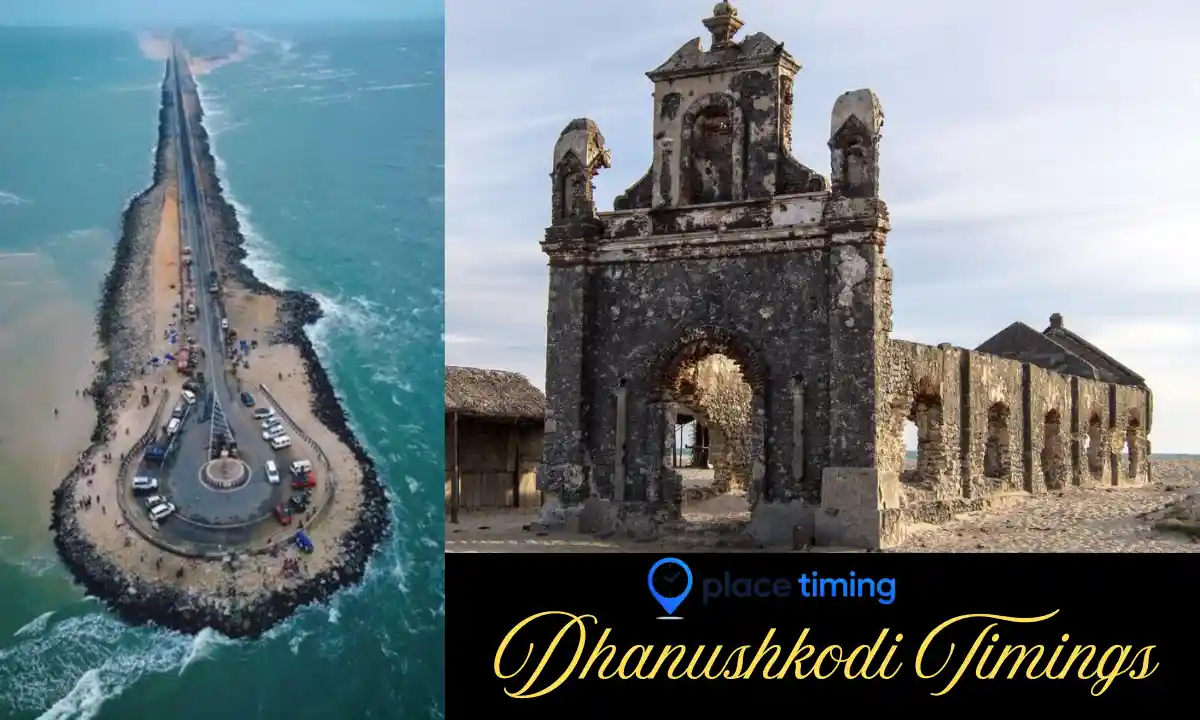
Dhanushkodi follows daylight time rules strictly, and it is for the sake of safety, not comfort. This deserted town located at the end of Rameswaram does not have any lighting or facilities, while the area is affected by the winds and tides after the sunset time, so it is closed for tourists after the late afternoon hours. Choose the right time of arrival, or you will fail to see the area or even leave the place at the check post. This guide provides all the information you may need about timings, the closing times, the ruins, Arichal Munai, the history of the ghost town, and how to get there.
Dhanushkodi Timings: The Short Version
Here is the core of it. Dhanushkodi Timings are only during day time say from approx. 6:00AM – 06:00PM, far end entry is generally closed around 5:00 PM. This abandoned town lying at the south-eastern tip of Pamban Island in Tamil Nadu conforms to the one below. Check at the check post since timings can get tighter in inclement weather.
| Detail | At a glance |
|---|---|
| Open | About 6:00 AM to 6:00 PM, daily |
| Last entry to the tip | Usually around 5:00 PM |
| Leave the area by | Before dusk, around 6:00 PM |
| Entry fee | Free, with a small vehicle charge at the check post |
| Best time | Early morning or late afternoon for sunset |
| Time to spend | 2 to 3 hours |
| Location | Southern tip of Pamban Island, about 18 to 20 km from Rameswaram |
Opening Hours and the Closing Window: Why It Matters
Dhanushkodi is accessible during daylight hours, that is, between six o’clock in the morning and six o’clock in the evening, daily. The important thing is the afternoon cutoff when access to Arichal Munai, the point at the extreme end, is normally closed by about five, and travelers are required to vacate the place before dusk, around six.
It is an important safety measure and not just a mere formal procedure. The extreme end is a long, isolated stretch of sandy spit, without any lighting, shops, or even inhabitants, and on either side there are seas. And, winds and tides grow stronger in the evening. Once it becomes dark, the place becomes desolate and potentially dangerous, and the timings are strictly adhered to.
Entry and Costs: What You Pay
Dhanushkodi happens to be one of the most affordable tourist destinations in the south because there is no charge for entering either the beach, the ruins, or the temple. The following prices are only estimates and are often revised; please verify at the check post.
| Item | Approximate cost |
|---|---|
| Entry to the beach and ruins | Free |
| Vehicle or road-use charge at the check post | Around Rs 20 per vehicle |
| Shared jeep or van to Arichal Munai | Around Rs 150 to Rs 250 per person |
| Private jeep hire for the tip | Around Rs 1,000 to Rs 2,000 for the group |
| Local guide | Charged separately, negotiable |
The primary expenditure is the journey to the very end. Though there is a metal road that covers almost the entire distance from Rameshwaram to Arichal Munai, most tourists prefer taking a jeep to reach the last part and the beach, thus be prepared with some cash for that.
Reaching the Tip: The Road to Arichal Munai
Reaching the end-point has undergone changes in recent times. A proper road has been constructed up to Arichal Munai, and it is now possible to drive a lot farther compared to the time when only jeeps could drive over the sands.
- The distance from Rameswaram to Dhanushkodi by vehicle is around 18 to 20 km, through the picturesque Pamban approach.
- A tarred road has been laid till a considerable distance beyond the ruins, and the trip is much easier now.
- For reaching the last mile and the beach at the end-point, a shared jeep or van service is usually used.
- The public transport facility is not sufficient here, and people prefer a private car, van service, or a two-wheeler for commuting.
The approach route itself is worth visiting, a narrow strip of land with the Bay of Bengal on one side and the Indian Ocean on the other.
What to See: Arichal Munai and the Ruins
This small yet scenic location is packed with diverse sites of interest.
- Arichal Munai – the Land’s End: the southernmost point of the island, where the Bay of Bengal merges with the Indian Ocean, marked as the end of the Indian landmass and the beginning of the Ram Setu to Sri Lanka.
- The wrecked church: the ruin of the roofless church of colonial era, one of the major attractions of the lost town.
- Old Railway Station and Ruins: the ruin of the railway station, water tank, and building damaged by the cyclone of 1964.
- Dhanushkodi Beach: a stretch of white sand beach and turquoise water, perfect for a stroll.
- Ram Setu View Point: the location from where, in good weather conditions, the line of shoals towards Sri Lanka is visible.
According to some reports, at night during good visibility, it is possible to catch sight of the Sri Lankan coast that is approximately thirty kilometers away.
The Kothandaramaswamy Temple: The Cyclone Survivor
On the route to Dhanushkodi comes Kothandaramaswamy Temple, which is significant in being the only building to have survived the devastating cyclone that leveled the city in 1964. It is a temple devoted to Lord Rama and it is thought to be the place where Ravana’s brother Vibhishana surrendered to Lord Rama.
The temple usually opens a bit later than the tip, usually around seven in the evening, and it becomes an ideal place to stop on your way to or from Dhanushkodi.
History: The Town the Sea Took
Dhanushkodi was a busy port town with a railway station, churches, hospitals, hotels, and ferry service for pilgrimage and tourist purposes to transport them across to Talaimannar in Sri Lanka. Dhanushkodi means the tip of the bow since according to the legend it is marked by Lord Rama with the tip of his bow.
During the night of 22nd to 23rd December 1964, a terrible cyclonic storm hit the region resulting in a tidal wave which caused complete destruction to the town as well as a passenger train that was passing through the area. The destruction was so immense that the government pronounced it to be uninhabitable. It is now deserted and today attracts many visitors as ruins lying between two seas.
Spiritual Significance: The Ramayana Connection
Apart from its mystical charm, Dhanushkodi also holds a lot of religious importance in the Ramayana. It is said that it was from here that the army of Lord Rama constructed the Ram Setu or the bridge of stones that goes up to Lanka to save Sita.
A number of people make it a point to also visit the Ramanathaswamy Temple in Rameswaram during their pilgrimage tour. Even the merging of the two oceans at Arichal Munai is considered holy.
Best Time to Visit: Season and Time of Day
Timing plays a role in two ways at this place.
- October to March: The cool and dry weather, which is by far the most pleasant time to be there with clear skies and tranquil views of the coastline.
- Morning time: The quietest winds, soft lighting, and a wonderful sunrise over the water, with the least number of visitors.
- Late afternoon: The golden hour lighting on the ruins and the wonderful sunset, but you have to respect the time limits and go home before dusk. Stay away from the monsoon and the time period with stormy weather, as strong winds and high tides can make the tip a hazardous place to be. The summer weather is unpleasant on this exposed tip of the land.
Things to Note and What to Carry
The distance that makes Dhanushkodi unique also means that you need to be well-prepared.
- Bring drinking water and food, because amenities on the spot are limited.
- Choose durable clothes, wear comfortable shoes and carry a scarf or face cover, because the wind carries sand and salt.
- Take a cap, sun block and sunglasses, as there is very little shade here.
- Prepare cash for the jeep, its charge and refreshment, because digital transactions do not work there.
- Stay away from swimming, because of strong and unpredictable currents in the area of the convergence of rivers.
- Above all, depart in time before sunset and don’t try to stay beyond the closing hour.
There is poor mobile coverage at the point, so coordinate your plans with the driver or other people, and don’t expect to contact anyone on the sandspit.
How Long to Spend: Planning Your Visit
Most tourists take up around two to three hours in visiting Dhanushkodi where the drive, the remains, Arichal Munai, and the visit to the beach are included. There isn’t much activity to indulge in apart from enjoying the view, therefore, making it unnecessary for a whole day, but still worth visiting leisurely.
A wise way would be to depart from Rameswaram either in the morning or early afternoon, visit the Kothandaramaswamy Temple on the way, visit the Dhanushkodi, and come back before nightfall. Those who are interested in witnessing the sunset must plan their timing well to ensure that they get back in time.
How to Reach Dhanushkodi: Air, Rail and Road
Dhanushkodi is reached via Rameswaram, which is the gateway, and the last leg runs out to the tip.
| Mode | Details | Approximate cost |
|---|---|---|
| By train | Rameswaram station is about 18 to 20 km away, reached over the Pamban rail route | Onward cab or van to the tip |
| By air | Madurai airport is the nearest, about 170 km from Rameswaram | Taxi or bus to Rameswaram |
| By road | Rameswaram is linked by the new Pamban road and rail bridges to the mainland | State and private buses to Rameswaram |
| Rameswaram to the tip | About 18 to 20 km by road, then a short jeep stretch | Shared van Rs 150 to Rs 250 per person |
This route passes through the Pamban straits, which are now connected by the newly built Pamban vertical-lift railway bridge, along with the renowned road bridge, adding charm to the route. One can reach Rameshwaram in a cab or shared van from there.
Nearby Attractions: What to Combine With Your Visit
Dhanushkodi blends well with other spots in Rameswaram.
- Ramanathaswamy Temple: the famous Jyotirlinga temple in Rameswaram known for its lengthy corridors and holy wells, which forms the primary attraction for pilgrims.
- Pamban Bridge: the famous rail and road bridges over the water, and the newly built vertical-lift bridge.
- Agni Theertham: the holy bath site next to the Ramanathaswamy Temple.
- Dr. A. P. J. Abdul Kalam Memorial: the memorial of the former President at his hometown Rameswaram.
Since all the sites are located close to each other on Pamban Island, it is possible to explore them in one or two days from Rameswaram.
Trivia and Lesser-Known Facts: Dhanushkodi
- Dhanushkodi refers to the point of a bow, according to the mythology of Lord Rama having marked the point with his bow.
- The place has been devastated by the storm that hit in December 1964 and has not been reoccupied since.
- The Kothandaramaswamy Temple was the only building standing after the storm.
- At Arichal Munai, one can see the meeting of the Bay of Bengal and the Indian Ocean where the island ends.
- On a clear night, the coastline of Sri Lanka, about thirty kilometers away, can reportedly be seen.
- The place is considered to be the starting point of the mythical bridge Ram Setu to Sri Lanka.
Quick Tips: Making Your Dhanushkodi Timings Work
- Ensure that you reach the tip by mid-afternoon, because beyond this time, there is no access to the place.
- Do not linger after the window closes because it can be very dangerous after dusk at the remote tip.
- Go either early in the morning for serenity and sunrise or late in the afternoon for the sunset depending on the timing.
- Pack some water and sunscreen and a scarf to protect yourself from dust and wind.
- Carry money for the jeep charges and do not rely on credit card transactions.
- Go during October to March, avoiding harsh weather conditions.
Final Take: Planning Your Dhanushkodi Visit
Dhanushkodi remains operational only during the day time, from 6:00 AM to 6:00 PM, with access to its tip point at Arichal Munai stopping by 5:00 PM; this is not a suggestion but a safety requirement because this isolated spit lacks light and other facilities and becomes dangerous after sunset. Be at its tip end by mid-afternoon, spend around two to three hours there, and visit the Kothandaramaswamy Temple that survived the cyclone.
Visit between October and March, either for a peaceful sunrise or sunset experience, and do take along some water, sun protection, and cash for the jeep ride. Most of all, do not stay back beyond sunset. Being situated at the confluence of two seas, with the ghostly ruins of a city swallowed up by the sea in 1964 and Ramayana myth of the Ram Setu, this Lands’ End of India is one of the most evocative sites in the country, to be experienced alongside the Ramanathaswamy Temple and Pamban bridges of Rameswaram.
Frequently Asked Questions
When is the time of entry into Dhanushkodi?
Dhanushkodi remains open during daylight hours, roughly from 6:00 am until 6:00 pm. Visitors are advised not to stay beyond 5:00 pm since the entrance to the extreme end point called Arichal Munai is closed in the late evening.
Why does Dhanushkodi remain closed in the evening?
For safety reasons. The point is a remote area with nothing but sandy land with no light or facilities available once darkness sets in. It is exposed to harsh winds and high tide and is left all alone during the night hours.
Does Dhanushkodi have an entry fee?
There is no charge for the visit to the beach or ruins or the temple. However, there is a vehicle or road-use fee of about Rs 20 payable at the check post.
How do I reach Arichal Munai, the tip of Dhanushkodi?
From Rameswaram it is about 18 to 20 km. A tarred road now runs most of the way to the tip past the ruins, and shared jeeps and vans commonly cover the final stretch and the beach. Public transport is limited, so a cab, van, or two-wheeler is usual.
What is the best time to visit Dhanushkodi?
October to March is the most comfortable season, with clear skies and calm views. Early morning is best for a calm sunrise and fewest crowds, while late afternoon offers a memorable sunset, provided you leave before the closing window.
What is there to see at Dhanushkodi?
Arichal Munai, where the Bay of Bengal meets the Indian Ocean, the ruined colonial church, the old railway station and cyclone ruins, Dhanushkodi Beach, the Ram Setu viewpoint, and, on the way, the Kothandaramaswamy Temple, the only structure to survive the 1964 cyclone.
How much time do I need at Dhanushkodi?
About two to three hours, covering the drive out, the ruins, the tip, and the beach. It does not need a full day, but the setting rewards an unhurried visit, and sunset chasers should time their return within the closing window.
How do I reach Dhanushkodi from Rameswaram?
Dhanushkodi is about 18 to 20 km from Rameswaram by road. From Rameswaram station or town, a cab or shared van takes you towards the tip, with a short jeep stretch at the end. The area is reached over the Pamban strait, now served by the new road and rail bridges.
Also read about: Edappally Church Mass Timings: Full Schedule, Rules, Feast and Travel Guide




Leave a Reply