
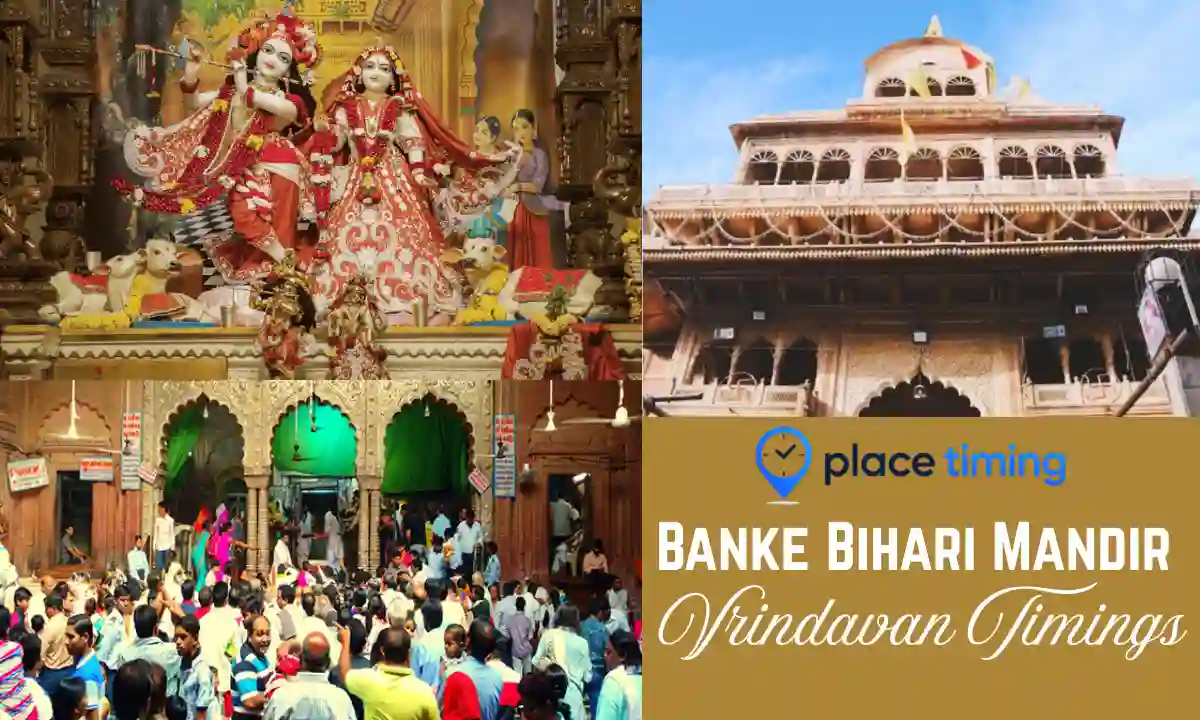
Banke Bihari Mandir operates on two separate schedules throughout the year, and it performs darshan in a way that no other Indian temple does. It has no morning Mangala Aarti, no bells, and no non-stop darshan of the deity. Rather, a curtain is drawn in front of the idol every few minutes, providing only quick flashes. With an afternoon closure and a rush for the Rajbhog darshan that closes the doors to any late-comers, scheduling your visit becomes very important indeed. This article will help you plan your darshan schedule for the summer and winter times, understand the special features of the darshan, decide which month to visit and do much more.
Banke Bihari Mandir Timings: The Short Version
Here is the core of it. Banke Bihari Mandir Vrindavan timings are different in summer and winter, with a long gap of 2 p.m. to 6 p.m. during noon, while free entry except for the special Darshan at the Janmashtami fest. The Shri Banke Bihari Temple located at Goda Vihar, V rindavan follows are as shown below. However note that timings change on Ekadashi, festival days so best to ask just before you set off!
| Detail | At a glance |
|---|---|
| Summer (about Mar to Oct) | 7:45 AM to 12:00 PM and 5:30 PM to 9:30 PM |
| Winter (about Nov to Feb) | 8:45 AM to 1:00 PM and 4:30 PM to 8:30 PM |
| Darshan style | Jhanki, a curtain drawn every few minutes |
| Mangala Aarti | Not performed daily, only at Janmashtami midnight |
| Entry | Free, no ticket, no genuine VIP pass |
| Best time | First 60 to 90 minutes after morning opening, on a weekday |
| Location | Banke Bihari Mandir Road, Goda Vihar, Vrindavan |
Summer and Winter Timings: The Two Schedules
While most temples follow a regular timetable, Banke Bihari operates on two different seasonal schedules, whereby the temple opens early during summer and late during winter, with an extended afternoon break when the deity is supposed to rest.
| Session | Summer (Mar to Oct) | Winter (Nov to Feb) |
|---|---|---|
| Morning darshan | 7:45 AM to 12:00 PM | 8:45 AM to 1:00 PM |
| Afternoon closure | 12:00 PM to 5:30 PM | 1:00 PM to 4:30 PM |
| Evening darshan | 5:30 PM to 9:30 PM | 4:30 PM to 8:30 PM |
The closing of the temple during the afternoon is one of the longest in many of the important temples of North India, lasting between five and six hours during the summers, as this practice is very religiously followed, considering the importance of the belief that one should not disturb the sleep of the Lord.
The Jhanki Darshan: Why This Temple Is Different
This is what makes Banke Bihari stand out from every other temple, and this shocks first time visitors. There is no continuous darshan. Every few minutes a curtain, the parda, is closed over the deity and then opened again, so you receive the Lord in quick glimpses rather than an unbroken view.
It is believed that Banke Bihari Ji has such an appealing gaze, which could make any devotee lose them and hence the curtain closes up to break this magic spell. More than complicating darshan, those quick, cyclic peeks create an extraordinary pairing that often lingers longer than the visitors themselves. Like other temples, bells are missing inside the temple and Mangala Aarti is not performed to wake up the Lord early morning, which is a unique tradition of this temple.
Aarti and the Rajbhog Rush: Timing Within the Session
The temple does not conduct the usual set of aartis that are open to the public. Rather, the Shringar Aarti, which takes place in the morning, when the idol is decorated and the Rajbhog, just prior to the morning closure of the temple.
An important advice to keep in mind: do not plan to visit the temple at 11:30 AM, expecting to see the last darshan before closure. This time, that is, the time for Rajbhog, is the peak period of activity for the temple and the lanes near it are jam-packed. If one does not enter the temple complex before 11:00 AM, during the summer, the guards may not allow entry into the temple. The only exception to the no-morning-Mangala-Aarti rule is Janmashtami.
Entry, Passes and What to Know About VIP Darshan
Banke Bihari entrance is totally free of charge and that needs to be stated clearly owing to the scams surrounding the place.
- There is no entrance fee; there is no darshan ticket either.
- No VIP passes or priority access is officially offered online; anybody who offers such is better avoided.
- Free cloakroom and locker facilities are available near the temple for mobiles, luggage, and footwear.
- Darshan at Banke Bihari is equally accessible to all visitors in the traditional jhanki manner.
That is why it would be wise to ignore any agent or website offering a paid entry pass at Banke Bihari.
Crowd and Safety: A Serious Word
Banke Bihari temple is among the most crowded places in India and its approach pathways are very narrow. There have been crush deaths here in the past, so this is certainly no place to underestimate the power of the crowd.
- It is best to avoid visiting during the Rajbhog rush period just before the temple closing in the morning.
- Be extra careful during weekends, Ekadashi and festival days, especially during Holi and Janmashtami when there are too many people around.
- Children should be kept close and should be held by the hand in the narrow pathways and also keep an eye on the direction of the crowd flow.
- Follow the direction of barricades and policemen and do not resist the direction in which the crowd is moving.
Visiting Banke Bihari on a weekday morning would be relatively safe compared to other times.
What to Carry and Dress Code: Before You Go
- Wear modest traditional clothing, covering shoulders and knees, as is customary at temples in Vrindavan.
- Go in carrying a light dupatta or shawl, the easiest way to stay covered without need for extra clothes.
- Photographing inside is not permitted so leave mobile phones, cameras and bags in the free lockers because with a bag you always slow down in the flock.
- Minimal and easy to remove footwear, use the stands for footwear.
- Bring only a small amount of cash for offerings and the cloakroom, and keep it safe in the crush.
- Carry water (especially in summer), although you will leave most items at the locker prior to darshan.
Which Month to Visit: A Season-by-Season Guide
Choosing the right month makes an enormous difference to both comfort and crowds, so here is an honest month-by-month picture.
| Period | What it is like | Verdict |
|---|---|---|
| October to February | Cool, pleasant weather, the most comfortable for darshan and walking | The best overall window |
| March, Holi season | Vrindavan’s famous Holi, spectacular but wildly crowded and chaotic | For the festival only, not for calm |
| April to June | Very hot, up to the mid-40s, exhausting in the queues | Avoid unless unavoidable |
| July to September, monsoon | Humid, with Jhulan Yatra and Janmashtami crowds in Aug | Atmospheric but busy and sticky |
| Kartik month, Oct to Nov | Spiritually the most auspicious, pleasant weather | Wonderful but busier |
This makes October to February the best time to visit with a great balance of weather and crowds. For festival seekers come to witness Holi or Janmashtami with open eyes to massive crowds and if spiritual significance is what you desire, Kartik month is the most sacred but also jam-packed month. If possible, avoid the peak summer from April to June.
Festivals at Banke Bihari: The Big Days
The festivals of the temple are quite unique, and also the most crowded ones of the year.
- Holi: The Holi of Vrindavan is internationally renowned, along with its phoolon wali Holi with flowers played in Banke Bihari, unforgettable yet very crowded.
- Janmashtami: Birthday of Lord Krishna, on this day, a Mangala Aarti is done in midnight only in this temple, attracting huge crowd.
- Radhashtami: Birth of Radha Rani, decorated with special darshan.
- Jhulan Yatra: Swinging festival, where the deity is put on a decorated silver swing.
If the festival is your purpose of visit, then plan everything from travel to accommodation, in advance.
What Else to Do in Vrindavan: Beyond Darshan
Vrindavan is more than just its temples, and it is good to combine darshan with experiencing the rest of Vrindavan.
- Go for the evening aarti of Yamuna and catch a sunrise on the banks of Keshi Ghat, which is the most beautiful experience in Vrindavan.
- Go and witness the light and musical fountain display at Prem Mandir after sunset, which is one of the best parts of any evening.
- Do the parikrama of Vrindavan, which is the holy circle of Vrindavan that pilgrims do barefoot.
- Visit the local market for sweets, particularly the world-famous pedas, and devotional items.
- Ride in an e-rickshaw from temple to temple because Vrindavan’s old-town streets are narrow and pedestrians dominate.
Spending at least a full day in Vrindavan is good, and even better is spending two days here.
Other Temples in Vrindavan: The Full Circuit
Vrindavan is packed with temples, and pairing Banke Bihari with the best of them makes a complete pilgrimage. Here are the major ones with their approximate timings, all free to enter.
| Temple | Known for | Approximate timings |
|---|---|---|
| Prem Mandir | White-marble temple, evening light-and-fountain show | 8:30 AM to 8:30 PM, show after sunset |
| ISKCON Krishna Balaram | Kirtans, Gita classes, 5:00 AM Mangala Aarti | 4:30 AM to 8:45 PM, no afternoon break |
| Radha Raman Temple | A self-manifested Krishna idol, authentic Gaudiya rituals | 8:00 AM to 12:30 PM, 6:00 PM to 8:00 PM |
| Radha Vallabh Temple | Striking architecture, deep devotional tradition | About 7:00 AM to 12:00 PM, 6:00 PM to 9:00 PM |
| Nidhivan | The mystical grove, closed to all after night aarti | About 6:00 AM to 8:00 PM, seasonal |
| Rangaji Temple | A grand South Indian Dravidian-style temple | About 6:30 AM to 8:00 PM with a midday break |
| Govind Dev Ji, Madan Mohan, Jugal Kishore | Among the oldest and most historic temples | Vary, generally morning and evening |
For a first visit, pair Banke Bihari with ISKCON, Prem Mandir, Radha Raman, and Nidhivan, which together capture the range of Vrindavan, from the ancient and intimate to the grand and modern.
Temples in Mathura: The Wider Braj Circuit
The birthplace of Krishna, Mathura, is merely 12 to 15 km away, and most pilgrims visit the two places together.
- Shri Krishna Janmabhoomi: the birthplace of Krishna, the holiest spot of Mathura, guarded very securely, hence cell phones and bags are deposited into lockers before entering the holy shrine.
- Dwarkadhish Temple: the major temple of Mathura City, celebrated for its intricate paintings and vibrant aartis.
- Vishram Ghat: the prominent ghat on river Yamuna, famous for the evening aarti.
- Barsana and Gokul: Radha’s birthplace at Barsana, known for Lathmar Holi festival, and Krishna’s place Gokul, both of which can be visited through a drive outside the city.
- Govardhan Hill and Kusum Sarovar: the holy hill famous for Krishna’s miracle, taken around by pilgrims on the parikrama of Govardhan Hill.
There is a popular itinerary that visits Janmabhoomi, Dwarkadhish and Vishram Ghat in Mathura on Day One and Banke Bihari, ISKCON and Prem Mandir in Vrindavan on Day Two. The places in Barsana and Govardhan are included if there is a third day.
How Long to Spend: Planning Your Visit
Banke Bihari darshan takes about one to two hours for you, depending on the day and considering the queue and the crowd around in the lanes. In order to visit Vrindavan with some temples, ghats, and Prem Mandir show, you need an entire day. To visit both Mathura and Vrindavan, you need two days.
The best way to visit these places is taking your time. The best way would be a peaceful darshan at Banke Bihari early morning followed by leisurely darshans in some other temples.
How to Reach Banke Bihari Mandir: Air, Rail and Road
Vrindavan is easy to reach, and the temple sits in the old town, accessible on foot or by e-rickshaw through the lanes.
| Mode | Details and distance |
|---|---|
| By air | Delhi airport is the main gateway, about 150 km, roughly 3 to 4 hours by road. |
| By train | Mathura Junction is the nearest major station, about 12 to 15 km, with the Vrindavan rail link and onward autos. |
| By road | Vrindavan is just off the Yamuna Expressway, with frequent buses and taxis from Delhi, Agra, and Mathura. |
| Local transport | E-rickshaws and cycle rickshaws reach the edge of the temple lanes, the last stretch being on foot. |
Cars cannot reach the temple itself, since the final approach is through narrow pedestrian lanes, so park or alight at the edge and walk in, following the crowd towards the sanctum.
Trivia and Lesser-Known Facts: Banke Bihari
- This deity is worshipped through the jhanki system, wherein the curtain is lowered every few minutes, which is unique to the temples of Vrindavan.
- There is no Mangala Aarti performed here, and also no bells within the temple, as the deity is considered like a child and should not be disturbed in the morning.
- It is said that the deity has appeared to the saint musician Swami Haridas in Nidhivan.
- Banke implies bent in three places, which represents the tribhanga posture of Krishna.
- The temple was constructed in 1864, which is fairly recent for a revered temple.
- The phoolon wali Holi of the temple is one of the most celebrated Holi festivals in India.
Quick Tips: Making Your Banke Bihari Timings Work
- To reach there in the first 60-90 minutes after the morning opening at a weekday for the most peaceful darshan.
- Avoid coming close to Rajbhog just before the closing time of the morning session because this is when crowds are maximum.
- Ignore people who are offering to sell a VIP pass, as entry is free and no such pass exists.
- Park your phone and bag in the free lockers because photography is not allowed inside.
- Come between October and February for better weather and crowd and be prepared for Holi and Janmashtami.
- Go along with ISKCON, Prem Mandir, and Radha Raman, and also visit Mathura for a two-day visit.
Final Take: Planning Your Banke Bihari Mandir Visit
This temple operates in two seasons from 7:45 AM to 12:00 PM and from 5:30 PM to 9:30 PM in the summer, and from 8:45 AM to 1:00 PM and 4:30 PM to 8:30 PM in winter, with extended closure in the afternoon and free entry. Jhanki darshan, which is drawing of curtains every few minutes, without any Mangala Aarti and without bells makes it unique from all other temples, and the only way is to get there within an hour or two of opening in the morning, not during the weekends and not during the festivals period.
Plan your visit between October and February, avoiding Rajbhog before closing in the morning and taking into consideration that it could be crowded in the narrow streets. Don’t buy VIP passes; it is free entrance and make it part of a Braj pilgrimage visiting also ISKCON, Prem Mandir, Radha Raman, and Nidhivan in Vrindavan, and Krishna Janmabhoomi and Dwarkadhish in Mathura. If you want festivals, then plan your visit during the flower Holi or Janmashtami.
Frequently Asked Questions
What are the Banke Bihari Mandir Vrindavan timings?
In summer, roughly March to October, the temple is open 7:45 AM to 12:00 PM and 5:30 PM to 9:30 PM. In winter, roughly November to February, it is open 8:45 AM to 1:00 PM and 4:30 PM to 8:30 PM, with a long afternoon closure. Timings shift on Ekadashi and festivals.
Why is there no Mangala Aarti at Banke Bihari?
By tradition, Banke Bihari Ji is treated as a beloved child and is not woken with an early Mangala Aarti, and there are no bells inside the temple. The only exception is Janmashtami, when a special midnight aarti is performed.
What is jhanki darshan at Banke Bihari?
Jhanki darshan is the temple’s unique tradition of drawing a curtain across the deity every few minutes and then opening it, giving devotees brief, repeated glimpses rather than a continuous view. The belief is that the Lord’s gaze is so powerful that the curtain closes to break the spell.
Is there an entry fee or VIP pass for Banke Bihari?
No. Entry and darshan are completely free, and there is no official VIP or priority pass. Anyone selling a paid pass for guaranteed entry should be avoided. Free lockers are available for phones and bags.
Which month is best to visit Banke Bihari Mandir?
October to February is the best window, with cool, pleasant weather and more manageable crowds. April to June is very hot and best avoided. For festivals, Holi in March and Janmashtami in August are spectacular but extremely crowded, and the Kartik month is the most spiritually auspicious.
What is the best time of day for Banke Bihari darshan?
The first 60 to 90 minutes after the morning opening, on a weekday, is best, when the Shringar has just concluded, the deity is freshly decorated, and the crowd has not yet peaked. Avoid the Rajbhog rush just before the morning closure.
Which temples are near Banke Bihari in Vrindavan?
Major Vrindavan temples include Prem Mandir, ISKCON Krishna Balaram, Radha Raman, Radha Vallabh, Nidhivan, Rangaji, and Govind Dev Ji, all free to enter. In nearby Mathura, about 12 to 15 km away, are Shri Krishna Janmabhoomi and Dwarkadhish. Most are within a short e-rickshaw ride.
How do I reach Banke Bihari Mandir?
Mathura Junction, about 12 to 15 km away, is the nearest major railway station, and Delhi airport is about 150 km via the Yamuna Expressway. From the edge of the old town, the final approach to the temple is on foot or by e-rickshaw through narrow pedestrian lanes.
Also read about: Dhanushkodi Timings: Entry Hours, Arichal Munai and Complete Guide



Leave a Reply