
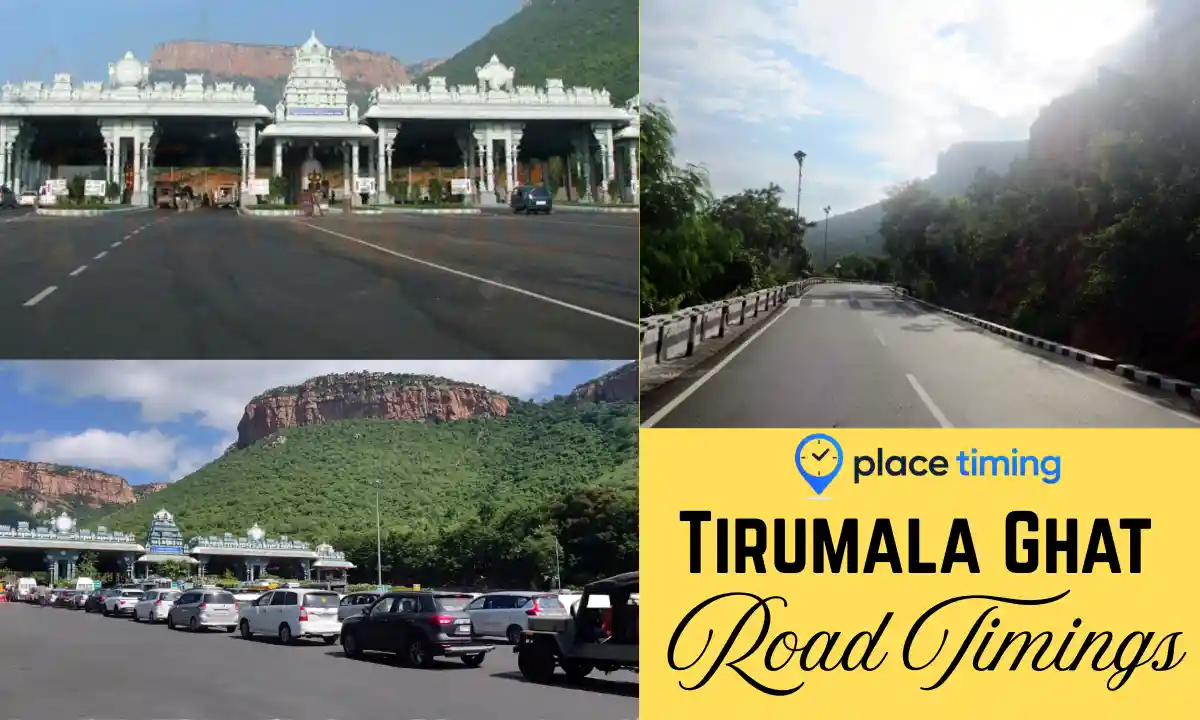
The Tirumala ghat road timing is not something that just lets anyone go up the ghat road anytime they want. There are certain restrictions: the ghat road is open only for certain hours at night; two-way travel happens separately along two different one way roads; there is a toll gate, a security check, and a token system with a minimum driving time. Anything that goes against any of these will be denied access at the gate itself in Alipiri. The guide gives information about all the timings involved and the rules related to them, and finally, the part that almost all other guides omit, the best and most economical ways to take the ascent.
Tirumala Ghat Road Timings: The Short Version
Here is the core of it. Tirumala Ghat Road timings vary for four- and two-wheelers, as well as closing it overnight for a few hours. The pattern of the climb from Alipiri in Tirupati to Tirumala is this: Thus timings differ on days of festival and during bad weather, so always verify before you head out to the official TTD site.
| Detail | At a glance |
|---|---|
| Four-wheelers (cars, vans, buses) | About 3:00 AM to 11:45 PM |
| Two-wheelers | About 4:00 AM to 10:00 PM |
| Night closure | A few hours overnight, when the road is shut |
| Toll (car) | Rs 50 one-way, return free within 24 hours |
| Two-wheeler toll | Free, no toll charged |
| Drive time | About 40 minutes, a minimum is enforced |
| Start point | Alipiri toll gate, Tirupati, at the foot of the hills |
Opening and Closing Hours: Four-Wheelers vs Two-Wheelers
The road to the ghats is open throughout the day except at night. TTD ensures that it remains open for almost twenty-one hours, although the timing differs depending on your mode of transport. Four-wheelers can access the roads between three in the morning and just before midnight. Two-wheelers, on the other hand, have a shorter time frame, which is between four in the morning and ten in the evening.
For safety reasons, the road will be closed for a few hours at night where the four wheelers cannot pass through between midnight and early morning, while two-wheelers cannot access the road slightly earlier and later than this period. Therefore, if you reach Tirupati very late at night by train or plane, do not consider going straight to the temple but spend the night in the city and begin the ascent the following morning.
The Two Ghat Roads: Which One Goes Up and Which Comes Down
- One confusion experienced by new drivers: there are two different ghat roads, and both of them are one-way only.
- The newer of the two ghat roads was constructed in 1974 and takes the upward route to Tirumala from Tirupati.
- The older ghat road, which was laid in 1944, takes the downward route back from Tirumala to Tirupati.
Both ghat roads originate at Alipiri and are twin lanes with an approximate distance of nineteen kilometers each, and numerous hairpin bends through the Seshachalam hills. The upward journey takes around forty minutes. With the one-way system, all one needs to do is follow the signboards.
Toll Gate and Charges: Alipiri Security and Fees
Every vehicle passes through the Alipiri toll gate, where there is a security check before the climb. The toll is modest and charged only on the way up.
| Vehicle | Toll (one-way) |
|---|---|
| Car, jeep, or van | Rs 50 |
| Mini-bus | Rs 100 |
| Bus or heavy vehicle | Rs 200 |
| Two-wheeler | Free, no toll |
| Return within 24 hours | Free |
Use of the FasTag system is allowed at the Alipiri toll gate. The FasTag system is faster but costs the same as the cash lane. The luggage of all passengers is collected to go through the security screening process.
The Token System: How Entry and Exit Work
It is essential for you to know this before taking the drive. Once you enter via the Alipiri gate, you will get a token that has your entry time stamp on it. The token is checked both on your entry and exit from Tirumala because you have to carry it throughout your stay here, since it is mandatory for both.
You also have to be aware of the minimum time for your journey, which is estimated at around forty minutes with a lower limit of twenty-eight minutes. If you take a shorter time to reach the top then the token marks you for over-speeding, resulting in a fine. The speed limit on the curves is 30 km per hour.
Smart Ways to Save: Deals and Free Options
- This is the section that most guidebooks don’t cover, and that’s how to get to the top the smart and economical way. Climbing the hill is cheaper than everyone thinks, and some of the methods are even totally free.
- The APSRTC bus, the cheapest way: government buses go regularly from Tirupati to Tirumala at around Rs 60 to Rs 110 per person, and the bus toll is charged by APSRTC, not passed on to you. It’s the cheapest and easiest and most stress-free way to go, without driving on the bends.
- Your personal car almost for free: the toll is a mere Rs 50 each way, while going back in 24 hours is completely free, so the only thing you pay for is the fuel.
- Two-wheelers go free: two-wheelers do not have any tolls at all.
- Free Parking at the top: TTD offers free parking facilities at many Tirumala parking lots, and thus, there is no charge for parking your vehicle.
- Walk Up and get faster darshan: pilgrims who use free Alipiri Mettu and Srivari Mettu walking paths will be granted special darshan called Divya Darshan, faster darshan queue, and free luggage transport by TTD for walkers.
Thus, the final verdict on all of this is that while in terms of cost-effectiveness and convenience you should opt for APSRTC buses, if you are planning to drive, taking your own car will be both cost-effective and convenient.
Rules and Prohibited Items: What You Cannot Carry
Since the ghat road passes through the reserved forest area and ends at the sacred hill, the restrictions are strict and are enforced at the Alipiri check post.
- Banned items: Non-vegetarian food items, liquor, smoking material, fireworks, inflammable articles, arms, and animal products are prohibited. Intoxicated individuals are not allowed entry.
- Two-wheeler: The rider and pillion have to wear helmets, and the driver must possess a driving licence. Temporary driving licenses are not allowed.
- On the road: One is not supposed to halt on the bends, halt only at designated points of interest, avoid overtaking on the bend, and high beam lights must not be used at night, and use of the horn must be restricted.
- Vehicle limits: private buses are not allowed up, so park them at Alipiri and take an APSRTC bus. Seat capacity limits are enforced.
Following these keeps the drive safe and your entry smooth, and avoids being turned back at the gate.
Driving Tips: Handling the Hairpin Bends Safely
The road has many sharp hairpin turns, so a bit of caution is required when driving yourself up.
- Check your brakes, tires, and lights before beginning, because the road is steep and curvy from both ends.
- Drive within the speed limit of 30 kilometers per hour and use a lower gear when descending to save the brakes.
- Pull over only at the indicated viewing points such as Sila Toranam; do not stop anywhere on the bends.
- For any emergency situations, assistance through cranes and ambulances is provided by TTD on the ghat road helpline service.
In case the bends pose a problem for you, you can always rely on the APSRTC bus.
Best Time to Drive the Ghat Road: Avoiding the Rush
A good timing of the journey would ensure a smooth ride throughout.
- It is best to travel early in the morning when the roads just open up due to least traffic and the coolness of the day.
- Do not try to reach Tirupati at night, as the road is closed overnight and you may need to wait till morning.
- In festival times or holidays when there is heavy traffic, please do refer to TTD updates and plan your schedule well in advance.
In monsoon season, be sure of the road condition before you start your journey, as rains might cause landslides and road closures.
Walking Instead of Driving: The Mettu Footpaths
But, if walking is more your thing, like many pilgrims, then there are two paths that have been carved into stone and each one has its schedule, independent of the ghat road.
- Alipiri Mettu: The longer route of approximately nine kilometers with 3,550 steps, open from 6:00 am to 6:00 pm.
- Srivari Mettu: The shorter path of about two kilometers, faster for those who are moderately fit.
The benefit for the pilgrims that walk is the Divya Darshan quick-darshan facility offered by the temple, plus, the TTD takes care of their luggage free of cost.
How to Reach Alipiri: Getting to the Ghat Road Start
The ghat road begins at Alipiri, on the edge of Tirupati city, marked by a large Garuda statue. Reaching Alipiri is easy from anywhere in Tirupati.
| From | Details and distance |
|---|---|
| Tirupati Railway Station | About 4 to 5 km to Alipiri, a short auto or taxi ride, and well signposted. |
| Tirupati bus stand | A few kilometres away, with frequent APSRTC buses to Tirumala. |
| Tirupati Airport | About 15 km away, with taxis and buses to the city and Alipiri. |
| By APSRTC bus | Buses run directly from Tirupati to Tirumala over the ghat road, the simplest option. |
If you are driving your own vehicle, head for the Alipiri toll gate, complete the security check, collect your token, and begin the climb on the upward ghat road.
Trivia and Lesser-Known Facts: Tirumala Ghat Road
- The first ghat road was constructed in 1944 under the guidance of the famous engineer Sir M. Visvesvaraya, while the second was constructed in 1974.
- The older road can be used for descent while the newer road is used for ascending, which makes the route a one way traffic route.
- Both the roads are about nineteen kilometers long with a lot of hairpin curves within the Seshachalam range.
- The starting point of Alipiri is guarded by a huge statue of Garuda, the carrier of Lord Vishnu.
- The toll gate of Alipiri serves as a security checkpoint for all the vehicles and pilgrims coming into the hills.
- Free parking and luggage services for pilgrims climbing the stairs are provided by TTD at the top point of the hills.
Quick Tips: Making Your Tirumala Ghat Road Timings Work
- Check the timings from tirumala.org the previous day because they vary during festival days and bad weather conditions.
- Avoid climbing late night, as the road is closed down during night for some hours.
- Take care of your token, it will be checked at the time of entering, at the summit, and exiting.
- Do not speed through the curves, speeding will get you a speeding ticket.
- For the easiest travel at low cost, take the APSRTC bus, as there is no toll charge for you.
- Keep the prohibited items away from you, and have a valid license if you are using a two-wheeler.
Final Take: Planning Your Tirumala Ghat Road Journey
Tirumala ghat road requires that you follow some basic guidelines. The rule regarding four-wheelers is that they can go up until 11:45 PM starting at 3:00 AM, whereas two-wheelers can ascend until 10:00 PM starting at 4:00 AM on two different routes in two directions, where the new road is used for going up, and the old road is used for coming down. It is closed for a couple of hours during the night; therefore, it should be avoided that you arrive there during that period. Check the current timings on the TTD website before heading there.
In terms of costs, this pilgrimage trip is among the least costly pilgrimages where the lowest cost will be the APSRTC bus followed by driving your own vehicle at only Rs 50 and walking for which there is no fee and gives you access to a quicker Divya Darshan. Don’t lose your token, stick to 30 km per hour limit on turns and leave prohibited objects at home.
Frequently Asked Questions
What are the Tirumala ghat road timings?
Four-wheelers are generally allowed from about 3:00 AM to 11:45 PM and two-wheelers from about 4:00 AM to 10:00 PM. The road closes for a few hours overnight. Timings change on festivals and in bad weather, so confirm on tirumala.org before you travel.
How much is the Tirumala ghat road toll?
The toll at Alipiri is about Rs 50 for a car, jeep, or van, Rs 100 for a mini-bus, and Rs 200 for a bus, charged one-way. The return within 24 hours is free, and two-wheelers pay no toll at all. FasTag is accepted.
Are there two ghat roads to Tirumala?
Yes. There are two one-way roads. The newer road, opened in 1974, carries the upward journey from Tirupati to Tirumala, and the older 1944 road carries the return journey down. Each is about nineteen kilometres with many hairpin bends.
What is the cheapest way to reach Tirumala from Tirupati?
The APSRTC bus is the best value, roughly Rs 60 to Rs 110 per person, with the toll paid by APSRTC and not charged to you. Driving your own car is also cheap at Rs 50 with a free return, and walking the free footpaths even earns you a faster Divya Darshan.
Why is there a minimum travel time on the ghat road?
For safety on the curved climb, TTD enforces a minimum drive time of about forty minutes. A token stamped with your entry time is scanned at the top, and reaching there faster than the limit flags you for over-speeding, which draws a fine.
Can I drive to Tirumala at night?
Only within the permitted window. Four-wheelers can climb until close to midnight and two-wheelers until about 10:00 PM, after which the road shuts for a few overnight hours. If you arrive very late, stay in Tirupati and start the next morning.
What items are banned on the Tirumala ghat road?
Non-vegetarian food, alcohol, tobacco, fireworks and flammable materials, weapons, and animal products are not allowed, and intoxicated persons are turned away. Two-wheeler riders must wear helmets and carry a valid licence.
How do I reach the Alipiri ghat road start?
Alipiri is on the edge of Tirupati, about 4 to 5 km from the railway station and near the bus stand, well signposted and marked by a large Garuda statue. Autos, taxis, and frequent APSRTC buses all reach it.
Also read about: Kolhapur Mahalaxmi Temple Timings: Darshan, Aarti, Seva and Significance





Leave a Reply