
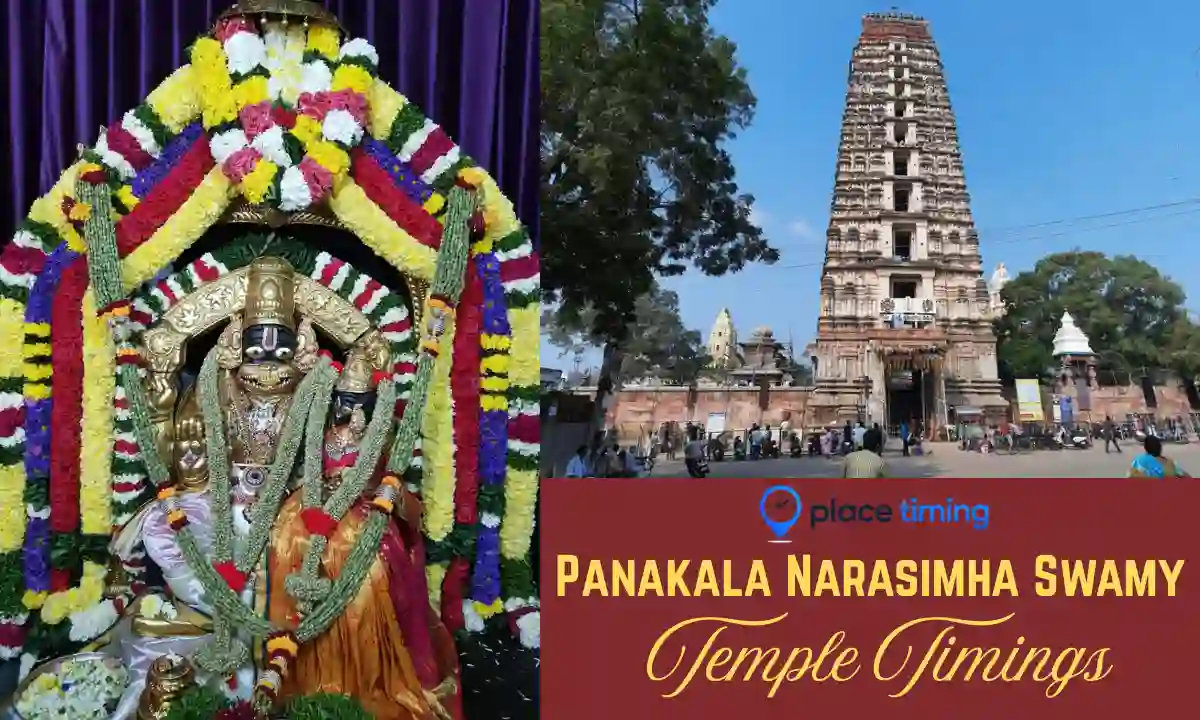
Panakala Narasimha Swamy at Mangalagiri, which is one of the most unique temples in India. Here, the Lord drinks. Jaggery water, which is called panakam, is offered to Lord through the mouth of Lord, who keeps his mouth open all the time. A sound of Lord drinking is heard, and precisely half of the panakam offered comes back out as prasadam, regardless of how much of it is offered, without an ant or fly ever being seen around. The temple remains closed by early afternoon since it is considered that gods worship the Lord in the evening.
Panakala Narasimha Swamy Temple Timings: The Short Version
Here is the core of it. The Panakala Narasimha Swamy temple timings is 7:00 am to 3:00 pm, the temple closes early in the afternoon, and darshan is free of cost. It is located at Mangalagiri Hill, near Vijayawada, in Guntur district, Andhra Pradesh, and its timing follows the following structure. The timing varies on Brahmotsavam days, so please check before visiting.
| Detail | At a glance |
|---|---|
| Panakala Swamy (hill) temple | 7:00 AM to 3:00 PM |
| Panaka Nivedana (offering) | 7:00 AM to about 3:30 PM |
| Why it closes early | Believed the demigods and sages worship in the evening |
| Lakshmi Narasimha (foothill) temple | 5:00 AM to 12:30 PM and 4:00 PM to 8:30 PM |
| Entry | Free general darshan, paid sevas and panakam |
| Famous for | The panakam miracle, where the Lord drinks half the offering |
| Location | Mangalagiri Hill, near Vijayawada, Guntur district, Andhra Pradesh |
Opening Hours and the Early Afternoon Closure
The Panakala Swamy temple situated atop the hill has an opening time of seven in the morning and closing time at three in the afternoon; however, the panakam ceremony continues till a little after half past three in the afternoon. Surprisingly, there is no evening session at this hill temple.
According to legend, after three in the afternoon, Sri Panakala Narasimha Swamy gets worshipped by the demigods and sages. Hence, the temple remains closed to devotees after that time of the day, which is a unique characteristic of this temple. Therefore, if you plan to visit this temple, make sure to do so in the morning, while the Lakshmi Narasimha temple situated on the foothill of the hill has different timings.
The Panakam Miracle: The Lord Who Drinks
This is why pilgrims come from all over the country, and is worth knowing completely. The deity is Swayambhu, self-manifested, and just the mouth of the lotus is open, fifteen centimeters in diameter, covered with a metallic face. Devotees offer panakam through the priest, which is a mixture of sweet water made from jaggery with added cardamom and spices, directly into the mouth of the deity.
- A specific sound of gulping can be heard when the water is being offered into the mouth of the deity.
- The process continues for some time after which the sound stops, and exactly half of the offered quantity comes out and is offered to devotees as prasadam.
- It is irrespective of whatever quantity is offered, as half of it always goes back out. No ants or flies can be spotted despite thousands of liters of sweet jaggery water being offered every day in front of the deity.
This speciality of Mangalagiri is unique, which gives it such a good reputation among devotees. The Lord here is Sudarshana Narasimha.
The Yuga Offerings: Honey, Milk, Ghee and Panakam
The tradition of the temple says that the offering to the Lord has evolved throughout the centuries or yugas.
- During Krita Yuga, honey was offered.
- During Treta Yuga, milk was offered.
- During Dwapara Yuga, ghee was offered.
- Currently, during the Kali Yuga, panakam, which is made from jaggery water, is offered.
It is a part of the history of this temple that explains the significance of offering panakam in this temple.
The Three-Temple Complex: The Whole Hill
Sometimes, the visitor may be unaware that there are actually three temples in Mangalagiri having Narasimha shrines, as the hill looks like an elephant. A visit to all three temples would be a must.
- Sri Panakala Lakshmi Narasimha Swamy temple: The famous panakam temple that exists on the hill through the staircase.
- Sri Lakshmi Narasimha Swamy Temple: The temple that is found at the foot of the hill, having a gigantic tower known as Gopuram, having a height of 153 feet and 11 floors that were built by Raja Vasireddi Venkatadri Naidu between 1807-09, believed to be built by Yudhishthira, one of the Pandavas.
- Sri Gandala Narasimha Swamy Temple: The temple that is located on the top of the hill without any idol but only a lamp or deepam for the Lord who takes away the troubles of life.
Mangalagiri literally means auspicious hill because the place has Goddess Lakshmi as an abode who is supposed to have observed penance here and is one of the eight Mahakshetras of Lord Narasimha and Vishnu.
Darshan, Sevas and Panakam Offering: Costs
General darshan is free, and panakam and other sevas can be offered in the temple. The following figures are indicative as the temple sets its own prices and changes them over time, so please confirm at the counter.
| Item | Approximate cost |
|---|---|
| General darshan | Free |
| Panakam offering | Bought at the temple, a small charge |
| Archana | A modest nominal amount |
| Abhishekam and special sevas | Set rates at the counter |
| Nija-rupa darshan on Ekadashi | Attend the 5:00 AM mangala arati |
| Prasadam | The returned panakam, given free |
Another unique experience would be during Ekadashi days when devotees attending mangala arati at around 5 in the morning get an opportunity to have darshan of Panakala Narasimha in nija-rupa without the metal covering. Remember to carry money for offerings, as card facilities might not be available.
Spiritual and Astrological Benefits: What Devotees Seek
- Protections and bravery: In the form of Narasimha, the Lord, the fierce protector, who eliminates all the evil, is invoked to seek protection and bravery.
- Removal of obstacles and difficulties: Worshiping the Lord and lit a lamp at the Gandala temple, it will help overcome the obstacles of life.
- Wealth, prosperity, and well-being: Offering prayers for wealth, prosperity, and family wellness, along with Goddess Lakshmi, the goddess of wealth and prosperity.
- Overcoming fears and negative forces: The fierce form of the Lord helps overcome all fears and negative forces.
- Fulfillment of vows: Many devotees offer panakam to fulfill their vows.
Many devotees travel to Pancha Narasimha Kshetra circuit, the five great Narasimha temples in the Telugu region, where Mangalagiri becomes one of the most convenient to visit among them.
Other Temples and Places Nearby: The Vijayawada Circuit
Located between Vijayawada and Guntur, Mangalagiri is surrounded by one of the wealthiest temple zones of Andhra Pradesh, and so a tour of this place matches well with many popular temples. Here are some of them with their distances.
| Place | Distance from Mangalagiri | Known for |
|---|---|---|
| Kanaka Durga Temple, Vijayawada | About 12 to 15 km | The famous hill temple of the goddess on the Krishna, a Shakti Peetha |
| Undavalli Caves | About 10 to 12 km | Ancient rock-cut cave temples with a giant reclining Vishnu |
| Amaravati | About 30 to 35 km | The great Buddhist stupa and the Amareswara Shiva temple |
| Bhavani Island, Vijayawada | About 12 to 15 km | The river island with boating and water sports |
| Mopidevi and Hamsaladeevi | About 60 to 70 km | The Subrahmanya temple and the river confluence |
| Kondapalli Fort | About 25 to 30 km | The hill fort near Vijayawada, famous also for its toys |
A typical itinerary consists of Mangalagiri, Kanaka Durga temple, and Undavalli caves in one day because of their proximity to each other near Vijayawada, and then adding Amaravati or Kondapalli as well to make it more interesting.
How Mangalagiri Compares to the Pancha Narasimha Kshetras
Mangalagiri is one of the five great Narasimha temples, and knowing how it relates to the other four when taking the Narasimha pilgrimage can be very useful.
| Kshetra | Where | Known for |
|---|---|---|
| Mangalagiri | Near Vijayawada | The panakam miracle, the easiest to reach |
| Ahobilam | Nandyal district | The Nava Narasimha, nine forms across the hills |
| Yadagirigutta | Near Hyderabad | The five forms, a grand government-built complex |
| Simhachalam | Visakhapatnam | The Varaha Narasimha, covered in sandal paste |
Thus, to be clear, the reality is that Ahobilam is the toughest Narasimha pilgrimage, with its nine temples, and Simhachalam and Yadagirigutta are impressive hill temples, whereas Mangalagiri has its own panakam miracle which is very conveniently located close to Vijayawada city. To many pilgrims, it is the easiest and most miraculous of all the Narasimha kshetras.
Pros and Cons: An Honest Assessment
Weighing both sides helps you plan the visit.
The pros:
- The panakam miracle, which is live and unique in comparison to other temples.
- Free darshan and accessibility from Vijayawada.
- Three temples on one hill, along with hilltop views of Mangalagiri.
- Located close to a large number of temples and places of interest around Vijayawada.
- One of the most accessible of the five Narasimha temples.
The cons:
- The hill temple closes at 3:00 PM and does not have any darshan after that time, confusing many tourists.
- Steps have to be climbed up to reach the hill temple, and it is tiring for many people and tough in summer.
- Slow and crowded on weekends, during festivals, and Brahmotsavam.
- Little shade and facilities in the steps, so carry water.
- Timings of the three temples are different from each other.
Common Mistakes to Avoid
- Reaching late afternoon when the hilltop temple will be closed by 3:00 PM.
- In case all the three temples have similar timings and the foothill temple conducts evening darshans while the hill top temple doesn’t.
- Miss out on the Ekadashi nija rupa darshan due to missing the 5:00 AM mangala arati.
- No money available for the panakam and offerings as the cards might fail.
- Underestimate the difficulty level of climbing and the heat factor as well as water.
- Skip the nearby Kanaka Durga temple and Undavalli caves that complete the day.
Is It Worth Visiting? Who It Suits
Yes, Mangalagiri is definitely worthwhile, and it is ideal for certain people.
- Ideal for: devotees of Narasimha, devotees on the Pancha Narasimha route, and all those interested in the panakam ritual.
- Good for: all families and tourists who travel from Vijayawada due to its proximity and the concentration of temples in this area.
- Worthwhile for: anybody interested in observing a unique living temple ritual.
Mangalagiri is a must for all travellers visiting Vijayawada because of the panakam ritual alone, and it is one of the most important Narasimha temples in the south for all devotees.
Festivals: The Brahmotsavam
The most spectacular of all festivals celebrated in the temple is the annual Brahmotsavam that takes place for around eleven days during February or March, attracting thousands of devotees, and featuring unique rituals believed to have been started by Yudhishthira based on directions from Lord Krishna. Narasimha Jayanti, as well as other Vaishnavite festivals, is celebrated with unique worship rituals.
Since during the Brahmotsavam period there will be a lot of people, it is recommended to carefully plan your schedule accordingly.
Best Time to Visit and What to Carry
- Visit in the morning, long before 3:00 PM closing time, and ideally right after the 7:00 AM opening time for the quietest time and to perform the panakam.
- There are not many people on weekdays and holidays compared to weekend times.
- October to February is the best season for climbing.
- Have your water bottle, cap, and sunblock ready for the stairs, and wear comfortable shoes that you can take off.
- Dress traditional, decent clothes, and have cash with you to pay for panakam and sevas.
Visitors who are unable to climb can still visit the Lakshmi Narasimha Temple at the bottom of the hill.
How Long to Spend: Planning Your Visit
A tour of Panakala Swamy Temple, with the trek, darshan, and panakam offering will take roughly an hour or two. If you want to view the three temples in one place, then plan for some extra time, and if you wish to visit the other attractions in Vijayawada, plan a whole day.
Since Mangalagiri plays an important part in the Vijayawada temple circuit, it is better suited to be combined with other places such as Kanaka Durga and Undavalli Caves.
How to Reach Panakala Narasimha Swamy Temple: Air, Rail and Road
Mangalagiri lies right between Vijayawada and Guntur, making it one of the easiest major temples to reach in the region.
| Mode | Details and distance |
|---|---|
| By train | Vijayawada railway station is about 12 km away, and Mangalagiri has its own station too. |
| By air | Vijayawada International Airport at Gannavaram is about 30 to 35 km away. |
| By road | Mangalagiri is on the Vijayawada to Guntur highway, with frequent buses and taxis. |
| Local | Autos and buses reach the foothill, from where you climb the steps to the hill temple. |
From Vijayawada it is a short drive down the highway, and buses between Vijayawada and Guntur pass through Mangalagiri constantly, so it is very easy to reach.
Trivia and Lesser-Known Facts: Panakala Narasimha
- The Lord keeps only half of the offerings of the panakam and returns the rest of it as prasadam.
- Even though a large quantity of jaggery water is offered daily, there are no ants or flies found inside the temple premises.
- The Lord here is called Swayambhu, meaning self-manifested, who has only the lotus mouth visible.
- The hill temple closes before 3:00 PM as it is said that the gods and sages offer their prayers to the Lord in the evening.
- Mangalagiri Hill resembles an elephant and is called auspicious hill due to penance of Goddess Lakshmi.
- The foothill Lakshmi Narasimha temple boasts of 153 feet tall gopuram constructed in the beginning of 1800s.
Quick Tips: Making Your Panakala Narasimha Timings Work
- Go in the morning, because the hill temple is closed at 3:00 PM with no evening darshan.
- Offer panakam and get the half which is given back as prasadam.
- For nija rupa darshan, attend the 5:00 AM mangala arati on an Ekadashi.
- Bring water to climb the hill and money for panakam and sevas.
- Visit all three temples of the complex for your pilgrimage.
- Combine this visit with Kanaka Durga and Undavalli caves in proximity.
Final Take: Planning Your Panakala Narasimha Visit
Panakala Narasimha Swamy Temple at Mangalagiri Hill operates from 7:00 AM until 3:00 PM, the darshan is free, and the only time to remember is the early afternoon closing because the hill temple does not conduct any evening darshan session, thought to be the time for Gods only. Come in the morning to see the miracle in which the Lord drinks half of the jaggery water that has been offered to him and returns back the rest of it as Prasad, and there will never be any ants around.
Visit all three temples at the hill complex from the panakam shrine to the tall gopuram at the foothill to the lamp on top of the hill. Try also to come for the 5:00 AM Ekadashi arati to have the darshan of the Nija rupa of the Lord. Bring some water to drink during the climb up the hill and some money for offering at the temple and combine this visit with the nearby Kanaka Durga temple, Undavalli Caves, and Amaravati as well.
Frequently Asked Questions
What are the Panakala Narasimha Swamy temple timings?
The Panakala Swamy temple on Mangalagiri Hill is open from 7:00 AM to 3:00 PM, with the panakam offering until about 3:30 PM. There is no evening session, since it is believed the gods worship the Lord after 3:00 PM. The foothill Lakshmi Narasimha temple keeps longer hours.
What is the panakam miracle at Mangalagiri?
Devotees pour panakam, jaggery water, into the wide-open mouth of the self-manifested deity. A gurgling sound of drinking is heard, and exactly half the offering flows back out as blessed prasadam, no matter how much is poured. Despite the sweet offering, no ants or flies are ever seen.
Why does the Panakala Narasimha temple close at 3 PM?
By tradition, the hill temple closes by 3:00 PM because it is believed that after that hour Sri Panakala Narasimha Swamy is worshipped by the demigods and sages, so it is closed to devotees for the rest of the day.
What are the three temples at Mangalagiri?
The complex has the Panakala Lakshmi Narasimha Swamy temple on the hill, the Lakshmi Narasimha Swamy temple at the foothill with its 153-foot gopuram, and the Gandala Narasimha Swamy temple at the hilltop, where only a lamp is lit and there is no idol.
Which temples are near Panakala Narasimha Swamy?
The Kanaka Durga temple in Vijayawada is about 12 to 15 km away, the Undavalli Caves about 10 to 12 km, and Amaravati about 30 to 35 km. Kondapalli Fort and Bhavani Island are also nearby, making a fine Vijayawada temple and heritage circuit.
Is there an entry fee at Panakala Narasimha temple?
General darshan is free. The panakam offering and various sevas carry small charges at the temple counters, and the returned half of the panakam is given free as prasadam. Rates are revised over time, so confirm at the temple, and carry cash.
What is special about Ekadashi at Mangalagiri?
On Ekadashi days, devotees who attend the mangala arati at about 5:00 AM can have darshan of the Panakala Narasimha in the nija-rupa, without the metal covering over the deity, which is a rare and special sight.
How do I reach Panakala Narasimha Swamy temple?
Mangalagiri is on the Vijayawada to Guntur highway, about 12 km from Vijayawada railway station, with its own station too, and the airport about 30 to 35 km away. Buses and autos reach the foothill, from where you climb the steps to the hill temple.
Also read about: Tiruvannamalai Girivalam Dates and Timings 2026: The Complete Pilgrim Guide



Leave a Reply