
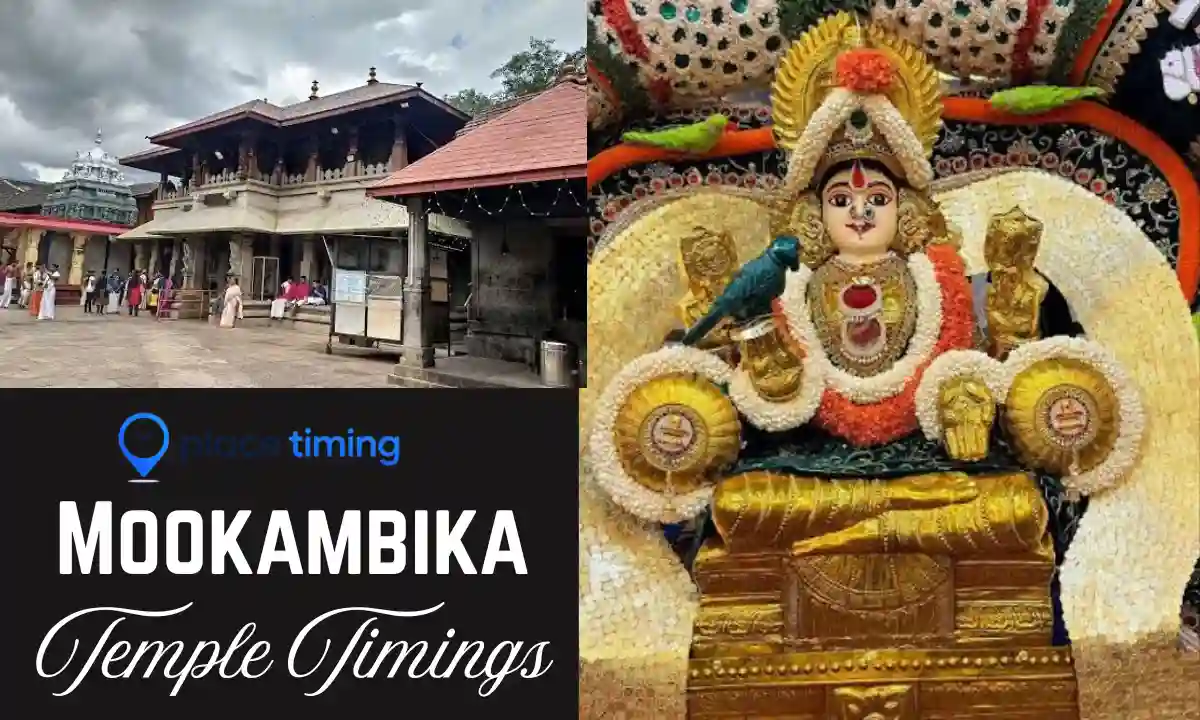
The people travel to Kollur for a very particular blessing. Mookambika, the goddess of knowledge who all three, Saraswati, Lakshmi and Kali etc, have fused into one filmmaker Mookambika festivals around the country to pay for families from across the south in Mookambika goddess of education at her feet You need two things to get the visit right: darshan timings, which runs in slots around the day’s poojas, and a sense of what grant by the goddess and how devotees seek it. So this guide, tells you everything from the seva prices to the dress code to the history as well as how to reach this temple located at Western Ghats.
Mookambika Temple Timings: The Short Version
Here is the core of it. Mookambika temple timings are in the form of a morning session and an evening session with a midday break, general darshan is without charge. The Kollur Sri Mookambika Temple, located on the banks of the Souparnika river in Udupi district, patterns similar to below. On the days of festivals, these timings will differ, hence consider them as regular.
| Detail | At a glance |
|---|---|
| Morning session | 5:00 AM to 1:30 PM |
| Midday break | 1:30 PM to 3:00 PM |
| Evening session | 3:00 PM to 9:00 PM |
| General darshan | Free of charge |
| Famous for | Vidyarambham and blessings of knowledge and learning |
| Best time to go | Weekday mornings, soon after opening |
| Location | Kollur, Udupi district, Karnataka, in the Western Ghats |
Daily Darshan Hours: Morning, Break and Evening
Temple opens at five in the morning and the morning session of darshan continues until about half past one in the afternoon. During this procession, the priests do the abhishekam and both the aartis at which points the darshan queue stops for those rituals to happen before continuing.
There is a break in the temple usually around between half past one and three, and then into the evening session which continues until nine at night. There is no weekly closure. The temple is open each day of the year and darshan flows in slots as per the poojas that are performed through the day rather than one continuous stretch.
Pooja and Aarti Timings: The Daily Rituals
The day is molded around a round of rituals. An approximate timing helps you work around the brief darshan breaks and choose a ritual to watch.
| Ritual | Approximate time |
|---|---|
| Temple opening and Nirmalya darshan | 5:00 AM |
| Panchamrutha Abhishekam | Around 7:30 AM |
| Mangala Aarti | Around 8:00 AM |
| Morning darshan | Until about 11:30 AM |
| Maha Mangala Aarati (noon) | Around 12:30 PM |
| Evening darshan | From 3:00 PM |
| Night rituals and closing | Up to about 9:00 PM |
During festive days, especially during the nine-day long Navaratri, the ritual schedule are increased and timings tailored to accommodate additional sevas and the more intense rush.
Seva Prices: Poojas and Offerings at Mookambika
General darshan is free, but the temple provides a variety of sevas and poojas where applicable with fixed prices. The prices mentioned below indicate a range of options, ranging from simpler offerings to larger rituals. This are updated every now and then, so you should check the current rate with Seva counter or on official booking portal.
| Seva | Approximate price |
|---|---|
| General darshan | Free |
| Archana, Kumkumarchana, Pushpanjali | Around Rs 10 to Rs 25 |
| Ghee lamp or Karpoora Aarti | Around Rs 15 to Rs 30 |
| Vidyarambha Kanike (learning ritual) | Around Rs 200 |
| Alankara Pooja | Around Rs 75 |
| Ekavara Rudrabhisheka | Around Rs 30 |
| Ganahoma (one coconut) | Around Rs 150 |
| Parivara Pooja | Around Rs 500 |
| Friday Pooja (for one year) | Around Rs 2,000 |
| Maha Pooja | Around Rs 8,000 |
| Udayasthamana Pooja (18 poojas) | Around Rs 18,000 |
Larger sevas like the Chandika Homa or the Anna Santharpana that supports a free food service go well into bigger sums. Most sevas require advance booking, some upto at least three days before time online, and ticket printout alongwith a photo id is compulsory to perform them. If you are unable to be physically present, then sevas can also be scheduled to perform on your behalf.
The Significance of Mookambika: The Goddess of Knowledge and Power
Mookambika is not only one dimensional of the divine being, but all combined. She resides as the powers of Mahasaraswati, the goddess of learning, Mahalakshmi, the goddess of wealth and Mahakali to be worshipped as Adi Parashakti. It is that union that drives her worship.
The sanctum reflects this. There lies at its benevolence a swayambhu jyotirlinga an automatic initiated symbol of Shiva crossed by a slender golden line which supposedly divides it into two, the Shiv side and the Shakti side for both the Lord and Goddess are worshipped together in one form. The idol of the Goddess in the background, seated peacefully and made up of five metals, is believed to have been installed there by Adi Shankaracharya. Kollur is also one of Seven Mukti Sthalas, Places that believed to give Livertion in Karnataka.
What Mookambika Grants: The Blessings Devotees Seek
The devotees that make their way to Mookambika seek particular favors from her, and it is good to be aware of what these are. They include:
- Education and knowledge: foremost amongst these is education and wisdom and success in studies. Students, educators, and their parents pray to her for a child’s education and also for wisdom and clarity.
- The arts and speech: as the goddess Saraswati, she is called upon by people in the arts for mastery of their craft. Her name is related to the gift of speech, and therefore people also pray to her if they find themselves struggling to speak.
- Prosperity and health: as the goddess Lakshmi, she is prayed to for abundance, wealth, and prosperity.
- Strength and protection: as goddess Kali, she is sought for strength and courage, the removal of obstacles and also for safety from harm.
- Spiritual liberation: as one of the Mukti Sthalas, she is worshipped by people who wish for spiritual freedom and moksha.
This is the reason why the most famous ritual performed at the place is associated with learning, which deserves its own section.
Vidyarambham at Mookambika: The Initiation Into Learning
Vidyarambham, also spelt as Aksharabhyasam, is the formal initiation of education childhood programme and Kollur Mookambika is one of the most famous temples in India where it is done. Rituals centers on the writing done by an individual, a small child usually, what was framed in as a tray of rice which is where they will write their first letters in hopes that the goddess gives them blessings to continue seeking knowledge for life.
The ritual is conducted every day and can be booked immediately as a seva, but attains its culmination on Vijayadashami, the last day of Navaratri, when thousands of families assemble together to initiate their children into the path of knowledge. If starting a child’s education is your reason for the visit, be sure to work around this rite of passage and book early as availability is limited.
History and Legend: Adi Shankaracharya and the Silenced Demon
The name of the temple holds the legend of its foundation. There lived a demon called Kaumasura, who did severe penance to obtain tremendous power. The Goddess feared what he would do with it, and according to legend struck him dumb before defeating him, making him Mooka the silent one. It is from that victory that she has been Mookambika, the one who hushed the demon Mookasura.
The other thread is saint Adi Shankaracharya. Traditionally, he worshipped in neighbouring hill of Kodachadri, where the Goddess appeared to him. She followed him to a spot of his choice on the condition that he does not look back, but when in Kollur she had halted making sounds with her anklets, he turned and it was then that she chose to stay here. The idol is believed to have been installed here by Shankaracharya and the worship of the temple was established by him, with Kodachadri still revered as the original seat of the Goddess.
Best Time to Visit Mookambika: Crowds and Season
This season matters, the timing here is shaped by two factors – the crowd and weather, and add to this mix a Western Ghats setting.
- Mornings within a week of opening —The lightest crowds and the smoothest darshan.
- October to May: the most favourable and predictable months with clean mornings and friendly weather.
- June to August: monsoon, fully drenched green hills but heavy rains and a slower pace with travel
The most well known gathering is for Navaratri approximately in September or October, when the temple is at its busiest and full of life or the yearly car celebration. These are the times you want to visit so book darshan, sevas and stay well in advance if you plan a trip on festival dates.
How Long to Spend: Planning Your Visit
Allow about one to two hours for general darshan on a normal day; more at weekends, when waits can be an hour long. Reserve extra time at the slot of a ritual if you are doing any seva like Vidyarambham or abhishekam The ideal way to do this is by staying at Kollur one night, having a dip in the Souparnika and dedicating the dawn (morning) and dusk (evening) to the temple.
Dress Code and Rules: Before You Enter
The temple has a dress code, which is traditional.
- Men: a dhoti, with shirt and vest shed before entering for darshan
- Women: saree, half saree or salwar kameez with a dupatta. Western wear is not allowed.
- Before heading for darshan, numerous convoys participate in the ritualistic sacred immersion within the Souparnika river.
They do not allow mobile phones or cameras inside (use the cloakroom, but footwear comes off before the temple).
Wearing properly is part of the respect and worship that temple demands in order to keep a smooth entry.
How to Reach Mookambika Temple: By Air, Train and Road
The temple sits in Kollur, a hill village in Udupi district, set among the Western Ghats, so reaching it means a journey through green, winding country.
| Mode | Details and distance |
|---|---|
| By air | Mangalore International Airport is the nearest, about 135 to 140 km away, roughly three to four hours by road. |
| By train | Byndoor Mookambika Road is the closest station, about 25 to 30 km away. Kundapura is around 40 km and Udupi about 80 km. |
| By road | Udupi is about 80 km, Mangalore about 140 km, and Bengaluru roughly 430 to 450 km, around nine to ten hours. KSRTC and private buses run regularly. |
| Local transport | Autos and buses connect the nearby towns and the station to Kollur, and the temple is a short walk within the village. |
It is best to book overnight at Kollur if you wish for early morning darshan or a dawn seva. The temple trust also operates guest houses and rooms, followed by some private lodges filling the remainder (the latter are extremely busy near festivals).
Trivia and Lesser-Known Facts
- Mookambika itself is fusion of three deities (i.e. Saraswati, Lakshmi and Kali) hence she is worshipped for Knowledge, Wealth and Strength together.
- A self-manifested jyotirlinga that is believed as Shiva and Shakti in a single body, thrived in the center of the sanctum, crossed by a golden line.
- The idol in five metals of the Goddess is believed to have been installed by a Saint Adi Shankaracharya.
- The famous temple in Kollur is among the seven Mukti Sthalas of Karnataka, which are believed to provide liberation.
- The name Mookambika literally comes from the story of goddess suppressing a demon king called Mooka.
- Kodachadri hill near by is believed to be the original seat of the Goddess and pilgrims, trekkers still climb it.
Nearby Attractions: What to Combine With Your Visit
Kollur is one of the places on both nature and pilgrimage route.
- Kodachadri: an ideal picturesque and challenging trek is a high peak located in the middle of Mookambika National park which is named after goddess, considered as original of Goddess.
- Souparnika river: sacred and adjacent to the temple where devotees bathe.
- Maravanthe beach – A beautiful stretch of coast a short drive away, featuring the sea and a river running parallel.
- Udupi: 80 km away the famed Krishna temple town, an ideal lengthier getaway.
Quick Tips: Making Your Mookambika Temple Timings Work
- Stay away from the midday break, 1:30 PM — 3:00 PM; plan your darshan in the morning or evening.
- Coming for Vidyarambham? Please make the seva booking prior especially during Vijayadashami time.
- The shortest darshan queue can be found on a weekday morning.
- Wear traditional clothes note that men must remove the shirt for darshan.
- Book bigger sevas three days in advance and do carry a photo identity proof.
- Monsoon is another challenge with slower travel on Western Ghats, hence plan around the monsoon from June to August.
Frequently Asked Questions
What are the Mookambika temple timings?
The temple is open for darshan from 5:00 AM to 1:30 PM in the morning and from 3:00 PM to 9:00 PM in the evening, with a midday break in between. It is open every day, and darshan runs in slots around the day’s poojas.
Is darshan free at Mookambika temple?
Yes, general darshan is free. A wide range of sevas and poojas carry fixed fees, from around Rs 10 to Rs 25 for a simple archana to several thousand rupees for major rituals, and these are booked separately.
What is Mookambika Devi known for?
Mookambika is worshipped as Saraswati, Lakshmi, and Kali combined, and is best known as the goddess of knowledge and learning. Devotees seek her blessings for education, the arts, prosperity, protection, and spiritual liberation.
What is Vidyarambham at Mookambika and how much does it cost?
Vidyarambham is the ceremony that begins a child’s education, guiding them to write their first letters before the Goddess. It is performed daily and peaks on Vijayadashami. The Vidyarambha Kanike seva costs around Rs 200, though prices are revised periodically, so confirm the current rate.
What is the best time to visit Mookambika temple?
A weekday morning soon after opening is best for a smooth darshan. For weather, October to May is the most comfortable. Navaratri around September or October is powerful but very crowded, and the heavy monsoon runs June to August.
What is the dress code at Mookambika temple?
Men wear a dhoti and remove the shirt and vest for darshan, and women wear a saree or salwar kameez with a dupatta. Western wear is not allowed, and many pilgrims take a dip in the Souparnika river before entering.
How do I reach Mookambika temple?
The nearest railway station is Byndoor Mookambika Road, about 25 to 30 km away, and Udupi is around 80 km. The nearest airport is Mangalore, about 135 to 140 km away, and Bengaluru is roughly 430 to 450 km by road.
Why is Mookambika worshipped for education?
Because she embodies Saraswati, the goddess of learning and the arts, along with Lakshmi and Kali. Her worship is closely tied to knowledge, which is why families across South India bring their children here for Vidyarambham, the initiation into learning.
Also read about: Birla Mandir Kolkata Timings: Darshan, Aarti, and Visitor Guide



Leave a Reply