
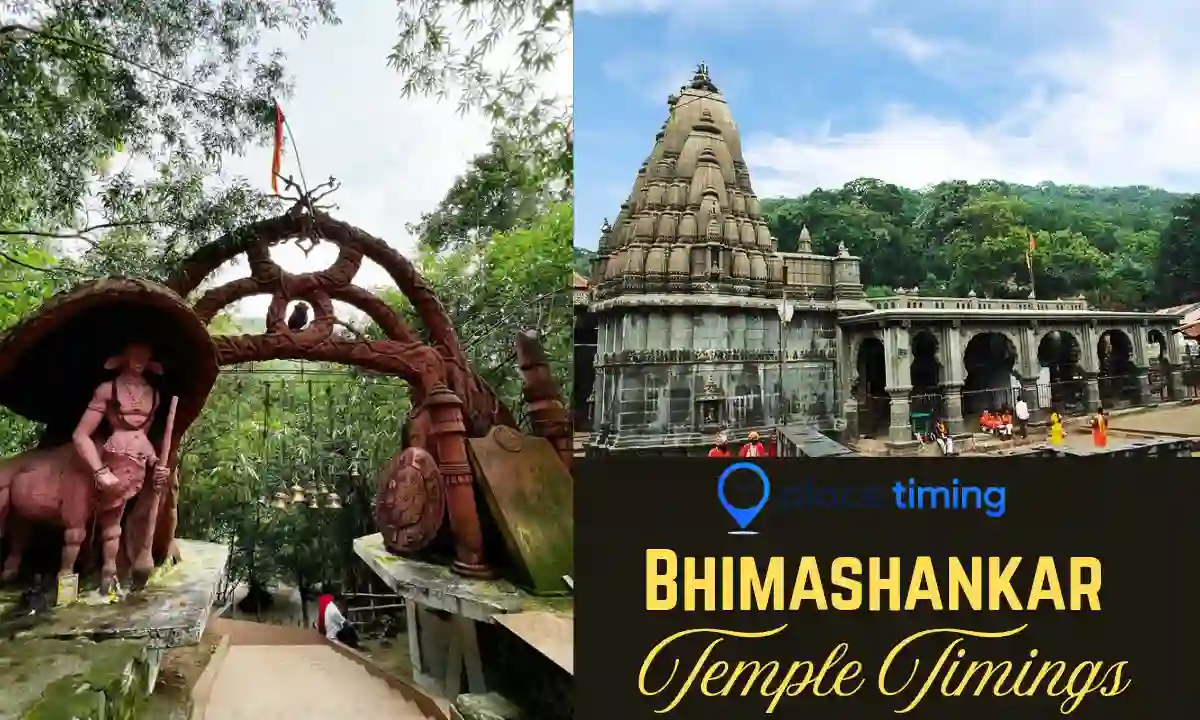
The Bhimashankar temple, one of the 12 jyotirlingas dedicated to Lord Shiva, is located in the heart of the Sahyadri range in Maharashtra, at a distance of 111 kilometers from Pune, and it is the only jyotirlinga temple which is located in a wildlife sanctuary. The temple remains open from dawn till late nights, including aarti and abhishek with free and paid darshan, which you can book in advance online. This guide will include information about timings, aarti timings, price, shekru squirrel, treks, and all the other things you need to know for your pilgrimage experience.
Bhimashankar Temple Timings: The Short Version
Here’s the essence of it all. Bhimashankar temple timings are from morning 4:30 or 5:00 am onwards up to late night 9:00 to 9:30 pm, and darshan is completely free. The Jyotirlinga temple situated in Khed taluka of Pune district operates on timings mentioned below. The timings might differ from source to source, and there have been renovations in the temple as well.
| Detail | At a glance |
|---|---|
| Opens | Around 4:30 to 5:00 AM, for the Kakad Aarti |
| Closes | Around 9:00 to 9:30 PM |
| Naivedya break | Around noon, for the food offering |
| Evening Aarti | Around 7:30 PM |
| General darshan | Free; VIP darshan around Rs 50 to Rs 100 |
| Special feature | The only Jyotirlinga inside a wildlife sanctuary |
| Location | Bhimashankar, Khed taluka, Pune district, Maharashtra |
Opening Hours and the Aarti Schedule
The temple opens very early for the first Aarti and goes through an entire ritual cycle through the day. The timings do vary slightly from source to source and as there have been renovations at the temple, so check out the present timings on the official website before making your journey plans.
| Ritual | Approximate time | Note |
|---|---|---|
| Kakad Aarti | Around 4:30 AM | The first morning aarti, temple opens |
| Nijaroopa Darshan | Around 5:00 AM | Darshan of the original linga |
| Panchamrit Abhishek and puja | From around 5:30 AM | Morning rituals through the day |
| Naivedya, Maha Puja | Around noon | The food offering, a short pause |
| Evening Aarti | Around 7:30 PM | Before the night close around 9:00 to 9:30 PM |
Some sources give a two-window schedule, roughly 6:00 AM to 12:00 PM and 4:00 PM to 9:00 PM, while others describe continuous darshan with brief ritual breaks. Either way, the early morning, around 5:00 to 7:00 AM, is the most peaceful, with the Panchamrit Abhishek.
Entry, VIP Darshan and Rudrabhishek
General darshan is free, with paid options for a faster darshan and for special poojas. The figures below are indicative and revised over time, so confirm at the counter or the official site.
| Darshan or seva | Approximate cost |
|---|---|
| General darshan | Free |
| VIP or special darshan | Around Rs 50 to Rs 100 per person |
| Rudrabhishek | Around Rs 500 to Rs 2,000 |
| Booking | Online at bhimashankar.in, or at the temple counter |
Book the VIP darshan and Rudrabhishek through the official website, bhimashankar.in, by registering for a special darshan or a special puja online or at the temple. Monday and the month of Shravan are very crowded, as these are the day and the month of Lord Shiva, respectively.
The Only Jyotirlinga in a Wildlife Sanctuary: The Shekru
This is what distinguishes Bhimashankar from other Jyotirlingas, and one should try to understand it thoroughly. Bhimashankar Temple is situated entirely within 131 square kilometres of the Bhimashankar Wildlife Sanctuary in the Sahyadri range; it is the only Jyotirlinga in such a location, combining faith and beautiful nature.
- Shekru (Indian Giant Squirrel), the state animal of Maharashtra, about two feet long with a multi-coloured tail, lives in the Bhimashankar Wildlife Sanctuary.
- The best time to observe Shekru is the Ganesh Ghat track in the morning between 6:00 to 8:00 AM from October to February.
- There is rich flora and fauna in the forest, making the site interesting both for pilgrims and for those who love nature.
- Since it is a protected area, there is a ban on plastic, with a fine of around Rs 500, so do not bring anything that will pollute the environment.
Thus, Bhimashankar is a unique combination of a famous Shiva pilgrimage and wildlife, and for those who love nature, watching Shekru in the morning is a great pleasure.
The Treks: Shidi Ghat and Ganesh Ghat
For the adventurous types, the journey to Bhimashankar is known to be an exciting one. The Bhimashankar temple is located amidst the Sahyadris, and there are two popular trekking trails through the Sahyadris to reach the temple.
- Shidi Ghat: This is a difficult trek with some portions having ladders.
- Ganesh Ghat: An easier and a longer trek for trekkers and for the sighting of Shekru.
- The temple can also be reached via road, and there are steps leading down to the shrine for those who don’t wish to trek.
Therefore, trekkers can go on to climb either of the two trails – the Shidi or the Ganesh Ghat, while pilgrims can use the ghat road. While trekking, make sure you have trekking shoes, water bottles, and a jacket.
The Deity, Legend and the Bhima River
The main deity worshipped here is Lord Shiva in his form as Bhimashankar. He is a Swayambhu Shivlinga, and he exists in a temple that has been built according to the Nagara style, constructed of black stone and which dates back to the thirteenth century. It has undergone renovations in the Maratha period by Nana Phadnavis.
According to the myths of this holy site, Lord Shiva fought with a terrible demon in this place, and the fight was so severe that his sweat became the Bhima river. It starts near the temple and flows towards the southeast and meets the Krishna river.
Monsoon: Beauty and a Driving Warning
The monsoon season needs to be mentioned specifically, for it is at once the most beautiful and the most difficult season. Between June and September, the region of Bhimashankar becomes one of the most attractive places in Maharashtra, with waterfalls, fog, and green hills.
Unfortunately, the ghat roads beyond Manchar become difficult during heavy monsoon rains, and an SUV would be preferred over a sedan, which means that you need to make sure about the state of the roads before leaving Pune, and leave no later than 6:30 in the morning.
Best Time to Visit
- Morning, 5:00 to 7:00 AM: the most serene darshan experience with Panchamrit Abhishek and cold air of the hills.
- October to February: the comfortable weather and the best period to sight the Shekru.
- Monsoons, June to September: wonderful yet with difficult ghats; take precautions while driving.
- Mondays and Shravan: avoid these days for a tranquil darshan experience, or visit on these days to experience religious fervor with huge crowds.
For an undisturbed visit and sighting the Shekru, visit in the cool weather period during weekday mornings, and for the greenery, monsoons are unique if you are ready for it.
The Five Maharashtra Jyotirlingas: Where Bhimashankar Fits
Maharashtra has five of the twelve Jyotirlingas, so it helps pilgrims to see them together, as many do a wider circuit.
| Jyotirlinga | Where | Known for |
|---|---|---|
| Bhimashankar | Pune district, Sahyadri hills | The one inside a wildlife sanctuary, source of the Bhima |
| Trimbakeshwar | Near Nashik | The source of the Godavari, often combined with Bhimashankar |
| Grishneshwar | Near Aurangabad | Beside the Ellora Caves |
| Vaidyanath and Aundha Nagnath | Parli and Hingoli | The other two Maharashtra Jyotirlingas |
And the reality of the matter is that Maharashtra’s five Jyotirlingas are great for a Shiva pilgrimage in all respects, with the uniqueness of Bhimashankar being its location in the heart of the sanctuary as the origin of the Bhima river. Bhimashankar is often visited along with Trimbakeshwar, which is near Nashik, on the same trip.
Pros and Cons: An Honest Assessment
Weighing both sides helps you plan.
The pros:
- One of the twelve Jyotirlingas, and the only one that is in a sanctuary.
- The scenic setting of Sahyadris along with Shekru Forest.
- Free darshan along with affordable VIP darshan.
- A known trekking route along with the temple, through Shidi and Ganesh Ghats.
- Can easily be coupled with Trimbakeshwar as a two Jyotirlinga tour.
The cons:
- Timing may vary depending on situations. There have been renovations to the temple. The road to the ghat is narrow and tough during monsoons. Very crowded on Mondays and Shravan. Far off, about 3 to 4 hours drive from Pune.
- Guidelines of the sanctuary must be followed. Penalty on use of plastic bags and littering.
Common Mistakes to Avoid
- Coming on Monday and on Shravan expecting a fast darshan, there will be huge crowds.
- Driving through ghat roads in the monsoon in a small car without checking the road condition.
- Traveling from Pune in the evening when the traffic slows down because of traffic in the day and the ghat drive.
- Taking plastics inside the wildlife sanctuary, where there is a fine for it.
- Not checking the timing, which changes according to renovation and festival time.
- Not booking VIP darshan and Rudrabhishek in advance.
Is It Worth Visiting? Who It Suits
Yes, Bhimashankar is definitely worth it and fits many.
- Essential for: Bhagwan Shiva devotees, especially those worshipping the twelve Jyotirlingas.
- Excellent for: nature enthusiasts, bird watchers, and Shekru sightings.
- Best for: trekkers, who can take either the Shidi and Ganesh Ghat paths via the Sahyadri ranges.
- Marvelous for: anyone who adores hilly landscapes in the monsoons, driven carefully.
A pilgrimage that will be one of the most fulfilling ones for both a Bhagwan Shiva devotee and a nature trekker in Maharashtra would definitely be an early morning darshan at Bhimashankar followed by a visit to the sanctuary and possibly Trimbakeshwar.
Accessibility, Accommodation and What to Carry
- Access to the temple involves climbing down the steps from the road, so there will be some walking and climbing involved.
- The temple trust has dharamshalas for the pilgrims at reasonable prices, offering guesthouses and lodges at Manchar and Khed.
- Take cash for VIP darshan and sevas, and wear traditional clothes for the temple.
- Take water, a jacket in the morning due to cold, and trekking shoes in case of trekking.
- Do not take any plastic items as per the rules of the sanctuary.
How Long to Spend and How to Reach
A darshan takes about an hour outside peak times, longer on Mondays, Shravan, and festivals, and much more if you trek up. Most pilgrims spend a few hours, and many make it a full day or two-day trip from Pune or Mumbai.
| Mode | Details and distance |
|---|---|
| From Pune | About 111 km, roughly 3 to 4 hours by car or taxi via the ghat roads. |
| By bus | MSRTC buses run from Pune, Shivajinagar and Swargate, with an early first bus. |
| By train and air | Pune is the nearest major railway station and airport, with road onward. |
| From Mumbai | About 224 km by road, a longer journey, so keep time in hand. |
The typical base is Pune which takes around 3–4 hours of travel by road or bus. Visitors from Mumbai should factor in some extra time for travel. Self-drive or taxis offer maximum convenience on the ghat route, while trekkers begin their journey from the Khandas side.
Nearby Places to Combine With Your Visit
- Trimbakeshwar Jyotirlinga – near Nashik: often in conjunction with Bhimashankar as a double Jyotirlinga tour.
- Bhimashankar Wildlife Sanctuary – the forest surrounding the temple, home to the Shekru and birds.
- Hanuman Lake and Gupt Bhimashankar – the lake and hidden temple close to the temple.
- Nagphani or Bombay Point – the view point over the Sahyadri range close by.
The usual itinerary takes in the Bhimashankar temple, its surrounding sanctuaries and views, sometimes with Trimbakeshwar Jyotirlinga.
Trivia and Lesser-Known Facts: Bhimashankar
- This is the only Jyotirlinga that exists within a wildlife sanctuary.
- The 131 sq km wildlife sanctuary is the habitat of the Shekru or the Indian Giant Squirrel which is the official state animal of Maharashtra.
- This temple is considered as the origin point of the Bhima river, created from the sweat of Shiva.
- It is a Swayambhu Shivlinga in a 13th century Nagara style temple constructed by Nana Phadnavis.
- It is one of the five Jyotirlinga of Maharashtra, paired up with Trimbakeshwar.
- The Shidi Ghat and Ganesh Ghat treks make it a well-known Sahyadri trekking spot.
Quick Tips: Making Your Bhimashankar Temple Timings Work
- Come early in the morning, between 5:00 to 7:00 AM, for a tranquil darshan and Panchamrit Abhishek.
- Check out their updated timings at bhimashankar.in, as these keep changing during renovation work.
- Arrange your VIP darshan or Rudrabhishek online in case of Mondays, Shravan and other festivals.
- Get out of Pune early in the morning, before 6:30 AM, and come in an SUV during monsoon season.
- Spot the Shekru along the Ganesh Ghat trail early in the morning, between October and February.
- Do not carry any plastic inside the temple, and visit Trimbakeshwar as well.
Final Take: Planning Your Bhimashankar Visit
Timings of Bhimashankar Temple begin from early hours in the morning between 4:30 and 5:00 AM for the Kakad Aarti and last till night closing around 9:00 and 9:30 PM, with the evening Aarti at around 7:30 PM and Darshan facilities being free. Timings have been mentioned in different websites due to renovation of the temple and should be checked out on bhimashankar.in website. Darshan timings can be availed comfortably from 5:00 to 7:00 AM for Panchamrit Abhishek. VIP Darshan costs from Rs 50 to 100.
The uniqueness of Bhimashankar is that it is the lone Jyotirlinga within the confines of a wildlife sanctuary, which houses the state animal of Maharashtra – Shekru, and the holy origin of the Bhima river, accessible by road or via the well-known Shidi and Ganesh Ghat trek. Monday and Shravan should be avoided for tranquillity, be careful on ghat roads during the challenging monsoons and use no plastic, along with visiting Trimbakeshwar in Nashik. It is about 3-4 hours from Pune and considered one of the best pilgrimages in Maharashtra.
Frequently Asked Questions
What are the timing hours of Bhimashankar temple?
The timings start from 4:30 am to 5:00 am for Kakad Aarti and end between 9:00 pm to 9:30 pm. There is a noon Naivedya period and evening aarti timings are around 7:30 pm. The exact timing may differ according to sources, some mention that timings are 6:00 am to 12:00 pm and 4:00 pm to 9:00 pm. Due to renovation, timings might change, please check at bhimashankar.in.
Is there an entry fee at Bhimashankar temple?
General darshan is free. VIP or special darshan is around Rs 50 to Rs 100 per person for a faster darshan, and Rudrabhishek is around Rs 500 to Rs 2,000. Book online at bhimashankar.in or at the temple counter. Mondays and the month of Shravan are very crowded, so book early. Prices are revised over time, so confirm.
What makes Bhimashankar temple unique?
Bhimashankar temple is one of the twelve Jyotirlingas of Lord Shiva and the only temple among the 12 Jyotirlingas that is completely situated inside a wildlife sanctuary called Bhimashankar Wildlife Sanctuary, which is known for housing the Shekru – the State animal of Maharashtra. This temple is the holy origin of Bhima River.
How do I book VIP darshan in Bhimashankar temple online?
Yes, you can easily book the Bhimashankar VIP darshan through the official website bhimashankar.in. You just have to register for special darshan or puja, choose your category and pay online to finalize your booking. The cost for VIP darshan is somewhere between Rs 50 – Rs 100 and that for Rudrabhishek is between Rs 500 to Rs 2,000.
What are the trek routes to Bhimashankar?
There are two classic treks up through the Sahyadris, usually from the Khandas side: Shidi Ghat, the steeper ladder route for experienced trekkers, and Ganesh Ghat, the easier and longer route, better for spotting the Shekru. The temple is also reachable by road, with steps down to the shrine, for those not trekking.
What is the best time to visit Bhimashankar?
Early morning, 5:00 to 7:00 AM, is the most peaceful, with the Panchamrit Abhishek. October to February is pleasant and best for spotting the Shekru. The monsoon, June to September, is beautiful but the ghat roads are challenging, so drive carefully. Avoid Mondays and Shravan for a calm darshan.
How do I reach Bhimashankar temple?
Bhimashankar is about 111 km from Pune, roughly 3 to 4 hours by road via the ghat roads, and about 224 km from Mumbai. Pune is the nearest major railway station and airport, and MSRTC buses run from Shivajinagar and Swargate. Self-drive or a taxi is most flexible, and trekkers start from Khandas.
Can I combine Bhimashankar with Trimbakeshwar?
Yes, and many pilgrims do. Both are among the five Jyotirlingas in Maharashtra, and combining Bhimashankar near Pune with Trimbakeshwar near Nashik makes a natural two-Jyotirlinga pilgrimage, planned over a couple of days, along with the other Maharashtra Jyotirlingas if time allows.
Also read about: Kanaka Durga Temple Timings: Darshan, Prices and Full Guide



Leave a Reply