
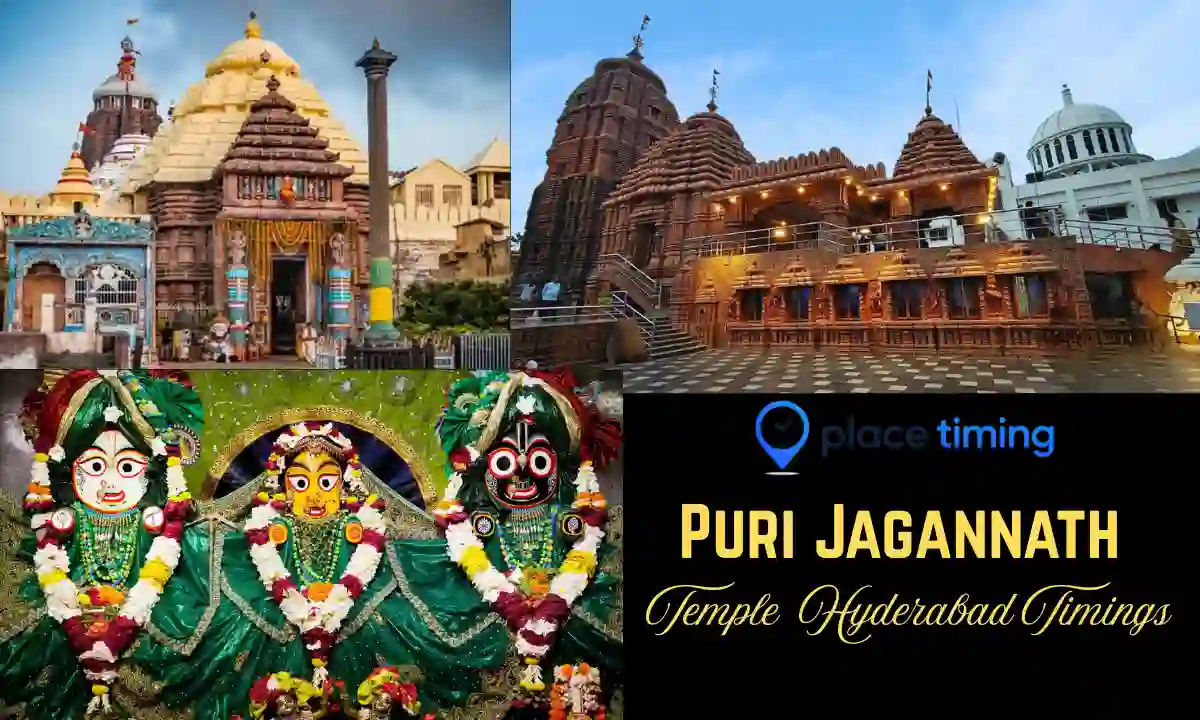
Hyderabad, is a replica of the original temple in Puri, a faithful replica made out of red sandstone dressed in Kalinga style and with indentical rituals to that followed at Jagannath temple at Puri. Visitors are caught out by two things: it closes for a long bout at the start of the afternoon and you can’t take phones inside. The timings of darshan and aarti, the strict rules, booking for Mahaprasad (Food), architecture and how this temple fares against its illustrious original in Puri is covered within.
Puri Jagannath Temple Hyderabad Timings: The Short Version
Here is the core of it. Puri Jagannath Temple Hyderabad timings are divided into two sessions, morning and evening, with a long afternoon gap and free entry given to all. The Shree Jagannath Temple on Road No.12, Banjara Hills, follows the pattern below. These are the regular timings, and they may vary during poojas or festivals.
| Detail | At a glance |
|---|---|
| Morning darshan | 6:00 AM to 12:00 PM |
| Afternoon closure | Roughly 12:00 PM to 5:00 PM |
| Evening darshan | 5:00 PM to 9:00 PM |
| Open | Every day, including weekends and holidays |
| Entry fee | Free for everyone |
| Phones and cameras | Not allowed inside, deposit them at the counter |
| Location | Road No. 12, Banjara Hills, Hyderabad |
Darshan Hours and the Afternoon Break: The Basics
Temple opens in the morning at six and darshan continues till noon. It will then shut for the day, with the deity having a rest, and reopen at five o’clock in the afternoon for its second session running until around nine at night.
The detail that trips people up is that the closure in the middle of the day, around noon to five, is not mentioned very much at all you will not visit during afternoon time aka mid-day. The temple is open 7 days a week including weekends and public holidays completely free of charge. The itinerary expands and the hours vary on festival days, so do call first if you are attending Rath Yatra or a major holiday.
Aarti and Pooja Timings: The Daily Rituals
The rituals here follow the traditions of the original Puri temple, which is part of what makes the place special. The main ones to plan around are the morning and evening aartis.
| Ritual | Approximate time |
|---|---|
| Ritual | Approximate time |
| Mangala Aarti (morning) | Around 6:00 AM, at opening |
| Morning darshan and rituals | Through the morning |
| Bhog Nivedan (food offering) | Around 12:00 PM |
| Afternoon rest (Pahada) | Roughly 12:00 PM to 5:00 PM |
| Evening darshan resumes | 5:00 PM |
| Sandhya Aarti (evening) | Around 7:00 PM |
The temple follows the daily ritual cycle of puri, and includes Mailam, The changing of deity clothing, Abakash, morning ablutions; Pahada: rest. This prasad is free and given to followers after the morning and evening aartis, so it’s worth timing your visit with one of these.
Best Time to Visit: Morning Aarti or Evening Glow
It depends on what you want to get from your visit.
- Early morning, approx. 6:00 AM Machalinga Aarti: most peaceful & divine atmosphere with fewest crowds (free prasad offered after).
- Evenings, during the 7:00 PM Sandhya Aarti: more atmospheric still with the temple illuminated and red sandstone glowing but busier.
- Sunset: every exterior photograph of the temple is taken during this time, the golden light giving it a dramatic effect.
During weekdays, it is much more peaceful than weekends and Sunday evening are very crowded with lots of traffic. If you plan to visit Rath Yatra and Navaratri then the temple is at its full swing, full crowd, so reach very early.
Entry and Costs: What You Pay
This is one of the easiest temples in the city to visit on any budget, since the darshan itself costs nothing. These figures are approximate and revised from time to time, so confirm at the temple.
| Item | Approximate cost |
|---|---|
| Temple entry and darshan | Free |
| Free prasad after aarti | Free, in limited quantity |
| Dry prasad, Khaja, Gaja and similar | Sold at nominal rates, from around Rs 20 to Rs 100 |
| Sankudi Mahaprasad (full meal) | On prior booking and payment, for a minimum group |
| Special pooja or seva | By prior request, charges vary |
| Parking | Available on site for two-wheelers and cars |
All these books, CDs and worship items are sold in the temple premises which can be purchased to practice devotion as per one’s desire along with special poojas & sevas on previous request.
Mahaprasad: How to Book the Sacred Meal
Here, Mahaprasad follows the traditional system of Puri and is a real highlight when you have to know certain rules in advance.
- Sankudi Mahaprasad (fully prepared feast comprising rice, dal, vegetables and sweets) is offered on prior booking basis, usually minimum 25 people group with payment at time of booking.
- Typically for the evening hours at about nine with afternoon arrangements permissible if the temple does not have any prior visitation.
- A limited quantity of free prasad is distributed to devotees on special occasions and also post morning & evening aartis, hence booking is not required in this case.
- Sukhila prasad: Inside the premises, dry sweets like Khaja and Gaja are sold at nominal costs and are easiest for taking back home.
If a full Mahaprasad meal is your goal, plan ahead and book, since it cannot be arranged on the day for a walk-in visitor.
Rules and Things to Note: Before You Enter
The rules here are stricter than at many a city temple and knowing them can save you a wasted trek to the counter.
- Cameras, as well as mobile phones, are not allowed in the temple. You drop them off at the safe house on deck near the main entrance.
- Shoes, socks, umbrellas and any kind of leather items are also prohibited inside so better leave at the counter too.
- Photography is not allowed inside the sanctum. While respecting the exterior and interior of the premises you are allowed to take pictures, without drone camera.
- Although there isn’t a strict dress code, you should be wearing modest and traditional attire as a sign of respect.
- There is parking available for two and four wheels on your premise, but it tends to get crowded during the festival days and evenings on Sundays.
Travel light, take only essentials, sort out belongings at the deposit counter before entering the darshan queue and it becomes first motion.
The Architecture: Kalinga Style in Red Sandstone
That itself is why many non-devotees come. Unlike many of Hyderabad’s other temples, it is one of the very few remaining true Kalinga (or Odisha) temples in South India.
- The structure is made of bright red sandstone, which has been transported from around Odisha to ensure that the construction was as true to the original as possible.
- The shikhara, the monumental tower that reaches an height of over 70 feet above the ground with characteristic curves and scrulptures of Kalinga architecture.
- The temple was made of tens of thousands of stones, but more than sixty thousand are said.
- Murals narrating the Puri temple, the ten avatars of Vishnu and other religious episodes are depicted on to the boundary wall.
The grounds covers quite a large property with three entrance gates, and sandstone at that time of the day glows beautifully, hence why everyone seems to have photos of the exterior.
The Deities and Shrines: What You Will See Inside
The ceremonial core contains Lord Jagannath, a Krishna incarnation with his brother Balabhadra and sister Subhadra just like in Puri, the only differences being their black faces and extravagant bulging eyes.
There are también smaller shrines surrounding the main temple, each one with its own priest.
- Lord Ganesha, on left of entrance; Lord Shiva, in the front.
- Bimala, a form of Parvati as Goddess anda deity known as Goddess Lakshmi.
- Lord Hanuman, and one for the nine planets (Navagraha of Shastras).
Over the course of the year, Lord Jagannath is dressed in various attires (called veshas), many of which are peculiar to incarnations of Krishna and celestial festivities, to which elaborated jewellery is added on special occasions.
Hyderabad vs Puri: How the Two Temples Compare
A question many visitors ask is how faithful this temple is to the original, and where it differs. The table below sets them side by side.
| Aspect | Puri, Odisha | Hyderabad, Banjara Hills |
|---|---|---|
| Age | Ancient, dating back many centuries | Modern, built by the Odia community and opened around 2009 |
| Size | Vast, one of India’s largest temple complexes | Much smaller, though built on a substantial plot |
| Architecture | Classic Kalinga style in stone | Faithful Kalinga style in red sandstone, with a 70-foot shikhara |
| Entry | Restricted to those of the Hindu faith | Free and open, with modest attire expected |
| Rath Yatra | The great original, drawing lakhs | A full chariot festival through Banjara Hills, drawing thousands |
| Rituals | The complete traditional cycle | The same rituals followed, adapted to the temple’s scale |
So here is the honest verdict. The temple in Hyderabad is not an alternative to Puri, but it surely is a temple, authentic, methodically constructed such that the deities are similar and rituals identical and architectural form and language too is similar. For anyone in Telangana unable to travel to Odisha, it has the nearest taste you shall get in the south and its Rath Yatra is done at a city level but closer to reality.
Festivals: Rath Yatra and the Temple Calendar
Festivals make the temple spring to life here, and a calendar similar to Puri’s is followed.
- Rath Yatra: the largest festival of the year in which Jagannath, Balabhadra and Subhadra are paraded through Banjara Hills on an elaborate chariot attracting thousands of devotees.
- Snana Purnima: snana meaning bathing and purnima, full moon — the holy bathing of deities before entering into seclusion.
- Chandan Yatra: a summer festival during which sandalwood paste is applied on deities to cool them down.
- Nabakalebara: a rare ritual that follows Puri tradition, whereby the idols are refreshed after many years.
In addition to that the temple is one of the very few places in Hyderabad which has special aartis and cultural programmes on Janmashtami, Shivaratri, Kartik Purnima and Navaratri, making it also a cultural anchor for the city’s Odia community.
History: Built by Hyderabad’s Odia Community
The temple was designed and constructed by the Odia community of Hyderabad via the Odia Samaj, located so far from Puri to bring the presence of Lord Jagannath closer to people. It was built in the 2000s and consecrated in about 2009.
Great care went into authenticity. There were strict guidelines that were adhered to on the lines of the Kalinga architectural style, and red sandstone had been sourced from a quarry near Odisha rather than locally so that it would not feel like an imitation but a true piece of Odisha. It now acts as both a temple and cultural centre, preserving Odia festivals and traditions in the heart of Telangana.
How Long to Spend: Planning Your Visit
For a darshan on an ordinary day, allocate some time range of forty-five minutes to arrival into the queue to devote contemplation at main sanctum and onto smaller shrines. If you wish to contemplate quietly, admire the murals on the boundary wall or wait for an aarti, add time.
If you are visiting at the time of aarti – morning or evening for prasad, then add some extra time. On Rath Yatra and other festival days, keep much more for the long haul as crowds and processions take the day brukar.
How to Reach the Jagannath Temple Hyderabad: Metro, Rail and Road
The temple sits on Road No. 12 in Banjara Hills, centrally placed and easy to reach from most parts of the city.
| Mode | Details and distance |
|---|---|
| By metro | The Jubilee Hills area stations, including Jubilee Hills Check Post and Road No. 5, are the closest, a short auto or cab ride from the temple. |
| By train | Secunderabad Railway Station is about 11 km away, with taxis and autos covering the rest. |
| By air | Rajiv Gandhi International Airport is about 35 km away, roughly an hour by cab. |
| By road | The Mahatma Gandhi bus stand is around 13 km off, and city buses, autos, and app cabs all reach Banjara Hills easily. Parking is available at the temple. |
If you are using a cab app or maps, simply search for Jagannath Temple, Banjara Hills, and you will be dropped at the entrance. The temple sits beside the main road, so it is easy to spot.
Trivia and Lesser-Known Facts: Jagannath Temple Hyderabad
- This is one of the very few true Kalinga-style, Odisha-pattern temples to be found south of Andra Pradesh.
- Red sandstone was imported from nearby Odisha to maintain the fidelity of the original construction.
- The main shikhara is around 70 ft height, while the temple was reportedly made from over sixty thousand stones.
- Murals narrating the tale of Puri and ten incarnations of Vishnu can be seen on the boundary wall.
- Srimandira is dressed from elders very auspicious dresses, the veshas all through out the year, which can be broadly correlated with Krishna’s incarnations and cosmic events.
- As with the Puri car festival, the chariot of the temple also rolls out down the streets of Banjara Hills during Rath Yatra.
Nearby Attractions: What to Combine With Your Visit
The temple is surrounded by many good places and it lies on a central portion of Hyderabad.
- KBR National Park: The Urban Green park near you, famous for morning walks.
- Birla Mandir: The hilltop temple with white marble and panoramic city skyline views.
- Hussain Sagar, Necklace Road: The lake and its promenade are all within a 15-min drive.
- Banjara Hills and Jubilee Hills: the neighbourhood edges around restaurants and shopping.
Quick Tips: Making Your Jagannath Temple Hyderabad Visit Work
- Do not get there between roughly 12:00 PM and 5:00 PM when the temple is closed.
- Plan your visit with 6:00 AM or 7:00 PM aarti for free prasad afterwards.
- You can deposit your phone, camera and leather items at the deposit counter because none are allowed inside.
- Want the full Mahaprasad meal? You must book it in advance, given that it requires a minimum group and payment beforehand.
- In terms of clothing, be modest and go on a weekday to avoid the Sunday-evening crowds and traffic.
- The best time of day for images of the crimson sandstone brick exterior is sunset.
Final Take: Planning Your Jagannath Temple Hyderabad Visit
The Jagannath Temple located in Banjara Hills; it is open every day, free, and exquisitely constructed, but it rewards some planning. Darshan is open from 6:00 AM to 12:00 PM and again from 5:00 PM to 9:00 PM; take care to avoid the long afternooon closure and, if possible attend the morning Mangala Aarti or be sure you get back at night for the Sandhya Aarti when there will be a feast of atmosphere (and free prasadam).
Of course, if you do not plan on leaving for a couple of days then light packing to probably leave your phones, cameras and leather goods in the deposit counter. We recommend booking for the complete Mahaprasad meal ahead of time. If you’re unable to go all the way to Puri, well this is as closest and genuine a Kalinga experience you can get in the south with identical deities under vibrant canvass roofs, identical conventions and a form of Rath Yatra that reverberates through the streets of Banjara Hills.
Frequently Asked Questions
What are the Puri Jagannath temple Hyderabad timings?
The temple is open from 6:00 AM to 12:00 PM in the morning and from 5:00 PM to 9:00 PM in the evening, every day. It closes through the afternoon, roughly noon to 5:00 PM. Timings can change during festivals and special poojas.
Is there an entry fee for the Jagannath temple in Hyderabad?
No. Entry and darshan are completely free for everyone. Only special poojas, sevas, and the booked Mahaprasad meal carry charges, and dry prasad is sold at nominal rates inside the premises.
Are mobile phones allowed inside the Jagannath temple Hyderabad?
No. Mobile phones and cameras are not allowed inside, and neither are shoes, socks, umbrellas, or leather items. A safekeeping facility near the main entrance takes them. Photography inside the sanctum is prohibited.
What are the aarti timings at the Jagannath temple Hyderabad?
The Mangala Aarti is around 6:00 AM at opening, the Bhog Nivedan around noon, and the Sandhya Aarti around 7:00 PM. Free prasad is distributed to devotees after the morning and evening aartis.
How do I get Mahaprasad at the Hyderabad Jagannath temple?
The full Sankudi Mahaprasad meal needs prior booking, generally for a minimum group of around twenty-five people, with payment at the time of booking, and is usually served in the evening. Free prasad in limited quantity is given after the aartis, and dry sweets like Khaja and Gaja are sold inside.
How is the Hyderabad Jagannath temple different from Puri?
The Hyderabad temple is modern, built by the city’s Odia community and opened around 2009, and is much smaller than the ancient Puri original. It follows the same Kalinga architecture, in red sandstone brought from near Odisha, with the same deities, the same rituals, and its own Rath Yatra through Banjara Hills.
What is the best time to visit the Jagannath temple Hyderabad?
Early morning, around the 6:00 AM Mangala Aarti, is calmest and least crowded. The evening aarti around 7:00 PM is the most atmospheric, and sunset is best for photographing the red sandstone exterior. Weekdays are far quieter than Sunday evenings.
How do I reach the Jagannath temple in Banjara Hills?
The temple is on Road No. 12, Banjara Hills. The Jubilee Hills area metro stations are the closest, Secunderabad railway station is about 11 km away, and the airport is about 35 km off. Autos, buses, and app cabs all reach it, and parking is available on site.
Also read about: Wagah Border Parade Timings: Seasonal Hours, Rules and Visitor Guide



Leave a Reply