
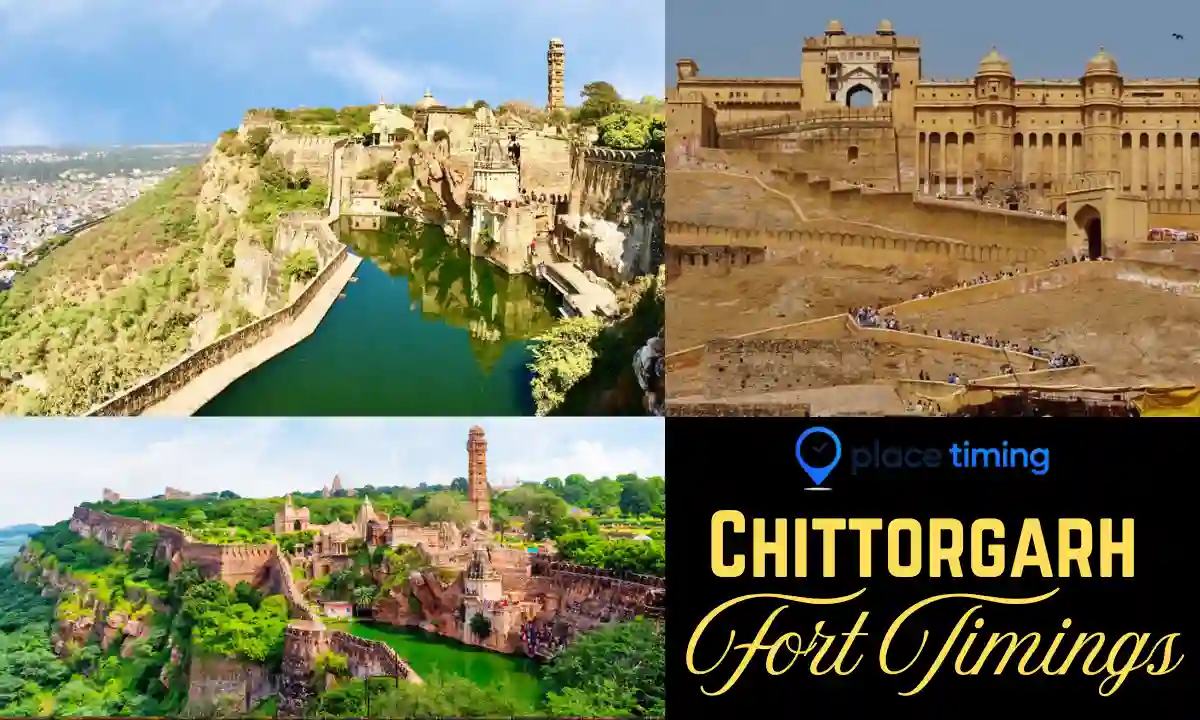
The Chittorgarh Fort is the biggest fort in India, and this single detail alone should set the tone for your entire tour. The fort is located on a hilltop and spreads over an area of approximately 700 acres enclosed within a 13-kilometre wall and contains a large number of palaces, temples, and towers spread across the entire place. If you come here with the idea of touring this place in an hour’s time, you are in for a disappointment. Here is a guide which tells you everything from when to be there till how to carry yourself.
Chittorgarh Fort Timings: The Short Version
Here is the core of it. Chittorgarh Fort Timings are 09:00 AM to 06:00 PM, all days of the week (museum and evening light and sound show functions by its own time). Fort in southern Rajasthan which is a recognized UNESCO site, follows underlying template mentioned below. These are the usual hours, but they can alter somewhat seasonally.
| Detail | At a glance |
|---|---|
| Fort open | 9:00 AM to 6:00 PM, all days of the week |
| Fateh Prakash Palace Museum | About 9:45 AM to 5:45 PM, closed on Mondays |
| Light and sound show | Evening, around 7:00 PM, after sunset |
| Best time to go | Early morning, 9:00 AM to 11:00 AM, on a weekday |
| Time to spend | Half a day, at least 3 to 4 hours |
| Entry ticket | Around Rs 40 to Rs 50 for Indians, Rs 600 for foreigners, under-15s free |
| Location | Atop a hill above Chittorgarh town, southern Rajasthan |
Opening Hours, Museum and the Light and Sound Show
The fort is open from 9 am to 6 pm on all days. The Fateh Prakash Palace Museum within keeps more limited hours – opening at quarter to ten and closing at a fraction earlier than six, with Mondays off from that pursuit too, hence the fort can then be seen by Monday visitors while the museum cannot.
The evening illuminate and sound experience is a different ticketed event. Starting around seven and going for forty five minutes, the show runs after dark, telling about the fort’s long history via light and voice. The specific kickoff changes with the season and light, and the show runs in Hindi and English on various evenings so check which language before you accept it.
Ticket Prices: Fort Entry, Museum and Light Show
The entry to the fort is through the Archaeological Survey of India and very cheap, but a separate ticket needed for the light and sound show in the evening. Below figures are rough estimates which may be refreshed now and again, so treat them as an indicator and check the present rate at the counter or on ASI portal.
| Ticket | Approximate price |
|---|---|
| Fort entry, Indian visitors | Around Rs 40 to Rs 50 per person |
| Fort entry, foreign visitors | Around Rs 600 per person |
| Children under 15 | Free entry |
| Light and sound show, Indian | Around Rs 100 to Rs 150 per person |
| Light and sound show, foreign | Around Rs 300 per person |
| Students and children, show | Reduced, around Rs 75 |
| Guided tour | Around Rs 400 for about 4 hours |
Tickets for the fort and the show can be bought at the counter or online in advance, which helps in peak season. Online e-tickets are usually non transferable and non refundable, and a small extra charge may apply for parking and for still or video cameras.
How to Explore Such a Huge Fort: Getting Around Inside
It is the single most useful thing you can know, and it is generally not mentioned in any guides. Chittorgarh is not a small fort that you walk therefore end. They are also on a long running line of hilltop that stretches for kilometers and walking over all those miles will leave you exhausted and miss half the monuments where in the heat.
The advised practical method is to drive a car up and around. You have the option of driving your own vehicles in, or you can hire an auto rickshaw or taxi on site to ferry you between main monuments and wait while you explore each monument. Having a local guide is also well worth the loop and bringing the history to life. Walk the sites, but ride between them and you will see much more in far less time.
What to Carry and What to Avoid: A Practical Checklist
Because the fort is large, open, and requires quite a bit of walking and climbing, some preparation can go a long way. Here’s what you need to carry and what not.
What to Carry:
- Comfortable, broken-in walking shoes, as you’ll do a lot of walking and climbing stairs in the towers.
- Some water, along with a hat or cap, sunglasses, and sunscreen, because most of the fort remains open to the sun.
- A proper form of identification for buying tickets, as well as cash and phone for payment online or at the counter.
- A camera or at least a fully charged phone and a power bank, because the vistas are worth capturing.
- Snacks, along with an umbrella in case of monsoon.
What Not To Bring:
- High heels or even fresh shoes, which make the climbs unbearable.
- Any heavy luggage or bags that would be a hassle while moving through the vast site.
- Feeding the monkeys and harassing them, which are pretty common here and can even snatch food and other items.
- The climb up to Vijay Stambh if you suffer from any mobility issues or claustrophobia.
- Dumping litter and touching the ancient carvings, along with the use of drones without
History: The Largest Fort and Its Three Great Sieges
It is the tale of Chittorgarh, which is why it leaves people as much in awe at its ruins as its architecture. The fort itself is considered to be 7th century, credited to a Mauryan or Mori king in legends that even ascribe its origins to the hero Bhima of the Pandavas. The image shown is Bappa Rawal, founder of the Mewar line and was capital of Mewar for several centuries under the Guhila and Sisodia dynasties.
Perhaps the fort is most remembered for three formidable sieges, all with excruciating loss. Rani Padmini and siege of 1303: In the era of Raja Ratan Singh, Alauddin Khilji (Delhi) laid a long siege in 1303 which is associated to the story about Queen Padmini. Bahadur Shah – of Gujarat attacked 1535 (Rani Karnavati’s time) In 1568 the fort was seized by Mughal emperor Akbar and shortly afterwards, Maharana Udai Singh II left Cheetor and founded Udaipur.
It is said that in each siege, when defeat loomed large, the women of the fort carried out a jauhar as they chose to perish rather than be captured, while the men rode out for battle until the end. These tragedies, wept and glorified among Rajput memories, air Chittorgarh’s legacy of being a Fort of renunciation and honour rather than wealth and royal splendor. It is associated with the warrior Maharana Pratap and the saint poet Meera Bai.
The Monuments Inside: A Site by Site Plan
It has approximately sixty five buildings, ranging from palaces to temples to towers and reservoirs. Render priority to these, broadly on the order you encounter them.
- Rana Kumbha Palace: the oldest and most impressive of the ruins, with underground chambers all connected to the legend of jauhar.
- Meera Temple, Kumbha Shyam Temple, The graceful temples located in the vicinity of the palace are linked to Meera Bai’s devotion.
- Vijay Stambha, the Tower of Victory: a nine storey tower constructed by Rana Kumbha to commemorate the victory, ascendable via a steep inner staircase leading to panoramic views over the entire fort.
- Gaumukh Reservoir — A small spring fed water reservoir in the side of a cliff that constantly flows out of a mouth shaped like a cow, and is full throughout the year.
- Padmini’s Palace: a four storey white palace adjoining a pool of lotuses, linked with the legendary tale of Queen Padmini’s reflection in the mirror.
- Kalika Mata Temple: an ancient temple (originally a sun temple), now used for goddess worship.
- Fateh Prakash Palace Museum: houses sculptures, weapons and frescoes that put a name to history.
- Kirti Stambh, Tower of Fame: An ancient and smaller Jain significance tower located to the South side of fort.
The Seven Gates: Climbing to the Top
Its winding approach road leads through giant gates, or pols constructed as a defence. In total there are seven gates, the Padan Pol, Bhairon Pol, Hanuman Pol, Ganesh Pol, Jodla Pol, Lakshman Pol and at the top RamPol. They are a sturdy stone arch, and they together illustrate how impregnable the fort was. The gates are probably worth a leisurely look on the way up rather than just driving by quickly.
Best Time to Visit Chittorgarh Fort: Season and Time of Day
This is where the two layers of timing, the season and the hour matter.
- October to March: the cool, pleasant season; by far the most bearable for a fort that requires hours of walking outdoors.
- Early morning,9:00 AM to 11:00 AM: The best window in the day, very soft light for photos and out the crowds of tour buses.
- Late in the afternoon going to sunset: nice lighting on the towers, and also acquisition for coupled night light & sound Show.
This exposed hilltop is brutal on summer afternoons, so if striding between April and June, get out early and take a break in the heat of midday. At Vijay Stambh, the golden hours at sunrise and sunset are a photographer’s paradise.
How Long to Spend: Planning Your Visit
Allow three to four hours minimum for the fort and half a day if you want to do it justice with museum, towers & temples. An hour or two at most is hardly enough to do a site of this magnitude any justice.
Create a pit stop period if you stay for the evening light and sound show as it occurs after normal fort hours (going by normal video charge assention). Chittorgarh is often combined with a visit to Udaipur, which is only a couple of hours away and makes it easy enough for a full day trip from there too.
How to Reach Chittorgarh Fort: By Air, Train and Road
The fort rises above Chittorgarh town in southern Rajasthan, well connected by rail and road, though the nearest airport is a distance away.
| Mode | Details and distance |
|---|---|
| By air | Maharana Pratap Airport in Udaipur is the nearest, about 90 to 100 km away, roughly two hours by road. |
| By train | Chittorgarh Junction is only about 7 to 8 km from the fort, well connected to Delhi, Mumbai, Ajmer, and Udaipur. |
| By road | Udaipur is about 112 km, Ajmer around 185 km, Kota about 155 km, and Jaipur roughly 300 km, all linked by good highways with regular buses. |
| Local transport | From Chittorgarh town, autos and taxis run up to and around the fort, the easiest way to cover the large grounds. |
Because the fort is only a few kilometres from the railway station, arriving by train and taking an auto up is one of the simplest ways to visit.
Trivia and Lesser-Known Facts: Chittorgarh Fort
- It is the biggest fort in India and the area that it occupies according to a rough estimate comes down to roughly 700 acres, having a wall running around the hill for almost 13 kilometres.
- It was included as one of the Hill Forts of Rajasthan in a 2013 listing of UNESCO World Heritage Sites.
- From the eighth century to sixteenth, the fort was Mewars capital.
- The nine storey high Vijay Stambh tower (Victory Tower) is one of the rare victory towers which you can climb.
- Gaumukh reservoir is continuously filled through a natural spring month after month for the entire year irrespective of its arid Rajasthan surroundings.
- Maharana Udai Singh II lost the fort to Akbar and later built a new capital which is Udaipur today.
Nearby Attractions: What to Combine With Your Visit
The Fort is definitely the center of attraction; however, the area surrounding the Fort has plenty of other places to visit.
- Chittorgarh Town: the base under the Fort, where you can find heritage stays and local cuisine.
- Sanwariaji Temple: an active Krishna temple that is a short drive away from the town.
- Sita Mata & Bassi Wildlife Sanctuaries: sanctuaries located close to Chittorgarh for nature enthusiasts.
- Udaipur: a lake city just about an hour’s distance from Chittorgarh.
Quick Tips: Making Your Chittorgarh Fort Timings Work
- Started around 9:00 AM to avoid the heat and tour crowds!
- Drive your vehicle up and rent a car or guide to move between the scattered monuments.
- Given the wide-open expanse of the site, wear a good pair of shoes and bring water, sunscreen and maybe a hat.
- Visiting on a Monday? The fort is visible, but the museum has been closed.
- Do not feed the monkeys and keep an eye on your possessions.
- Staying for the light and sound experience? The day will feature a start time and language for that evening.
Frequently Asked Questions
What are the Chittorgarh Fort timings?
The fort is open from 9:00 AM to 6:00 PM, every day of the week. The Fateh Prakash Palace Museum inside runs from about 9:45 AM to 5:45 PM and is closed on Mondays, and the evening light and sound show starts around 7:00 PM.
What is the entry fee for Chittorgarh Fort?
The fort ticket, managed by the Archaeological Survey of India, is around Rs 40 to Rs 50 for Indian visitors and about Rs 600 for foreign nationals, with free entry for children under 15. The light and sound show is separate, roughly Rs 100 to Rs 150 for Indians and about Rs 300 for foreign visitors. Fees are revised from time to time, so check the current rate.
What are the Chittorgarh Fort light and sound show timings?
The show runs in the evening after sunset, usually starting around 7:00 PM, and lasts about 45 minutes. It plays in Hindi and English on different evenings, and seating is limited, so book or buy tickets early.
How much time do you need at Chittorgarh Fort?
Allow at least three to four hours, and ideally half a day. Because it is the largest fort in India, spread over 700 acres, a quick visit sees only a small part of it.
Can you drive inside Chittorgarh Fort?
Yes. Because the monuments are spread far apart across the hilltop, visitors take a vehicle up and use a car, auto, or hired taxi to move between the main sites, walking within each one.
What should I carry to Chittorgarh Fort?
Wear comfortable walking shoes and carry water, a hat, sunglasses, and sunscreen, since much of the fort is open to the sun. Bring a photo ID for tickets, some cash, and a camera. Avoid heels, heavy bags, and feeding the monkeys.
What is the best time to visit Chittorgarh Fort?
The winter months from October to March are the most comfortable. Within the day, early morning from 9:00 AM to 11:00 AM is best for cooler weather, fewer crowds, and good light.
How do I reach Chittorgarh Fort?
Chittorgarh Junction railway station is only about 7 to 8 km from the fort and is well connected. The nearest airport is in Udaipur, around 90 to 100 km away, and Udaipur itself is about 112 km by road.
Also read about: Swarnagiri Temple Timings: History, Ticket Price, Distance, Architecture & Travel Tips





Leave a Reply