
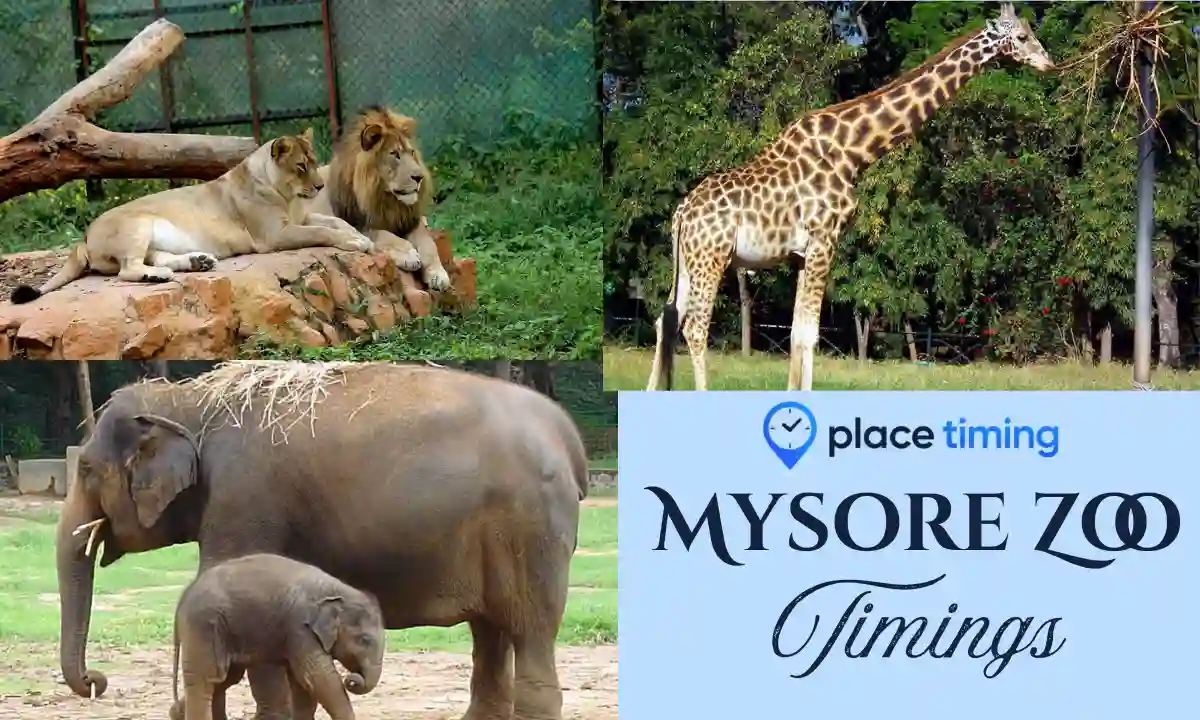
Here is something that a lot of the Mysore Zoo guides miss out on. The timing that counts is not only when the gates swing open, but when the animals are actually up. Come at the wrong time, and the big cats are tucked up snoozing in the shade. This guide will provide you with the opening hours, essentials first, then extras later; the best time to see animals on the move, comparing Mysore Zoo against other big Indian zoos; and all those history & facts that most timing pages gloss over.
Mysore Zoo Timings: The Short Version
Here is the core of it. The Mysore Zoo timings are not very long and lasts from 8am till early night, bazaar on one day of a week when the zoo is shut. One of the oldest zoos in India, Sri Chamarajendra Zoological Gardens also follows the pattern similar given below. During peak season, hours will be a little bit longer, so consider these the standard.
| Detail | At a glance |
|---|---|
| Open | About 8:30 AM to 5:30 PM |
| Weekly closure | Closed every Tuesday |
| Last entry | Allow time before closing, ideally by around 5:00 PM |
| Best time for animals | Early morning for birds, early and after 3:00 PM for big cats |
| Time to spend | 2 to 4 hours for a relaxed visit |
| Entry | A modest ticket, with lower rates for children |
| Location | Zoo Main Road, near Karanji Lake, Mysuru, Karnataka |
Opening Hours and Closed Day: The Basics
The opening time of the zoo is approximately 8:30 in the morning, and it closes at 5:30 in the evening. Closed every Tuesday for maintenance and animal care is the absolute thing to check before you visit, as many head there on a Tuesday only to find the gates locked.
Get there well before the 5:30 PM close (ideally by five, because the grounds are enormous and you will want to walk them). In peak seasons the hours is occasionally slightly extended so if you are going on an excursion in a festive rush it could be worthwhile checking what time it to go on that day.
The Best Time to Visit: When the Animals Are Active
This is where the difference between an ordinary experience and an outstanding one lies – and that is all about timing. Animals have different levels of activity throughout the day, depending on the hour you choose to visit; this determines how much of the action will be visible.
- Early morning, immediately after opening, the birds are at their most active, and the large predators and other mammals are still active before the day gets hot.
- Afternoon, around 3:00 PM: the mammals and large predators become active again, as the temperature begins to cool down, and this becomes another window of opportunity.
- Midday, around 11:00 AM to 3:00 PM: the hottest time of the day, during which most animals tend to rest in the shade.
Thus, if seeing lions, tigers, and other large mammals is your goal, go for the early morning or for the last few hours of your visit, and use the midday for a lunch break and shady walks. This one change alone makes a difference beyond anything else written on this page.
Entry, Tickets and Online Booking: What to Know
- There is an entry ticket system where the fee for an adult is affordable while that of a child is slightly reduced. Fees may change from time to time, so always check the latest prices instead of going with an old figure. There are some things to know to ensure a smooth experience.
- Online Booking: tickets can be booked through the zoo’s official website, and tickets booked online have a fast track entrance gate, which is more convenient during weekend times.
- Combination Tickets: there is a combination ticket for both the zoo and its adjacent Karanji Lake, and it is more economical if you are planning to visit both places.
- Cameras and parking: Mobile phones are free to take pictures, but still and video cameras have charges, and vehicle parking has charges too. Drones are prohibited here.
- Electric Vehicle: there is an electric vehicle that travels inside the zoo for an additional fee and is useful for senior people and children as well as those who do not want to walk around the entire zoo.
Weekends and school holidays are the busiest, so booking ahead and arriving early saves time at the counter.
How Long to Spend: Planning Your Visit
Most guests stick around two to four hours. Walking quickly around the primary enclosures will take roughly two hours; a leisurely visit with the battery vehicle, and at the lake, takes closer to four if people are willing actually to watch the animals. For families with young children, tend towards the longer end of that range.
The zoo sits randomly in the city and so fits easily into a Mysuru day plan with the palace and other sights, so you can give it a decent half day without overstretching your trip.
How Mysore Zoo Compares to Other Indian Zoos: What It Has and What’s Missing
An important question before you plan a trip is how does Mysore Zoo compare against the other major zoos in the country, particularly if you are deciding between them. It is placed side by side with some of India’s best kept in the table below.
| Zoo | Known for | Safari ride |
|---|---|---|
| Mysore Zoo, Mysuru | Heritage from 1892, exotic species diversity, excellent upkeep and greenery | No safari |
| Bannerghatta, Bengaluru | Bus safari through lion and tiger zones, butterfly park | Yes |
| Arignar Anna, Vandalur, Chennai | India’s largest zoo by area, lion safari | Yes |
| Nehru Zoological Park, Hyderabad | Safari rides and a dinosaur themed section | Yes |
| Nandankanan, Bhubaneswar | White tigers, lion safari, botanical garden setting | Yes |
| Alipore, Kolkata | India’s oldest zoo, opened in 1876, city heritage | No |
The pattern is clear. Mysore has none, but if you find drive through safari the biggest draw it does exist at Bannerghatta, Vandalur, Hyderabad and Nandankanan. What you get with Mysore is heritage, a host of exotic species crammed into a walkable, well-kept campus and maintenance standards that keep it among the best co.
What Mysore Zoo Has That Others Don’t: The Standout Points
Few things that make this zoo unique which is important to know before you visit it.
- Deep heritage: Once amongst the most oldest zoo in India and one of older zoo any where World wide replicate 1892.
- A designed landscape: The gardens were also then designed, by a German horticulturist; it’s more an arboreal park than a lowly zoo.
- Exotic range: It has always been known for some rare and foreign species, being the first Indian zoo to include great apes such as orangutans, gorillas and chimpanzees.
- A pioneering adoption scheme: Mysore Zoo was one of the early adopters at lezy an animal to fundaz its care, a model that many zoos have now successfully adopted.
- Karanji Lake: The connected lake brings large scale birdwatching to the trip that most urban zoos can not provide.
What’s Missing at Mysore Zoo: The Honest Gaps
There is no perfect city, and being honest about the gaps allows you to prepare. This is exactly where Mysore Zoo unfortunately lags behind some competitors.
- No safari: No drive through or bus safari like in Bannerghatta or Vandalur, just walk-in all the way.
- No night experience: no night safari aka viewing after dark.
- Midday lull: as a conventional motionless zoo, this might apply to some animals resting in the heat of the midday; therefore, timing does count.
- Size: It is walkable ( compact) but smaller than other sprawling safari parks in Vandalur, Bannerghatta and Nandankanan.
None of these are dealbreakers. They only mean that Mysore Zoo is better enjoyed as a heritage, high diversity, walkable zoo and at narrow time slots than a safari day out.
History: One of the Oldest Zoos in India
The zoo originated in 1892 as a private royal menagerie of Maharaja Chamarajendra Wodeyar, previously called by monikers such as Khas Bangle. It began small, some ten acres partially hewn from a summer palace garden with the Maharaja recruiting a German horticulturist to sculpt the land.
Realizing that the collection had educational significance and not simply royal puffery, the rulers made it accessible to visitors around 1920. Post-independence, it came to the Government of Karnataka and in due course to the Zoo Authority of Karnataka. In the following decades, it expanded from those ten initial acres into today’s sprawling campus dotted with trees and gained a reputation for its breeding programmes, veterinary care and conservation work.
Animals and Highlights: What You Will See
The zoo houses close to a hundred and fifty species of birds and animals, Indian and foreign. The headline residents draw the crowds, but the diversity is the real strength.
- Big cats: lions, tigers, including white tigers, leopards, and jaguars.
- Large mammals: elephants, giraffes, zebras, hippos, rhinoceros, and gaur.
- Primates: gorillas, chimpanzees, and a range of monkeys and langurs.
- Birds and reptiles: a wide aviary collection, plus crocodiles, pythons, and other reptiles, with more birds around Karanji Lake.
The zoo has been noted over the years for keeping rare species and for successes that few Indian zoos can match, part of why it stays so popular.
Facilities and Rules: Making the Most of Your Visit
There are several facilities and good practices which will dictate the day so remember these.
- A battery vehicle helps map the expansive grounds, and there is assistance for seniors and those with limited mobility.
- No plastic objects can come in, and no food can be given to the animals for their own health.
- Wear comfy shoes and tote some water because you do have a boat walk in the sun.
- Keep to the pathways, and eat in the allocated places as opposed to close to the enclosures.
Just remember, following these keeps your visit as smooth as possible for both you and the animals which is what a good zoo should aim for.
Best Season and Weather: Timing by Month
The daily hours apply all year but the season is one of comfort. The warm months are best from around October to February, when Mysuru is relatively pleasant for a long walk on the grounds.
Summer afternoons can get stifling hot, which makes the early morning slot even more crucial when it comes to comfort for yourself and activity from animals. During monsoon, the surroundings turn green with washed up places but not before gifting us with the odd shower so pack along something light weight to cover you.
How to Reach Mysore Zoo: By Air, Train and Road
The zoo sits right in Mysuru city, a short hop from the palace, which makes it easy to reach by any mode.
| Mode | Details and distance |
|---|---|
| By air | Mysuru Airport is about 10 to 12 km away with limited flights. Kempegowda International Airport in Bengaluru is roughly 170 km away. |
| By train | Mysuru Junction is around 3 km from the zoo, a short auto ride, with frequent trains from Bengaluru and beyond. |
| By road | The zoo is about 3 km from the city bus stand and roughly 1 to 2 km from Mysore Palace. Buses, autos, and cabs run to it easily. |
| Local transport | City buses and autos reach the gate. From the palace area you can even take a horse cart for a bit of old world charm. |
Because it is so central, you can base yourself anywhere in Mysuru and reach the zoo in minutes, which is part of why it fits so neatly into a day of city sightseeing.
Trivia and Lesser-Known Facts: Mysore Zoo
- Opened in 1892, it is one of the oldest zoos in India and one of the oldest in the world.
- A German horticulturist designed its landscape, and the grounds feel as much like a botanical park as a zoo.
- In 1970s, it was also the first zoo in India that had species like orangutan, gorilla and chimpanzee.
- The exotic arrivals range from a giraffe from Germany and red kangaroos from the United States.
- The only zoo in India that reportedly housed all three species of rhinoceros.
- One of its first initiatives was a memorial animal adoption programme with varying levels of sponsorship, which became a model later adopted by other zoos.
Nearby Attractions: What to Combine With Your Visit
The zoo sits amid some of Mysuru’s best sights, so it slots easily into a fuller day.
- Karanji Lake: adjacent and includes a walk through aviary and boating, should be done with the combo ticket.
- Mysore Palace: only a kilometre or two away, the grand Amba Vilas Palace.
- Chamundi Hills: a temple on top of a hill where you can see the views, just 15 minutes outside of the city
- Brindavan Gardens: terraced gardens, evening musical fountain.
Quick Tips: Making Your Mysore Zoo Timings Work
- Never plan a Tuesday visit. The zoo is closed.
- If you want to see active big cats, come early morning or in the last couple of hours before closing (midday tends to be a lull).
- On busy days, book online to save time at the entry gate, and if you would like both, make sure you pick up the Karanji Lake combo.
- Comfortable shoes and water are recommended because the grounds are large.
- If you have young children or seniors with you, make use of the battery vehicle.
- The best time to come up is between October to February when walking is a lot more pleasant.
Frequently Asked Questions
What are the Mysore Zoo timings?
The zoo is open from about 8:30 AM to 5:30 PM. It is closed every Tuesday, and hours can extend a little during peak tourist season, so it is worth checking on the day.
Is Mysore Zoo open on Tuesday?
No. Mysore Zoo is closed every Tuesday for maintenance and animal care. Plan your visit for any other day of the week.
What is the best time to visit Mysore Zoo?
Early morning, soon after opening, is best for active birds and mammals, and the last couple of hours before closing, from about 3:00 PM, are good for the big cats. Avoid the hot midday stretch, when most animals rest.
How many hours do you need at Mysore Zoo?
Most visitors keep two to four hours. A quick walk takes about two hours, while a relaxed visit with the lake and the battery vehicle runs closer to four. Allow more time with children.
Can I book Mysore Zoo tickets online?
Yes. Tickets can be booked on the official zoo website, and online tickets often use a separate, faster entry gate, which is a real help on busy weekends and holidays.
Does Mysore Zoo have a safari?
No. Mysore Zoo is a walking, enclosure based zoo with no safari ride. For a drive-through safari, Bannerghatta near Bengaluru or Vandalur near Chennai are the better-known options.
Which is better, Mysore Zoo or Bannerghatta?
It depends on what you want. Bannerghatta offers a bus safari and a butterfly park, while Mysore Zoo offers deeper heritage, a wider range of exotic species, and a beautifully kept, walkable campus. Many visitors to the region see both.
How do I reach Mysore Zoo?
The zoo is central, about 3 km from Mysuru Junction and the city bus stand, and only 1 to 2 km from Mysore Palace. Buses, autos, and cabs reach it easily, and Bengaluru Airport is around 170 km away.
Also read about: Sunder Nursery Timings: Seasonal Hours, Entry and Best Time to Visit




Leave a Reply