
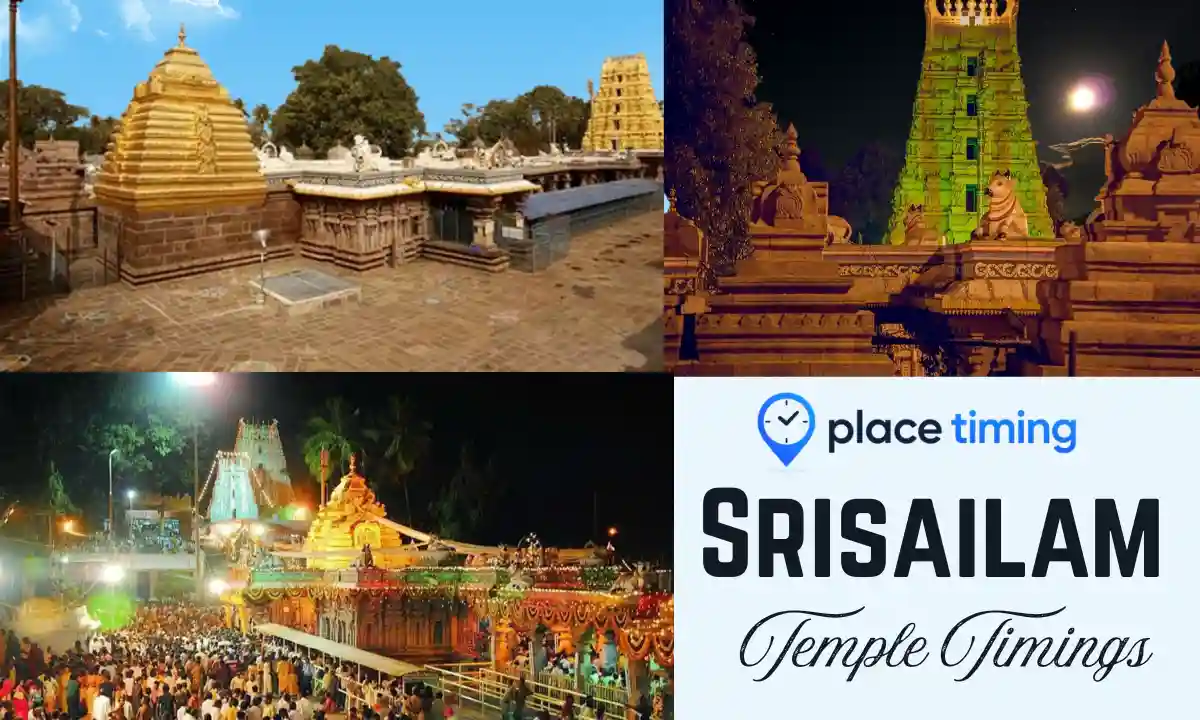
Srisailam is hailed as two pilgrimages in one. You see Shiva as Mallikarjuna and the Goddess as Bhramaramba in a single queue Jyotirlinga and a Shakti Peetha together, something most temples you won’t find. That also means more to plan: the darshan hours, the rare touch darshan, abhishekam slots and a late afternoon when doors draw back an evening for rituals. This is the complete timeline story, along with its history, the legends and the rituals you should know.
Srisailam Temple Timings: The Short Version
Here is the core of it. Srisailam temple timings are from pre dawn till midnight with a large break in the late afternoon timings. The Sri Bhramaramba Mallikarjuna Swamy Temple located on Nallamala hills overlooking the Krishna river is not an exception to below pattern. Festival days are longer – and hours drift, so consider these as the normal line up.
| Detail | At a glance |
|---|---|
| Temple opens | About 4:30 AM, with the Mangala Aarti |
| General darshan | From about 6:00 AM through to around 3:30 PM |
| Afternoon ritual break | Roughly 3:30 PM to 6:00 PM for the evening poojas |
| Evening darshan | About 6:00 PM to 9:00 PM, temple closing around 10:00 PM |
| Special feature | Sparsha darshan, the rare chance to touch the Jyotirlinga |
| Best time to go | Weekday mornings, soon after darshan opens |
| Location | Srisailam, Nandyal district, Andhra Pradesh |
Daily Darshan Hours: Morning to Night
It is open from about 4:30 in the morning for the Mangala Aarti, the first puja of the day and most devotees consider as a very sacred time. This is every day from the public, and general darshan sets in at about six in the morning.
After that, the free darshan queue will continue to run during the morning and in to early afternoon until around half past three. The temple then focuses on its evening procedures before reopening for the probably darshan, which runs until roughly 9pm. The doors close around ten. There is no weekly off in here. Open 365 days a year.
The Afternoon Ritual Break: When Darshan Pauses
This is the gap that should be made plans for. The priests will then conduct the evening round of poojas (the Pradosha rituals, the Susandhyam, etc.), meaning that general darshan stops around half past three and before six. You land in that window, and you wait.
Therefore, make sure you be on the queue or via Ian either in the morning hours or from evening reset. After all the long hill drive, you reach srisailam in mid afternoon you can use this break to rest, eat something and enjoy the view before darshan in evening time.
Types of Darshan: Free, Seeghra and Sparsha
There are a lot of darshan types done in Srisailam and based on your type the wait is how it is. The major attraction is the Sparsha darshan, as this one of the only few Jyotirlinga shrines anywhere in which devotees are allowed to physically touch the lingam.
- Free darshan: This is free and available to everyone, but the queue can be quite long during busy periods.
- Seeghra and Athi Seeghra darshan: compartment darshan for experienced seekers, with a separate line that is quick.
- Sparsh darshan: the precious touch darshan, which is pre-booked and happens in the wee hours of the morning where you can keep your hands on Jyotirlinga.
- Alankara darshan: Seeing the deity with all finery on.
The free queue can be long (hours even) on busy days and festivals, so a quick darshan ticket is worth it. If touching the lingam is your aim, Sparsha slots are limited and get filled up fast so book through the official channel in advance.
Abhishekam and Pooja Timings: The Daily Rituals
Besides darshan, a complete round of poojas dances throughout the day. They help you plan your breaks so you know when to sit down and choose which ritual to observe (or partake in).
| Ritual | Approximate time |
|---|---|
| Mangala Aarti (temple opening) | Around 4:30 AM |
| Abhishekam to the Jyotirlinga | Early morning, from around 5:00 AM to 6:30 AM |
| Archana and Alankaram | Through the morning |
| Maha Nivedana and Harathi | Around midday |
| Pradosha and evening poojas | Late afternoon, roughly 3:30 PM to 6:00 PM |
| Evening darshan and aarti | From about 6:00 PM |
| Ekantha Seva (final ritual) | Around 9:30 PM to 10:00 PM |
Special sevas such as the Rudrabhishekam and the Kalyanotsavam, the symbolic wedding of Mallikarjuna and Bhramaramba, can be booked at the counter or online. Many are also offered as remote sevas for those who cannot travel.
History and Significance: A Jyotirlinga and a Shakti Peetha
Srisailam is one of the oldest shrines in India and epigraphic records show its worship from Satavahana time of about 2000 years old. In both the Skanda Purana and the Shiva Purana, it is described as a spot where Shiva himself manifested Mallikarjuna.
What makes it rare is the dual status. Mallikarjuna is one of the twelve Jyotirlingas where Shiva is worshipped, while adjoining shrine Bhramaramba (Ma Kali) is one of eighteen Maha Shakti Peethas of Goddess. This means very few temples house both, thus a single trip allows a devotee to pray to Shiva and Shakti one after another. Here both deities are said to be Swayambhuwho is self-manifested.
Dynasty after dynasty many of them, the Chalukyas, the Kakatiyas, the Reddi kings and the Vijayanagara rulers, added to (funding) temple over these centuries. Srisailam the Kailasa of South,land born Kshathriya abode of Shiva on this earth.
Legends and Miracles: The Bees, the Jasmine and the Self-Born Linga
This temple comes with some of the most beloved myths in the south. The word Mallikarjuna means that the Lingam was worshipped with a fragrant flower, jasmine called mallika in Telugu, by Goddess Parvati, and so the Lord became Mallika Arjuna.
The Goddess has her own story to tell. Bhramaramba is the mother of bees. It is said that there was a demon named Arunasura and who held a boon, which no animal by two legs or four could kill him. The Goddess, as Bhramari, sent a swarm of six legged bees which crushed him and who remained on this planet in the Divine personification of her form as Bhramaramba.
Then there’s the origin story of the town itself. As a result, the young Kartikeya departed for a mountain in the distance; after he was followed by Shiva and Parvati who sought to comfort their son but decided to remain close in form as Mallikarjuna and Bhramaramba. Srisailam became the site of their stay. The devotees believe that the linga and the Goddess are swayambhu or self-born rather than installed as part of this temple’s divine charisma.
Notable Visitors Through History: Saints, Kings and More
Some temples have come with a guest list like this. As per the legend, it is here where Sri Rama worshipped and established the Sahasra Linga (the thousand lingas), while five other lingas are connected to the Pandavas.
As per popular belief, the philosopher saint Adi Shankaracharya visited this Kshetra and composed his own devotional hymnal — Shivananda Lahari in front of it. Among the list of rulers, the Maratha king Chhatrapati Shivaji is mentioned as a sponsor who constructed a tower at the temple in the 17th century.
That pull has not faded. However, Srisailam continues to be a routine visit for political leaders as well as film personalities from the Telugu states especially in time of Maha Shivaratri when Srisailam temple is central to spiritual calendar in the region.
Inside and Around the Temple: Pathala Ganga, Sikharam and Sakshi Ganapati
The old Srisailam visit goes until a few spots past the primary sanctum, and every one has its own significance.
- Pathala Ganga: Hundreds of steps descending from the hill on the bank of Krishna river, where pilgrims take holy dip before darshan.
- Sikhareswara, the summit: a shrine upon the highest of hills. That is supposed to liberate the soul from reincarnating; just a sight of the Sikhara, summit.
- Sakshi Ganapati: Just before you hit the town is a shrine where Ganesha supposedly records, or sakshi, your journey to Srisailam.
In very moment the devotees also perform the Giri Pradakshina that is a walking process on twenty one kilometres in around the hills.
Best Time to Visit Srisailam: Crowds and Season
There are two elements to time here, the crowd and the weather and season counts for something in a hill setting.
- Weekday mornings, soon after darshan opens — the lighter crowds and shortest free queue.
- Approx October to March: cool, congenial weather ideal for darshan and local sightseeing.
- June to September: The Nallamala hills get extremely heavy rain during the monsoon so plan your ghat drive wisely.
The largest crowds are drawn during the eleven day Maha Shivaratri Brahmotsavam, the most important festival of the temple, and on Karthika Masam when thousands of lamps are lit. These are the most auspicious times to come, but also when it will be the busiest so book your darshan, sevas, and stay far in advance.
How Long to Spend: Planning Your Visit
On a normal day, have one to two hours just for darshan itself, more if the free queue is long. A fast-darshan ticket cuts that down to size. Spend the best part of a day including Pathala Ganga, the summit shrine, and the caves and dam nearby or stay on top of the hill overnight.
Since the drive in from the cities takes hours, many of those who visit Srisailam allot for it a full night and a day so that there’s room amid events for darshan, rituals and other sights without hurry.
Dress Code and Rules: Before You Enter
You can find a traditional dress code followed in the temple and it is checked at the entrance.
- Men: dhoti or pancha (lungi), a shirt, and kurta. Not allowed are modern and sleeveless outfit.
- Women: Attire includes a saree, half sarees and/or salwar kameez with a dupatta.
- Footwear is removed before the line and the mada streets, and mobile phone does not enter because these are laying down in a cloakroom.
As well, food is forbidden to be brought into the temple. Organize your bags, shoes stop and phone 2 minutes before getting into the queue so darshan is smooth.
How to Reach Srisailam Temple: By Air, Train and Road
The temple sits deep in the Nallamala hills, so reaching it means a scenic drive through forest country. Plan for the distance from the nearest big city.
| Mode | Details and distance |
|---|---|
| By air | Rajiv Gandhi International Airport in Hyderabad is the nearest major airport, around 213 to 230 km away. |
| By train | Markapur Road is the closest railway station, about 85 km away. Nandyal and Kurnool, around 180 km off, are other railheads. |
| By road | Hyderabad is about 213 km, Vijayawada about 263 km, and Tirupati about 370 km. APSRTC and private buses run regularly. |
| Local transport | Buses and autos run within the temple town, and the temple is a short ride from the Srisailam bus station. |
If you want the dawn Mangala Aarti or an early Sparsha darshan, stay overnight on the hill. The Devasthanam runs guest houses, cottages, and rooms, and private hotels fill the rest, though they book up fast around festivals.
Trivia and Lesser-Known Facts: Srisailam
- It is one of the very few temples that are both a Jyotirlinga and Maha Shakti Peetha, allowing devotees to worship Shiva and Goddess in the same temple at one go.
- It is one of the few Jyotirlinga temples where devotees can touch the lingam in Sparsha darshan.
- This goddess is known as Bhramaramba, the mother of one thousand bees, named after a myth in which she released a swarm to fight a demon.
- Srisailam aka hailed as the Kailasa of South India its self proclaimed hill swaas from Shiva on earth.
- The temple is set on a high ridge overlooking a narrow gorge below used by the Krishna river, accessible via long Pathala Ganga steps.
- It is said that a darshan of the how Shikhara, or peak above the temple sends one free from rebirth.
Nearby Attractions: What to Combine With Your Visit
The hills around Srisailam hold several stops that pair well with the temple.
- Pathala Ganga and Krishna river. The sacrosanct bathing ghat fitted down the hillock
- Srisailam Dam: Huge dam on Krishna with wide angles, a short drive 55 km from Munnar.
- Akkamahadevi caves: ancient caves with profound mythological connections, arrived at via a short boating journey across the river.
- Sakshi Ganapati and Peak Shrine – Standard add ons to main darshan, within reach of town.
Quick Tips: Making Your Srisailam Temple Timings Work
- Skip the late afternoon prayer break, between about 3:30 PM to 6:00 PM when general darshan is halted.
- To attend the rare touch darshan, book a Sparsha slot in advance and reach during the early morning.
- Select a weekday morning for minimum wait-free queue, and opt for quick darshan ticket on busy days.
- Bring traditional clothing, deposit phone in cloakroom and if interested take the dip in Pathala Ganga.
- Time the ghat drive wisely in monsoon timemostly/typically June to September
- Only undertake a Maha Shivaratri visit if you are equipped for frenzied crowds.
Frequently Asked Questions
What are the Srisailam temple timings?
The temple opens around 4:30 AM with the Mangala Aarti. General darshan runs from about 6:00 AM to 3:30 PM, pauses for the evening rituals, then reopens for evening darshan from about 6:00 PM until the temple closes around 10:00 PM.
Is Srisailam temple open every day?
Yes. The temple is open all year, including weekends, holidays, and festival days, with no weekly closure. Only the daily afternoon ritual break interrupts the general darshan.
Can I touch the Shiva Lingam at Srisailam?
Yes. Srisailam is one of the very few Jyotirlinga shrines that allows devotees to touch the lingam, through the Sparsha darshan. It is booked in advance and held in the early morning, with limited slots.
Is general darshan free at Srisailam temple?
Yes, the general queue darshan is free. Seeghra and Athi Seeghra tickets give a faster line, the Sparsha darshan and special sevas are booked separately, and many sevas can be booked online.
Why is Srisailam temple famous?
It is one of the very few temples that is both a Jyotirlinga of Shiva, as Mallikarjuna, and a Maha Shakti Peetha of the Goddess, as Bhramaramba. This rare dual status lets a devotee worship Shiva and Shakti in a single visit.
What is the dress code at Srisailam temple?
Men wear a dhoti or pancha with a shirt or kurta, and women wear a saree, half saree, or salwar kameez with a dupatta. Modern and sleeveless wear is not allowed, and phones go in the cloakroom.
What is the best time to visit Srisailam temple?
A weekday morning soon after darshan opens is best for a short queue. For weather and sightseeing, October to March is ideal. Avoid the heavy monsoon from June to September for the hill drive.
How do I reach Srisailam from Hyderabad?
Hyderabad is about 213 km away, a drive of roughly four to five hours through the Nallamala hills, with regular buses. The nearest railway station is Markapur Road, about 85 km off, and Hyderabad is the nearest major airport.
Also read about: Kukke Subramanya Temple Timings: A Complete Darshan and Pooja Guide



Leave a Reply