
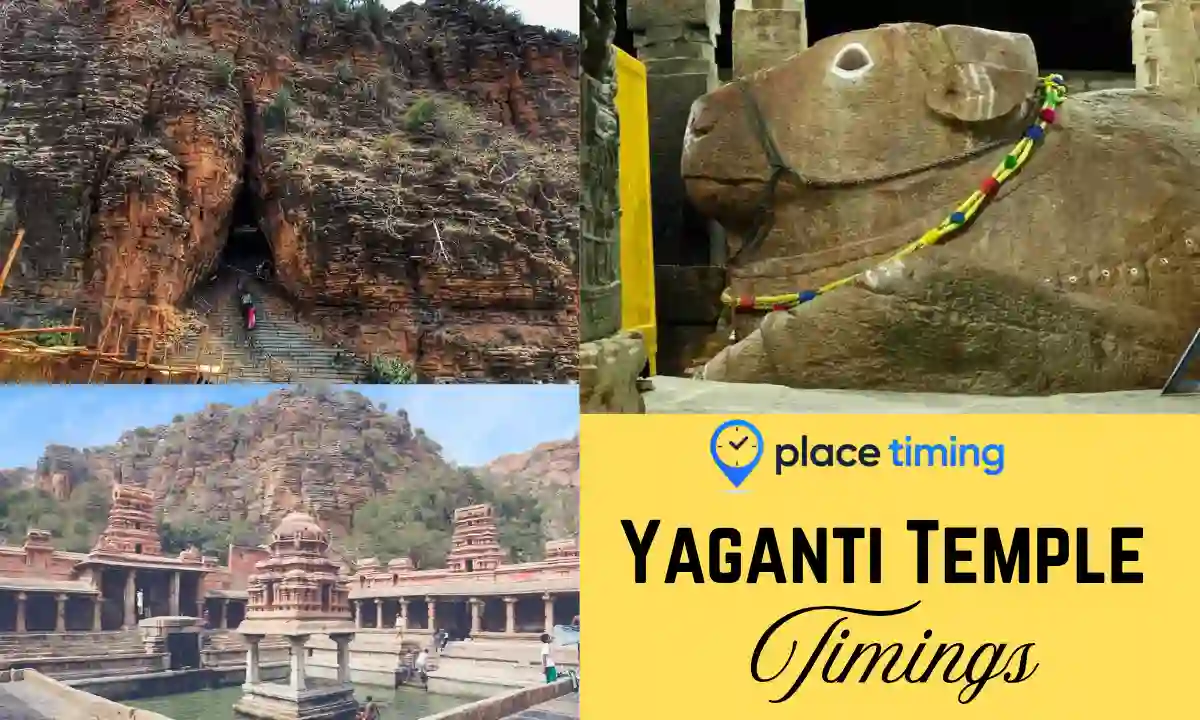
Very few temples exude their mysterious aura more than Yaganti. Set amidst the rugged terrains of Kurnool district, the Uma Maheswara Temple is the destination for a Nandi that is supposed to be growing day-by-day, where crows are not seen to fly at all and where the worship of Shiva and Parvati carved out of a single rock takes place. Before you plan to pay a visit to this temple, it is important to know the yaganti temple timings, as this temple has restricted visiting hours. This article discusses the yaganti temple timings, growing Nandi, crows not flying, caves and ponds, and the route to this location in Andhra Pradesh.
Yaganti Temple at a Glance
Here are the quick facts, with the midday break flagged so it does not catch you out.
| What you want to know | The short answer |
|---|---|
| What are the darshan hours? | 6:00 AM to 1:00 PM and 3:00 PM to 8:00 PM |
| Is there a midday break? | Yes, the temple closes from 1:00 to 3:00 PM |
| What is Yaganti famous for? | The Nandi idol said to be slowly growing |
| Which deity is worshipped? | Shiva and Parvati as Ardhanareeswara, from one stone |
| What is the strange legend? | Crows are believed never to enter Yaganti |
| Where is it? | Near Banaganapalle, Kurnool district, Andhra Pradesh |
| How long to spend? | A couple of hours, more if you climb to the caves |
Darshan Timings and the Midday Pause
Darshan is available from 6:00 AM to 1:00 PM in the morning and from 3:00 PM to 8:00 PM in the evening. What one needs to be careful about is the 1:00 to 3:00 PM gap, as a noon arrival is going to result in a wait for some time. Morning is definitely the most peaceful and cool period, leaving the afternoons free to visit the caves. It is customary here to have a bath in the tank attached to the temple, before proceeding to darshan.
Growing Nandi of Yaganti
Undoubtedly the most discussed curiosity of the temple is the huge stone sculpture of Nandi, the sacred bull facing the deity shrine. According to devotees and visitors, it has been growing slowly through the decades. This is not mere folklore, but has actually been confirmed by the Archaeological Survey of India, which notes that the idol grows slowly, by approximately an inch in 20 years, due to its nature. However, local belief, based on the predictions of sage Potuluri Veera Brahmam, says that it is going to grow until the end of the era, when it will finally awake.
Why Crows Never Come to Yaganti
The other major mystery, in fact, is that of absence, crows allegedly not having ever flown across Yaganti. The origins of this story go back to Sage Agastya who had performed penance at this site. According to legend, the crows used to disturb his concentration, thus Sage Agastya cursed them never to enter into this valley, which being the vahanam (vehicle) of Shani, Shani also allegedly stays away from this place. Visitors always notice how unusually quiet this site is and how there is no trace of the bird usually found everywhere.
The Ardhanareeswara Deity
Unlike most Shiva temples, Yaganti does not contain any Shiva Linga in the garbha griha. Rather, it contains the Uma Maheswara idol that consists of Shiva and Parvati in Ardhanareeswara form sculptured out of a single rock. As per legend, Sage Agastya wanted to install an idol of Venkateswara at this site but was disappointed to see that the nail of the toe of the deity broke. Thus, through his penance, Shiva appeared before him and gave him permission to worship both of them together in this form.
The Caves and the Sacred Tank
Yaganti is as much a hillside of caves and water as it is a temple, and the climb is part of the experience.
| Spot | What it is | Good to know |
|---|---|---|
| Agastya Cave | Where Sage Agastya did penance | Reached by a flight of around 120 steps |
| Venkateswara Cave | Holds an idol of Lord Vishnu | Linked to the broken-toenail legend |
| Veera Brahmam Cave | Where the seer spent time | Named for Potuluri Veera Brahmam |
| Pushkarini tank | The sacred temple tank | Devotees bathe here before darshan |
The tank receives water flowing down from the hill from the mouth of the Nandi carving and is believed to be sacrosanct for bathing before approaching the deity. Ensure that you have appropriate shoes if you intend to trek up the caves, such as the steps leading up to the Agastya cave.
How to Reach Yaganti
Since Yaganti lies off the main highways, it can be accessed by road and is located close to the town of Banaganapalle.
- By Road: Yaganti is near the town of Banaganapalle in the district of Kurnool, 24 km from Allagadda and buses are available from Banaganapalle to Yaganti.
- By Rail: The railheads nearest to Yaganti are Nandyal, located around 55 km away from where there is road connectivity.
- By Air: Hyderabad has the nearest airport; however, Yaganti is quite far via road, hence people use road and rail transport.
- Kurnool, the district headquarters, forms the usual base and is located at a distance of 90 km via road transport.
Best Time to Visit
The chilly and dry season from October to February is the most pleasant for the rocky valley and for the cave trekking which can get really sweaty in the summer. It is Maha Shivaratri that sees the largest gatherings at the temple and creates a special festive mood, so you should be prepared for queues here. If you would like to have a peaceful darshan on any other day, visiting early in the morning right after opening hours would be your best option, followed by spending the afternoon on the caves and returning to the temple after it opens again at 3:00 PM.
Tips for Your Yaganti Visit
- Go in the morning to avoid both heat and 1:00 to 3:00 PM closure.
- Wear strong shoes to climb the Agastya cave.
- Bring some water, because the valley gets hot and there is no shade.
- Spend more time if you want to visit all the caves and tank.
- Come at Maha Shivaratri only if you are ready for large crowds.
Common Mistakes Made by Visitors
- Visiting at 1:00 to 3:00 PM and being disappointed with the closed shrine.
- Thinking about the Shiva Linga, when the deity is the one-stone Ardhanareeswara.
- Missing the caves, which make up half of the interest of Yaganti.
- Climbing to the Agastya cave with flimsy footwear.
- Being unprepared for the road distance from Kurnool/Hyderabad.
Final Take: Yaganti Temple Timings
The Yaganti temple opens from 6:00 AM to 1:00 PM and from 3:00 PM to 8:00 PM, so visiting in the morning and spending the afternoon on the caves fits perfectly well with those hours. However, the timings of the shrine are only the practical side of the place which has much more to offer, such as the Nandi which is scientifically proven to grow steadily, the valley where crows allegedly never appear, the worship of Shiva and Parvati from one stone, and the caves which used to be a meditation spot for ancient sages.
Frequently Asked Questions
What are the Yaganti temple timings?
The temple is open for darshan from 6:00 AM to 1:00 PM and again from 3:00 PM to 8:00 PM. It closes for a midday break between 1:00 and 3:00 PM.
Is the Yaganti Nandi really growing?
The Archaeological Survey of India has recorded that the stone Nandi grows very slowly, about an inch every twenty years, attributed to the type of rock. Local belief holds it will come alive at the end of the age.
Why are there no crows at Yaganti?
Legend says Sage Agastya, disturbed during his penance, cursed the crows never to enter Yaganti. As the crow is Shani’s vehicle, Shani too is said to stay away.
Which deity is worshipped at Yaganti?
The main deity is Uma Maheswara, Shiva and Parvati together as Ardhanareeswara, carved from a single stone. There is no Shiva Linga in the sanctum.
What caves are there at Yaganti?
The hillside has the Agastya Cave, reached by about 120 steps, the Venkateswara Cave with a Vishnu idol, and the Veera Brahmam Cave, along with the sacred Pushkarini tank.
How do I reach Yaganti?
It is near Banaganapalle in Kurnool district, with Allagadda about 24 km away and Nandyal the nearer railhead at around 55 km. Most visitors come by road, often from Kurnool.
What is the best time to visit Yaganti?
The cooler months from October to February are most comfortable, and early morning is best for a calm darshan. Maha Shivaratri is the grandest but most crowded time.
How much time do I need at Yaganti?
About two hours for the temple, and longer if you climb to the caves and spend time at the tank, so half a day is ideal.
Also read: Post Office Timings, Kailasagiri Timings, 1930 Vasco Show Timings, RRB Group D Shift Timings, Jhandewalan Mandir Timings



Leave a Reply