
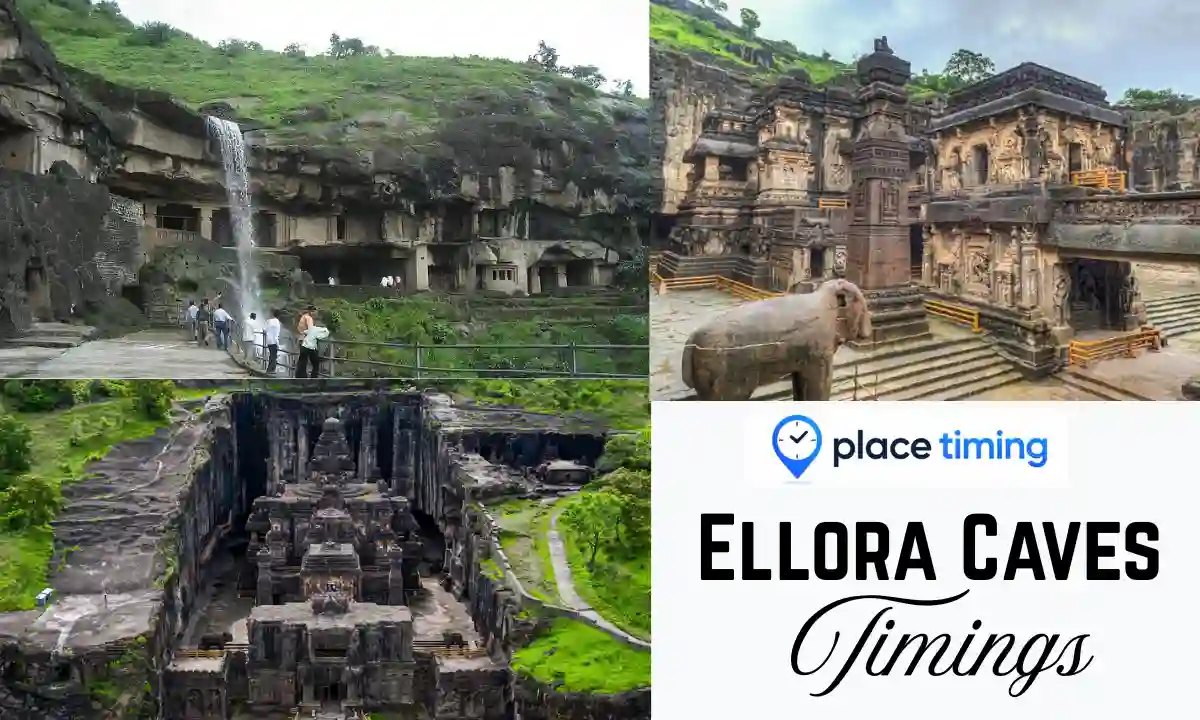
Ellora Caves, a UNESCO heritage site, located near Aurangabad, are 34 caves belonging to three religions, highlighted by the Kailasa Temple, the world’s largest temple carved out of a single stone. There is one basic rule while visiting Ellora: Ellora is open Tuesday through Sunday only, and, if you are planning to visit Ajanta too, it is open Monday through Sunday. You need to know your dates, or you will be knocking at a closed door. It opens early morning until evening, entrance is inexpensive for Indians, and the Kailasa Cave alone needs an hour of yours. This guide covers the timings, the fee, the caves, and everything else.
Ellora Caves Timings: The Short Version
Here is the core of it. Ellora Caves timings are from 6:00 AM to 6:00 PM, entry is by 5:00 PM, and the place is closed on Tuesdays. Ticket cost is Rs. 40 for Indians and SAARC nationals and Rs. 600 for foreigners. Entry is free for kids under 15 years old. It is a UNESCO site located in Aurangabad in Maharashtra and has a structure like the one below. Some sources cite 9:00 AM to 5:30 PM, so verify on the on-site notice board.
| Detail | At a glance |
|---|---|
| Open | About 6:00 AM to 6:00 PM (some list 9:00 AM to 5:30 PM) |
| Last entry | Around 5:00 PM |
| Weekly off | Closed on Tuesdays |
| Entry, Indians and SAARC | Rs 40 per person |
| Entry, foreign tourists | Rs 600; children under 15 free |
| The star | The Kailasa Temple, Cave 16 |
| Location | Verul, about 30 km from Aurangabad, Maharashtra |
Opening Hours and the Closed-Tuesday Rule
The one thing that you must remember is that the monument of Ellora is shut down every Tuesday throughout the year, and thus, must never be scheduled on any Tuesday. On the other days, it remains open throughout the day.
Some variations can be seen in the reported timings. Most people report the opening time as 6:00 AM to 6:00 PM, which is basically from sunrise to sunset, whereas some sources claim it to be 9:00 AM to 5:30 PM, and the cut-off time usually being 5:00 PM. Thus, it should be understood as timings from sunrise to sunset, closed on Tuesdays, with confirmation of the current timings at the on-site notice board or the ASI website.
Entry Fee and Online Booking
Ellora is very affordable for Indian visitors. The figures below are current ASI rates and subject to revision, so confirm before you go.
| Item | Cost |
|---|---|
| Indians and SAARC or BIMSTEC nationals | Rs 40 per person |
| Foreign tourists | Rs 600 per person |
| Children under 15 | Free |
| Video camera | An extra Rs 25 |
| Site shuttle bus | Around Rs 22 between sections |
| Booking | Online via the ASI portal, or QR and UPI at the gate |
The temple of Kailasa is covered under the single ticket. Personal cameras and mobiles are permitted, but for a video camera, a nominal additional fee needs to be paid. Bookings online through ASI’s ticket portal are advised on weekends and during the peak season from December to February. Payment via QR and UPI is possible at the entrance gate itself.
The 34 Caves: Buddhist, Hindu and Jain
Ellora’s wonder is that its 34 caves span three religions, carved side by side over nearly four centuries, a rare display of religious coexistence in stone. They fall into three groups.
| Group | Caves | Known for |
|---|---|---|
| Buddhist | Caves 1 to 12 | Monasteries and prayer halls, including Cave 10, the Vishvakarma or Carpenter’s Cave, and the three-storey Cave 12 |
| Hindu | Caves 13 to 29 | The grand Kailasa Temple, Cave 16, and Cave 29, Dhumar Lena |
| Jain | Caves 30 to 34 | Elegant, finely carved shrines, including Cave 32, the Indra Sabha |
Therefore, the best visit should include the Kailasa temple, a selection from the Buddhist caves including caves 10 to 12, and the Jain caves 30 to 34, instead of visiting all numbered caves, which can be tiring. Visiting only the highlights of each type would result in a complete tour within the allotted period of time.
The Kailasa Temple: Cave 16
And this is its masterpiece and one of the greatest architectural wonders in the world. The Kailasa Temple, Cave 16, is the largest structure cut out of monolithic rock in the whole world. It is a fully-fledged temple to Lord Shiva carved out of a huge basaltic rock mass, standing freely from the top to bottom.
- It was cut by digging out hundreds of tons of rocks, working from top to bottom without any way to reverse a mistake made.
- It has twice the floor area of the Parthenon in Athens, rising through many levels, but it has been created out of a single rock.
- It is embellished with huge gateways, life-sized elephant and lion statues, and elaborate friezes depicting gods and epics.
- Stood inside its enormous courtyard, it looks like a free-standing temple, even though it is actually a single piece of the mountain.
Allocate the Kailasa Temple at least an hour of your time, preferably early in the morning, when the first sunlight illuminates its sculptures and the courtyard is still empty.
Ajanta or Ellora: The Day-Planning Rule
Because of the fact that so many tourists do both, this becomes the most practical information and causes problems to more tourists than the actual roads do. The Ajanta and Ellora Caves are distinct sites, with 100 km distance between each other, opposite directions to Aurangabad.
| Aspect | Ellora | Ajanta |
|---|---|---|
| Closed day | Tuesday | Monday |
| Known for | Rock-cut sculpture, three faiths, Kailasa Temple | Ancient Buddhist paintings and frescoes |
| Age | 6th to 10th centuries CE | 2nd century BCE to 6th century CE, older |
| From Aurangabad | About 30 km | About 100 km |
So the honest picture is this. Ellora has monumental sculptures in Buddhist, Hindu, and Jain temples, including Kailasanatha Temple, whereas Ajanta is an earlier site known for paintings. The basic principle when visiting both sites is straightforward – always avoid Ellora on a Tuesday and Ajanta on Monday, as both sites are accessible from Wednesday to Sunday inclusive. Schedule your visit around those closed days, and you won’t end up driving three hours to find the doors locked.
Best Time to Visit
- From October to March: the comfortable and cool winter period, which is perfect for exploring the 34 caves on foot.
- Early morning, right after opening: the Kailasa Temple can be admired in its beauty and photographed with little crowd interference.
- Monsoon, August to September: when the waterfalls flow down the caves, it makes them magical to see, if one manages to avoid the pouring rain.
- Summer should be avoided: the floor of the cave becomes burning hot.
To enjoy all the aspects of comfort and aesthetics, you need to visit during winter mornings, but for a special treat, you can witness the monsoon waterfalls.
How Long to Spend and How to See It
Ellora is a big place; therefore, one should consider time management when visiting Ellora. One will spend two to three hours for a brief visit to the Kailasa temple alone. Four to five hours will be needed for a full visit including Kailasa and a mix of Buddhist and Jain caves.
- Go right away to the Kailasa temple, Cave 16, and spend an hour there.
- Next, look at the Buddhist series of Caves 10 to 12 and Jain series of Caves 30 to 34.
- In the hot season, use the site’s shuttle bus between sections to conserve energy.
- Avoid visiting every numbered cave because it is exhausting; one should focus on the best features of each group of caves.
One realistic plan involving highlights and not all caves will give one enough time and energy to admire the best of each, especially Kailasa Temple.
Pros and Cons: An Honest Assessment
Weighing both sides helps you plan.
The pros:
- UNESCO World Heritage Site featuring 34 caves of 3 religions.
- The Kailasa Temple – Largest rock cut monolith in the world.
- Inexpensive entrance for Indian tourists, with entry fee waived for kids.
- Just 30 km away from Aurangabad, it is easily accessible and can be combined with other attractions.
- Monsoon waterfalls and lovely mornings during winter season.
The cons:
- Closed on Tuesdays – something that can easily fool visitors.
- Closing times differ in reports so they have to be verified.
- The park is huge and requires lots of walking, tiring one in the process.
- Crowded on weekends and during the peak season.
- Visitors get exhausted while trying to see all the caves.
Common Mistakes to Avoid
- Visiting on Tuesday when Ellora is closed or visiting Ajanta on a Monday.
- Coming when the summer sun is scorching hot in mid-day.
- Covering all 34 caves when only the best caves need to be covered.
- Coming unprepared to explore the Kailasa temple which needs at least one hour.
- Coming without drinking water, wearing a cap, wearing comfortable shoes, and a flashlight for dark caves.
- Booking tickets online during the weekend and peak season period.
Is It Worth Visiting? Who It Suits
Indeed, Ellora is a place you simply cannot miss, and it’s perfect for almost everybody.
- A must for: History, architecture, art lovers; a top-notch heritage site in the world.
- Fantastic for: Photographers, because of Kailasa Temple and carvings, especially early in the morning.
- Perfect for: Those who are religious as well as devotees of Buddhism, Hinduism, and Jainism together.
- Absolutely perfect for: Those who combine Ellora with Grishneshwar, Daulatabad, and Ajanta.
If you are visiting Maharashtra for the first time, your morning visit to Ellora, above all to the Kailasa Temple, will be unforgettable.
Accessibility, Facilities and What to Carry
- There is a shuttle bus service for transportation among the cave sites that would be useful in the hot weather and the distance covered.
- There is an ASI museum that is close to the site and could be visited for scale models and history.
- Some parts of the caves have stairs, and therefore mobility might be a challenge for some people.
- It is advisable to have water, sunhat, sunscreen, shoes, and a flashlight for the dark caves.
- Have cash and an ID for the tickets and parking.
A Bit of History: Three Faiths in Stone
The Ellora Caves were created from around the 6th to 10th century AD, at the Verul site, by several dynasties who favoured varying religions. As opposed to structures which are constructed piece by piece, the caves were sculpted out of the basalt rock cliffs using the top down approach where they chip away at the stone to create halls, columns, and statues.
The uniqueness of Ellora is that the three religions –Buddhist, Hindu, and Jain caves, stand side by side in this one place for four centuries in perfect harmony. The Kailasa temple, which was created during the reign of the Rashtrakuta dynasty, was a masterpiece and the entire complex is a pinnacle in Indian rock cut architecture.
How to Reach Ellora Caves
Ellora is at Verul, about 30 km from Aurangabad, now Chhatrapati Sambhajinagar, and easy to reach.
| Mode | Details and distance |
|---|---|
| By road | About 30 km from Aurangabad, roughly 45 to 60 minutes by cab, with buses, shared jeeps, and autos too. |
| By train | Aurangabad railway station is the nearest convenient railhead, with road onward. |
| By air | Aurangabad, Chhatrapati Sambhajinagar, airport is the nearest, with Mumbai flights about an hour. |
| From Mumbai | About 5.5 to 6 hours by road via the Samruddhi Mahamarg expressway. |
Most visitors reach from Aurangabad by cab, bus, or a combined day tour, and self-drive is easy on the well-marked Ellora Cave Road, with parking near the entrance.
Nearby Attractions: What to Combine With Your Visit
- Grishneshwar Jyotirlinga: One of the 12 Jyotirlingas of Shiva, located just a kilometer away from the entrance of Ellora.
- Daulatabad Fort: The magnificent 14th century hill fort with its black tunnel, situated some 13 km away.
- Bibi Ka Maqbara: The Taj-like structure located at Aurangabad, on the way back.
- Ajanta Caves: The famous painted Buddhist caves, located some 100 km away from here.
A traditional one-day heritage tour includes Ellora with Grishneshwar and Daulatabad Fort, whereas a two-day tour includes Ajanta also.
Trivia and Lesser-Known Facts: Ellora Caves
- Ellora has 34 caves belonging to Buddhism, Hinduism, and Jainism, built one beside another.
- Kailasa Temple is the largest monolith rock-cut monument in the world.
- This structure was carved from top to bottom from one basalt rock, leaving no margin of error at all.
- Ellora remains closed on Tuesdays, but Ajanta remains closed on Mondays.
- During monsoons, water falls down the caves.
- Grishneshwar, one of the twelve Jyotirlingas, lies only about a kilometre away from the entrance.
Quick Tips: Making Your Ellora Caves Timings Work
- Never plan to visit on a Tuesday, when Ellora is closed, or Ajanta on a Monday.
- Time your visit to come early at the opening time for the Kailasa Temple with not too many people.
- Time yourself for 4-5 hours, and concentrate on Kailasa as well as a Buddhist and Jain tour.
- Bring water, hat, footwear, a flashlight, cash, and ID cards.
- Visit both online for weekends and peak time to avoid long queues.
- Visit along with Grishneshwar and Daulatabad as well, and plan your trip during the monsoon for waterfalls.
Final Take: Planning Your Ellora Caves Visit
Timings at Ellora Caves are from 6:00 AM to 6:00 PM, that is from sunrise to sunset, with the last entry being possible by 5:00 PM, while the site remains closed on Tuesdays, so make sure not to visit this site on Tuesdays, and if you are visiting the Ajanta Caves too, then note that they are closed on Mondays. The entry fee is just Rs 40 for Indian citizens and SAARC nationals and Rs 600 for foreigners and free of cost for kids below 15 years of age.
First, visit the Kailasa Temple, Cave 16, which is considered the largest structure carved out of one rock in the world, spending about an hour, preferably during the early mornings when the sunlight falls, and then explore the Buddhist and Jain caves, allocating around four to five hours. It is best visited during the winter season or the monsoons to witness the waterfalls. Ensure you carry water and comfortable footwear. You can make your reservations online for peak times. The visit to Ellora can be made along with that of Grishneshwar Jyotirlinga and Daulatabad Fort.
Frequently Asked Questions
What are the Ellora Caves timings?
Ellora is open from about 6:00 AM to 6:00 PM, from sunrise to sunset, with 5:00 PM being the time when people stop entering. It remains closed on Tuesdays. Some websites mention the timings from 9:00 AM to 5:30 PM; therefore, it is recommended to confirm your schedule from the on-site notice board.
Which day are the Ellora Caves closed?
The Ellora caves are always closed on Tuesdays and remain open from Wednesday to Monday every year. Remember that Ajanta Caves, which are located nearby, remain closed on Mondays, thus for visiting both the caves, it would be better to keep in mind both days.
What is the entry fee for Ellora Caves?
Entry is Rs 40 for Indian and SAARC nationals and Rs 600 for foreign tourists, with children under 15 free. A video camera costs an extra Rs 25, and the Kailasa Temple is included in the ticket. Book online via the ASI portal for weekends and peak season, or pay by QR or UPI at the gate. Carry ID.
What is the Kailasa Temple at Ellora?
The Kailasa Temple, Cave 16, is the largest monolithic rock-cut structure in the world, a full free-standing Shiva temple carved from a single basalt rock from the top down. It covers about twice the area of the Parthenon, adorned with elephants, lions, and epic friezes, and is Ellora’s crowning achievement. Give it at least an hour.
How long does it take to visit Ellora Caves?
A short visit focusing on the Kailasa Temple takes about two to three hours, while a complete visit covering Kailasa plus a balanced Buddhist and Jain loop needs about four to five hours. Ellora is large, so focus on the highlights of each group rather than every numbered cave.
What is the best time to visit Ellora Caves?
October to March is the pleasant winter season, best for walking the caves, and early morning is ideal for the Kailasa Temple in soft light with few crowds. The monsoon, August to September, brings stunning waterfalls over the caves. Avoid the scorching summer midday, and never visit on a Tuesday.
How do I reach the Ellora Caves?
Ellora is at Verul, about 30 km from Aurangabad, now Chhatrapati Sambhajinagar, roughly 45 to 60 minutes by cab, with buses, shared jeeps, and autos too. Aurangabad has the nearest railway station and airport, and Mumbai is about 5.5 to 6 hours by road via the Samruddhi Mahamarg expressway.
What is near the Ellora Caves?
Grishneshwar Jyotirlinga, one of the twelve Jyotirlingas of Shiva, is barely a kilometre from Ellora’s gate. Daulatabad Fort is about 13 km away, Bibi Ka Maqbara is in Aurangabad, and the Ajanta Caves are about 100 km away, making a rich Aurangabad heritage circuit.
Also read about: Kanchi Kamakshi Temple Timings: Darshan and Full Guide





Leave a Reply