
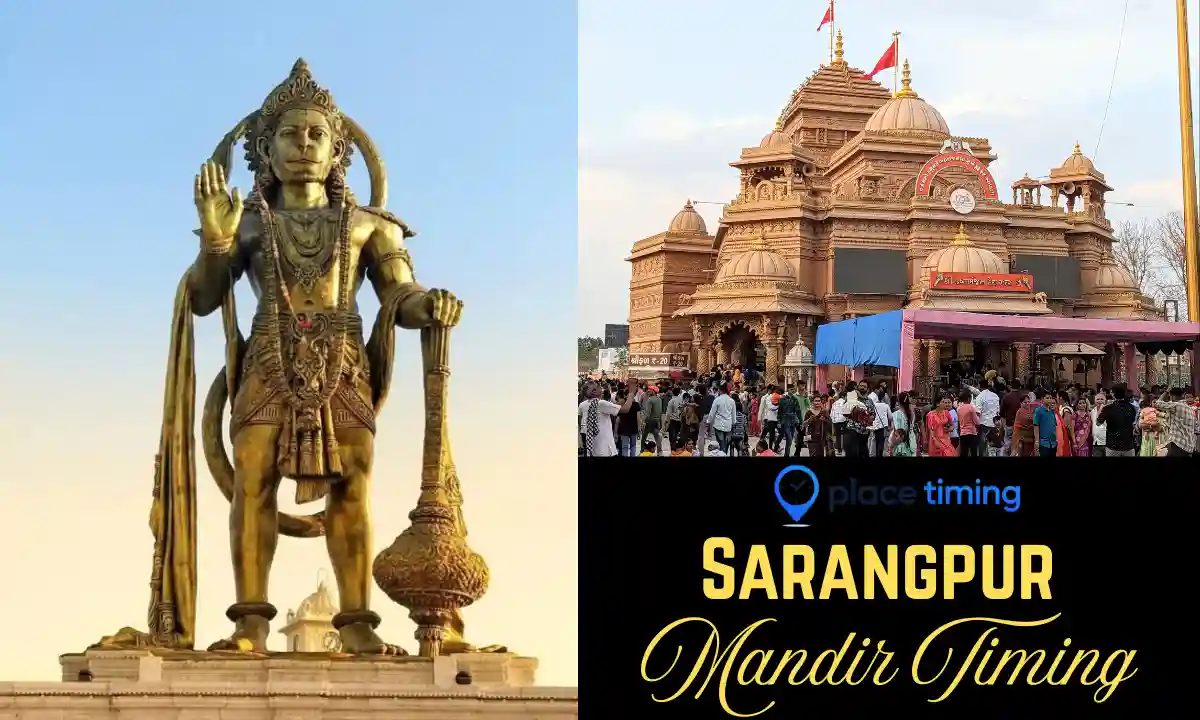
The Shree Kashtabhanjan Dev Hanumanji Temple, situated in Sarangpur or Salangpur, is not a generic Hanuman temple but the one that people in Gujarat flock to with a burden on their minds and hope to have it removed from their lives, be it through getting rid of sickness or Shani dosh. The temple opens early to conduct Mangala Aarti and then holds a morning and evening session, with a break during lunchtime, and everything, including darshan, food, and lodging, comes free. Tuesdays and Saturdays are the two most effective days at the temple. This guide covers the timings, the aarti schedule, what makes it special, and everything else.
Sarangpur Mandir Timing: The Short Version
Here is the core of it. Sarangpur mandir timing is usually between 5:30 AM to 6:00 AM till noon, followed by another time slot in the evening till 9:00 PM. The following schedule is applicable at this Kashtabhanjan Dev Hanuman mandir in Botad district of Gujarat. Note that the timings can be different on other days, especially during religious festivals.
| Detail | At a glance |
|---|---|
| Opens | Around 5:30 to 6:00 AM, for the Mangala Aarti |
| Morning session | Until about 12:00 to 2:00 PM |
| Evening session | From about 3:30 to 4:00 PM until about 9:00 PM |
| Darshan | Free, all devotees and faiths welcome |
| Free meals | At the Annakshetra, about 1:00 PM to 3:00 PM |
| Most auspicious days | Tuesday and Saturday |
| Location | Salangpur, Barwala taluka, Botad district, Gujarat |
Opening Hours and the Midday Break
Temple opens early at about half past five to six o’clock for the Mangala Aarti, and operates in two shifts – morning and evening with a lunch break in between. The exact timing of temple activities varies from source to source, as one can see it operating in morning till noon while other sources mention morning till two, and in the evening from half past three to four till nine. In any case, the pattern is similar, which is starting early, long morning session, a lunch break when the god sleeps and gets his food offerings, and evening session ends at nine. Since the exact timing varies, do check on the official website of the temple before taking a long journey. At least be sure that you should start your visit early as mornings are most powerful and peaceful.
Aarti Schedule: The Rhythm of the Day
The aartis are the heart of a Sarangpur visit, and the temple performs several through the day. Times are approximate and can vary, so treat this as a guide and confirm on the day.
| Aarti or ritual | Approximate time | Note |
|---|---|---|
| Mangala Aarti | Around 5:30 to 6:00 AM | The most powerful moment to be present |
| Bal Bhog (darshan closed) | Around 6:30 to 7:30 AM | A short offering break |
| Shangar Aarti | Around 7:00 AM | Especially on Tuesday and Saturday |
| Rajbhog Thal | Around midday | The midday food offering |
| Sandhya Aarti | In the evening | The evening prayer, closing the day |
Early morning Mangala Aarti is considered one of the most spiritually charged moments that people get a chance to see where the lamps are lit, the priests sing their chants, and the temple gets a calm and peaceful atmosphere. Arranging one’s schedule to see this phenomenon is the best way to enjoy Sarangpur.
Free Darshan, Meals and Accommodation
The first thing that comes to mind about Sarangpur is the plethora of free things in the Swaminarayan style of serving.
- Darshan is entirely free of cost without the need for tickets and open to everyone from all faiths.
- Free lunch is available for all at the Annakshetra, also known as Bhojanalay, generally between 1:00 PM to 3:00 PM.
- Accommodation can be availed by pilgrims; it is best to book two days in advance using the temple booking number.
- General queries and room bookings are done by the temple trust, with details available on the official website.
Thus, the visit to the temple does not cost anything for the darshan and the food, and accommodation is affordable and well-organised, which is important for a temple that receives millions of pilgrims annually. Carry cash only for any personal offerings or travel.
Kashtabhanjan Dev: Why This Hanuman Is Different
This is the uniqueness of Sarangpur and needs to be known well. While most temples of Hanuman offer prayers to the Lord in one of the famous forms as the warrior with the mountain, the devotee along with Ram and Sita, or the standing protector, worshipped for strength and protection or blessings in general, Sarangpur is different.
In this temple, the deity is called Kashtabhanjan Dev, which is a specific title referring to the destroyer of difficulties, where ‘kashta’ means sorrow or difficulty and ‘bhanjan’ is remover. The idea here is that Hanuman at Salangpur removes the three types of sorrow – adhi, mental distress; vyadhi, physical illness; and upadhi, the worldly as well as spiritual obstructions. Hence the devotees visit the place with problems, illnesses that have not been cured by treatment, family problems that cannot be sorted out, mental distress of some unknown reasons, liberation from Shani dosha, the trouble of Saturn, and from any other negative forces.
The Idol and the Legend
The idol of Kashtabhanjan Dev was installed by Sadguru Gopalanand Swami, who was one of the main disciples of Bhagwan Swaminarayan, and the temple falls under the Vadtal Gadi of the Swaminarayan Sampraday, which ensures that the temple remains well preserved and organized through the generations.
It is said that when Gopalanand Swami touched the idol, the idol shifted on its own accord, which was considered to be proof of the living presence of Hanuman within the stone idol. The idol is shown as a strong and magnificent form of Hanuman who is stepping on the demoness Shani or Panoti, representing the Lord conquering his sufferings.
The 54-Foot King of Sarangpur Statue
Apart from the main temple, the site now has an enormous 54-foot tall statue of Lord Hanuman referred to as the King of Sarangpur, which is one of the most photographed statues of Hanuman in Gujarat.
The huge idol, which can be seen from afar while approaching the village, is now a landmark in itself and a great photo opportunity. Allow some time to visit the monument and appreciate its height, particularly during the milder hours of the day.
Best Time to Visit and the Crowd Strategy
It makes all the difference in the world, considering the number of people who show up on the lucky days.
- Tuesday and Saturdays: Most auspicious days of Hanuman and most powerful days to visit, but most crowded too; hence, try to be there between 5:30 am and 6:00 am.
- Morning of any weekday except Tuesday: From 6:00 am to 7:30 am in the morning on a weekday is when Sarangpur is most serene and you can get through in about 20 to 30 minutes.
- For Mangala Aarti: Be there before six if you want to witness the dawn Aarti, which is the most enchanting experience.
- A Saturday visit takes two to four hours because the queue grows fast from 7:30 am onwards.
October to February marks the pleasant season. For the power-packed experience, then visit early on a Tuesday or Saturday morning and prepare yourself for the crowds; and for a serene darshan, early on any other weekday morning.
Recent Developments: A Growing Pilgrim Site
The town of Sarangpur is in the news and rapidly growing; this is something to keep in mind while making plans. In early 2026, the Ambanis visited the temple and announced that a huge donation has been made to the temple trust, which will be spent on improving facilities at the pilgrimage site, such as accommodation.
The temple trust has been preparing for an online system of darshan and room booking at this pilgrimage site, to come up soon at the official site, and thus it is recommended that one should check the salangpurhanumanji.org website.
Sarangpur vs Other Hanuman Temples
Since Sarangpur has a specific reputation, it helps to see how it compares with other famous Hanuman temples.
| Temple | Where | Known for |
|---|---|---|
| Sarangpur Kashtabhanjan Dev | Botad, Gujarat | Relief from affliction, Shani dosha, and negative energies |
| Mehandipur Balaji | Rajasthan | Also famous for relief from negative energies |
| Hanuman Garhi | Ayodhya | A revered hilltop Hanuman temple |
| Sankat Mochan | Varanasi | The remover of troubles, founded by Tulsidas |
Thus, the truth is this. Mehandipur Balaji Temple in Rajasthan is another well-known temple where the negative energy is removed. Hanuman Garhi and Sankat Mochan are the other two very popular devotional Hanuman temples, whereas Sarangpur’s uniqueness lies in the Kashtabhanjan avatar of Hanuman who removes the three sufferings, under the systematic and cost-free administration of Swaminarayan organization. For people in Gujarat, it is the most prominent Hanuman temple.
Pros and Cons: An Honest Assessment
Weighing both sides helps you plan.
The pros:
- An extraordinary Hanuman temple which provides solace from suffering and misfortune.
- Free darshan, free food, and inexpensive lodging.
- Efficiently organized and managed by Swaminarayan Sampraday.
- The colossal 54 feet high King of Sarangpur statue.
- Moving Mangala Aarti and peaceful morning ambiance.
The cons:
- Very busy on Tuesdays, Saturdays, and during festivals.
- The timings are flexible and depend upon the festivals, hence require verification.
- The lunchtime break will surprise people who reach at the wrong time.
- It is a little distant, around three hours from Ahmedabad.
- The queues form very quickly after the early morning.
Common Mistakes to Avoid
- Coming during the break period in the afternoon and not in the morning or evening hours.
- Coming on Tuesday or Saturday but not arriving before 5:30 to 6:00 AM.
- Missing the morning Mangala Aarti, which is the most effective time to come.
- Not checking out the latest timings since they keep changing during festivals.
- Not reserving rooms in advance if one intends to stay for a couple of days.
- Underestimating the Saturday queues that form quite quickly from 7:30 AM.
Is It Worth Visiting? Who It Suits
Yes, Sarangpur is definitely worth it, particularly for some.
- Absolutely necessary for: devotees of Hanuman as well as those looking for healing from diseases, troubles, Shani Dosha, or evil spirits.
- Perfect for: pilgrims who wish to have an organized and free visit to the temple.
- Exhilarating for: people who come early in the morning for the Mangala Aarti and the peace.
- Rewarding for: tourists visiting Gujarat’s temples as well as photographers attracted by the big statue.
For a particular devotee carrying a certain load, or any other Gujarat pilgrim, Sarangpur is one of the most powerful and welcoming Hanuman temples in India, particularly early in the morning on weekdays.
Dress Code, Rules and What to Carry
- Dress modestly and traditionally, as is appropriate for the temple.
- Take off your shoes before entering the temple and adhere to the queue and conduct code there.
- Take along water and other necessities, and come on time on the special days.
- Make reservations for your stay in advance from the temple.
- Maintain cleanliness in the temple, and behave respectfully during aartis.
- Visit the official website before making online reservations and for current timings.
Festivals: When Sarangpur Comes Alive
- Hanuman Jayanti: Birth day of the Lord, the most important occasion at the temple with many people visiting the temple.
- Kali Chaudas, during Diwali: a very important period for worshipping Hanuman at the temple.
- Tuesday and Saturday throughout the year: Most important days of the week with many devotees visiting the temple.
These are the busiest days at the temple and the village, so please plan the timings accordingly.
How Long to Spend and How to Reach
One can get a darshan in about an hour’s time during a calm and quiet weekday morning. But the pilgrims remain there for much more time for the aarti and the free meals. This takes around half a day or two to four hours on Saturdays just in the queue. The temple is located at Salangpur in Barwala taluka of Botad district.
| Mode | Details and distance |
|---|---|
| From Ahmedabad | About 150 km, roughly 3 hours by road, by car, taxi, or bus. |
| From Bhavnagar and Rajkot | Bhavnagar about 80 km, Rajkot about 150 km by road. |
| By train | Botad and Ahmedabad are the useful railheads, with road onward. |
| By air | Ahmedabad airport is the nearest major airport, with a road journey onward. |
Most pilgrims reach via Ahmedabad or Bhavnagar, then by road to Salangpur, with GSRTC buses and taxis serving the temple. A car gives the most flexibility for the rural route.
Nearby Places to Combine With Your Visit
- Velavadar Blackbuck National Park: The Grassland National Park known for blackbucks, accessible to nature enthusiasts.
- Bhavnagar: The city containing Takhteshwar Temple and Gaurishankar Lake.
- Virpur (Jalaram Temple): The sacred Jalaram Bapa Temple, a favored Gujarat pilgrim destination, in the greater area.
- Lothal: The historic site of the Indus Valley civilization, for people who like history.
A typical itinerary would involve visiting Sarangpur with Velavadar or Bhavnagar, or incorporating it in a larger Gujarat temple tour circuit.
Trivia and Lesser-Known Facts: Sarangpur
- The god here is Kashtabhanjan Dev, destroyer of sufferings, an exception amongst Hanuman incarnations.
- This deity image is depicted as crushing the foot of Shani or Panoti, conquering suffering.
- This temple is dedicated by Sadguru Gopalanand Swami and falls under Vadtal Gadi.
- There is a 54 feet statue of King of Sarangpur Hanuman at this temple site, a popular icon in Gujarat.
- Darshan, food, and lodging facilities are provided free to all devotees.
- It is one of the most visited temples of Gujarat, attracting millions of pilgrims annually.
Quick Tips: Making Your Sarangpur Mandir Timing Work
- Get there early between 5:30 to 6:00 AM, especially on Tuesday and Saturday.
- Get there for the morning Mangala Aarti that is the most powerful time.
- Stay away from the lunch time gap and check the latest timings at their official website.
- To get an undisturbed darshan quickly, arrive early on a weekday but not Tuesday.
- Take advantage of the free Annakshetra meal and reserve your place beforehand if you are staying.
- Do not forget to see the 54 feet statue of the King of Sarangpur.
Final Take: Planning Your Sarangpur Visit
The Sarangpur mandir timing is from 5:30 to 6:00 AM until noon and then from the afternoon till around 9:00 PM, with some break in the middle, and the darshan, food, and lodging are all free of cost. The reported timings may vary and are dependent upon festivals, so better to check on the official website, and be there at least one hour prior to your preferred time, and ideally as early as for the morning Mangala Aarti which is the most powerful period of time.
It is unique because of its Kashtabhanjan Dev incarnation of Hanuman, the one who destroys the three afflictions of the mind, body, and spirit. People visit this temple seeking relief from sickness, Shani dosha, and negative energy and see this Hanuman trampling on the afflictions under his feet. Visit the 54-foot King of Sarangpur statue, have a free Annakshetra meal, dress decently, and visit the official website to make use of the online booking facility that is currently being implemented. About three hours away from Ahmedabad, this is one of India’s most powerful and friendly Hanuman temples.
Frequently Asked Questions
What is the Sarangpur mandir timing?
The temple is commonly open from about 5:30 to 6:00 AM until midday, and again from about 3:30 to 4:00 PM until 9:00 PM, with a midday break, and darshan is free. Reported hours vary across sources and change on festivals, so confirm on the official site. The Mangala Aarti is around 5:30 to 6:00 AM.
What are the aarti timings at Sarangpur Hanuman temple?
The Mangala Aarti is around 5:30 to 6:00 AM, the most powerful moment, followed by a Bal Bhog break, the Shangar Aarti around 7:00 AM especially on Tuesday and Saturday, the midday Rajbhog Thal, and the evening Sandhya Aarti. Times are approximate and can vary, so confirm on the day.
Is darshan free at Sarangpur temple?
Yes, darshan is completely free, with no ticket, and all devotees and faiths are welcome. Free meals are served daily at the Annakshetra, around 1:00 PM to 3:00 PM, and accommodation is available for pilgrims, best booked a couple of days ahead through the temple, in the Swaminarayan tradition of service.
Why is Sarangpur Hanuman temple so famous?
It is famous because the deity, Kashtabhanjan Dev, is believed to remove the three kinds of affliction, mental, physical, and worldly, and to give relief from Shani dosha and negative energies. Unlike general Hanuman temples, people come here with specific burdens they want lifted, which is its unique reputation.
Which days are best to visit Sarangpur temple?
Tuesday and Saturday are Hanuman’s most auspicious days and the most powerful to visit, but the most crowded, so arrive by about 5:30 to 6:00 AM. For a calmer, quicker darshan, an early weekday morning other than Tuesday, in the 6:00 to 7:30 AM window, is ideal, when queues move in 20 to 30 minutes.
What is the 54-foot statue at Sarangpur?
The complex features a 54-foot statue of Lord Hanuman, known as the King of Sarangpur, one of the most photographed Hanuman statues in Gujarat. Visible from a distance as you approach the village, it has become a landmark and a favourite for photographs, adding a modern draw to the ancient temple.
How do I reach Sarangpur Hanuman temple?
The temple is at Salangpur, in Barwala taluka of Botad district, Gujarat, about 150 km, roughly 3 hours, from Ahmedabad, and about 80 km from Bhavnagar. Botad and Ahmedabad are the useful railheads, Ahmedabad the nearest major airport, and GSRTC buses and taxis serve the temple by road.
Can I book Sarangpur darshan or rooms online?
The temple trust has been rolling out an online darshan and room booking system, expected on the official site, salangpurhanumanji.org, so check there for the latest. Accommodation can also be booked through the temple’s booking number, ideally a couple of days ahead. Darshan itself is free and needs no ticket.
Also read about: Lalbagh Botanical Garden Timings: Entry Fee, Glass House and Full Guide




Leave a Reply