
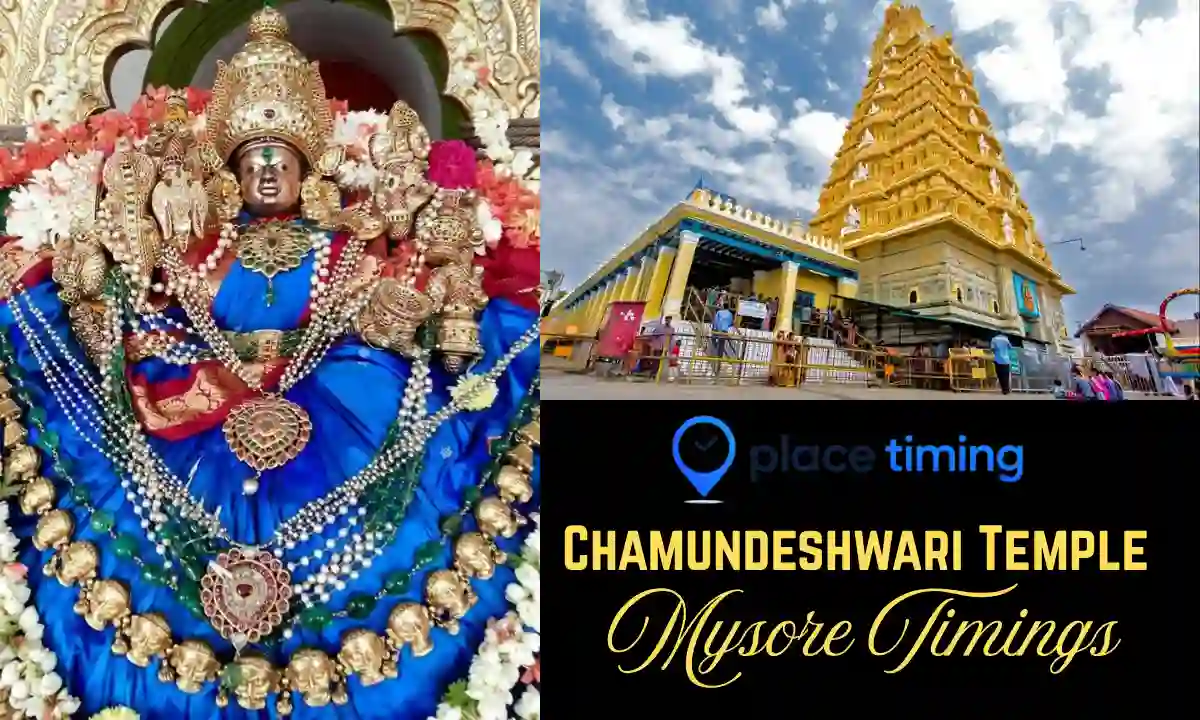
Chamundeshwari Temple is located at the top of Chamundi Hills, 13 km above Mysuru, and is not only an important Shakti Peeth but also the shrine of the Goddess who killed Mahishasura and has been the protective Goddess of the Mysore royal family for ages. The darshan happens in three batches during the day, with two intervals, so timing is important, and one can go to the top of the hills either via the famous 1,008 stairs or the ghat road. This guide covers the darshan timings, the abhishekam, the prices, the steps, and everything else for a smooth visit.
Chamundeshwari Temple Mysore Timings: The Short Version
Here is the core of it. Chamundeshwari temple Mysore Timings are in three parts with a break between each,7:30 AM to 2:00 PM, 3:30 PM to 6:00PM and early morning from 7-9 p.m for the evening darshan is free. About 13 km from Mysuru this temple on a hilltop follows the model below. Dasara and festivals have different timings, always confirmed on the official site.
| Detail | At a glance |
|---|---|
| Darshan, session 1 | 7:30 AM to 2:00 PM |
| Darshan, session 2 | 3:30 PM to 6:00 PM |
| Darshan, session 3 | 7:30 PM to 9:00 PM |
| Abhishekam | 6:00 to 7:30 AM and 6:00 to 7:30 PM (Friday 5:00 to 6:30 AM) |
| Entry | Free general darshan; VIP darshan around Rs 30 or Rs 100 |
| Getting up | 1,008 steps or the ghat road, about 13 km from Mysuru |
| Location | Chamundi Hills, about 13 km from Mysuru |
Darshan and Pooja Timings: The Three Sessions
The temple runs darshan in three sessions each day, with a break in the afternoon and another in the early evening, so knowing the sessions helps you avoid arriving during a break.
| Session | Timing | Note |
|---|---|---|
| Morning to midday | 7:30 AM to 2:00 PM | The longest session |
| Afternoon | 3:30 PM to 6:00 PM | After the 2:00 to 3:30 PM break |
| Evening | 7:30 PM to 9:00 PM | After the 6:00 to 7:30 PM break |
In short, the temple remains closed for darshan from about 2:00 to 3:30 PM and again between 6:00 to 7:30 PM. Going early in the morning or soon after tea time will give you a more peaceful darshan. The opening hours slightly differ from some sources, and timings change during festivals so check on the official site if traveling a long distance.
Abhishekam and Dasoha Timings
Aside from darshan, there are two more things that should be noted in planning your visit.
- Abhishekam: The bathing of the goddess takes place between 6:00 and 7:30 AM in the morning and 6:00 and 7:30 PM in the evening, as well as Fridays from around 5:00 to 6:30 AM.
- Dasoha: The free meal for the devotees usually takes place during the day, in the morning, midday at 12:00 to 3:30 PM and in the evening.
Observing the abhishekam in the morning or evening makes for an even more enriching experience because that is when the temple is at its liveliest. The exact time of abhishekam and Dasoha may slightly differ; make sure to check.
Entry, Darshan Types and Prices
General darshan is free, with paid options to save time. The figures below are indicative and revised over time, so confirm on the official portal or at the counter.
| Darshan or item | Approximate cost |
|---|---|
| General darshan (Sarva Darshan) | Free |
| VIP or special darshan | Around Rs 30 or Rs 100 per person |
| Sevas and poojas | Various rates, bookable online |
| Battery car for elderly and disabled | Around Rs 30 per person |
| Rooms and accommodation | Bookable on the official portal |
In weekends and festivals, the queue for free darshan could stretch to take hours. Therefore, VIP or special darshan would be considered. Booking can be done in advance via the temple’s portal or at the counters. It is advisable to carry money along with the booking.
The Goddess and the Legend: Slayer of Mahishasura
The presiding goddess is Chamundeshwari, a fearsome manifestation of Shakti, i.e. Durga or Parvati, as the destroyer of the demons Chanda and Munda, and more importantly of Mahishasura, the buffalo-headed demon who was the king of this hill. The demon Mahishasura gives the city its name, Mysuru, earlier known as Mahishuru, and his vibrant statue stands close to the temple on top of the hill.
The goddess Chamundeshwari has been the tutelary, or protector, goddess of the Mysore Maharajas, the Wadiyars, for ages past and is also considered as Nada Devi, the State Goddess of Karnataka. The temple also has been one of the important Shakta Peethas of India, said to have been one place where parts of Sati fell and therefore one of the most holy Devi temples of India like Kamakhya and Vaishno Devi.
The 1,008 Steps and the Big Nandi
The walk itself is a big part of the pilgrimage, which features a well-known landmark along its route. The historic stone staircase, which consists of about 1,008 stairs cut out of the hill around three hundred years ago, takes the pilgrims to the temple; and the climb itself is believed to be an act of devotion.
- The Big Nandi: at the two-third of the climb, approximately at the 700th step, there is a huge monolithic Nandi bull, which is 16 feet high and was carved during the 17th century, and which is a big highlight of the pilgrimage route.
- The view points: the climb itself and the top of the hill provide stunning views of the city of Mysuru, including the palace and lakes.
- The Mahishasura statue: the amazing demon statue near the temple at the top.
Many devotees climb the steps up and take the road down, or vice versa. If you climb, start early to beat the heat, carry water, and take breaks at the Nandi and the viewpoints.
Getting to the Top: Steps, Road or Bus
There are three ways up Chamundi Hills, so it helps to compare them if you are deciding how to go.
| Way up | What it is | Best for |
|---|---|---|
| The 1,008 steps | The traditional climb, past the Big Nandi | Devotees and the fit, as a penance |
| The ghat road | The motorable road by car, taxi, or auto | Comfort and those short on time |
| KSRTC bus | Frequent buses from Mysuru city | Budget travel, running about every 20 minutes |
And so the reality is this. The 1,008 steps represent the old-fashioned, religious route for those who are healthy, the ghat road via car or taxi is the easy and fast route, and the KSRTC bus service, which operates roughly every 20 minutes from the city bus stand, represents the economic route. People use a combination of all of them.
Rules and What to Know Before You Go
- Wear clothes that cover the shoulders and knees because that is how people should dress in the temple.
- This place has no plastic whatsoever, so don’t bring any plastic bags, and do not litter around on the hills.
- Watch out for the monkeys since they will take anything that they can eat from you.
- Use the locker at the entrance to store your phones and whatever else that is necessary.
- Bring cash for your sevas and offerings and have your booking details handy if you booked online.
- Keep quiet and reverent, and follow the temple staff’s guidance, especially in the queues.
Best Time to Visit: Time of Day and Season
- Early morning, starting from the 7:30 am opening: most peaceful and cool for a peaceful darshan.
- Late in the afternoon after the break, at 3:30 pm: more peaceful than the early morning rush.
- Week days compared to weekend: much less crowded because the weekend is crowded.
- October to February: the beautiful Mysuru season and Dasara is the grandest festival season.
For a peaceful darshan, the best choice is a weekday morning, but for a grand atmosphere, the best season is Dasara; however, this season is extremely crowded. Avoid the Ashada Fridays and festival peaks if you want a quick darshan.
Festivals: Dasara and Ashada Fridays
- Dasara, Navaratri: The Mysore Dasara, which revolves around Chamundeshwari, is the biggest festival celebrated here, attracting large crowds and modified timings.
- Fridays of Ashada Shukravara: special days in the honor of the goddess, attracting large crowds on the hill.
- Rathotsava and other days of the festivals: Celebrated with special processions and poojas.
These days are the busiest time of the year for the temple and the hill, so it would be wise to plan your trip in advance.
Pros and Cons: An Honest Assessment
Weighing both sides helps set expectations.
The pros:
- A Shakti Peetha that is worshipped and the main temple of the kings of Mysore.
- Free darshan and a budget-friendly VIP darshan to avoid queues.
- Located atop a hill with amazing views of Mysuru.
- Renowned for its 1008 steps and the Big Nandi along the way.
- Very easy to visit with Mysore Palace and other Mysore attractions.
The cons:
- Three sessions with breaks in between, so timing is important.
- Very busy on weekends, Friday of Ashada, and during Dasara season.
- Queues may take hours in case of free entry.
- Take note of the monkeys and plastic ban.
- Timings change during festivals; hence, confirmation required.
Common Mistakes to Avoid
- Arrival during a break period, that is 2:00 to 3:30 pm or 6:00 to 7:30 pm.
- Visit during weekends, Ashada Friday, or Dasara, expecting quick darshan.
- Not taking into account the VIP darshan, even when the waiting queue is in hours.
- Bringing in plastic bags to a place where plastic is not allowed.
- Bringing food loosely, making it easy for the monkeys to grab.
- Not verifying festival timing, as it varies from the normal schedule.
Is It Worth Visiting? Who It Suits
Yes, Chamundeshwari Temple is a must visit during your trip to Mysuru and it would suit almost everyone.
- Needed by: devotees of the deity and those who like a Shakti Peetha.
- Good for: tourists in Mysuru who can visit the temple along with the palace.
- Rewarding for: the physically fit and devout ones who climb the 1,008 steps as a religious experience.
- Ideal for: nature lovers who will enjoy the panoramic view of Mysuru from the top.
For a new visitor to Mysuru, visiting the temple and having a darshan at Chamundeshwari, whether via steps or road, and combining it with Mysuru sightseeing is among the best things to do in the region.
Accessibility and Facilities
- A battery-driven vehicle can be used by the elderly and the disabled for about Rs 30 per person.
- That road enables people who are not able to climb stairs to travel to the top in cars, taxis, or buses.
- The locker facility is there for storing phones and other belongings.
- Dasoha lunch is offered every day for free.
- Contact the temple authorities for help on festival days.
How Long to Spend and How to Reach
Typically, a darshan takes about an hour, or a little longer if it is a weekend or festival time, or if one goes up the stairs. Visitors typically take two to three hours for the hill tour, which includes Nandi, the view, and the Mahishasura sculpture.
| Mode | Details and distance |
|---|---|
| By road | About 13 km from Mysuru, up the ghat road by car, taxi, or auto. |
| By bus | KSRTC buses run about every 20 minutes from the Mysuru city bus stand. |
| By train | Mysuru railway station is about 13 km away, with road onward up the hill. |
| From Bengaluru | About 154 km, roughly 3 hours to Mysuru, then up the hill. |
From Mysuru it is a short drive or bus ride to the hilltop, and the temple is well signposted. Those wanting the pilgrimage climb start at the foot of the 1,008 steps.
Nearby Attractions: What to Combine With Your Visit
- Big Nandi & Mahishasura Statue: The two landmarks found on the hill, in proximity to the temple.
- Mysore Palace: The glorious palace of royalty, located some 11-13 km from the temple complex.
- Karanji Lake & Mysore Zoo: Both these places are in the heart of the city.
- Brindavan Garden: This is an ornate terrace garden and fountain found at the KRS Dam.
A traditional Mysuru itinerary would be visiting Chamundi Hill in the morning and the palace and gardens in the evening.
Trivia and Lesser-Known Facts: Chamundeshwari Temple
- She is considered as the destroyer of the demon Mahishasura whose name is derived from Mysuru.
- She has been the patron goddess of the royal lineage of Mysore, the Wadiyars.
- She is venerated as Nada Devi, the State Goddess of Karnataka.
- This temple is considered one of the most important Shakta Peethas in India.
- The conventional route comprises 1,008 stairs, having a giant Nandi bull in between the way.
- This temple is located at an elevation of 3,300-3,489 ft above sea level on the Chamundi Hills.
Quick Tips: Making Your Chamundeshwari Temple Timings Work
- Plan the three sessions from 7:30 AM to 2:00 PM, 3:30 PM to 6:00 PM, and 7:30 PM to 9:00 PM, without considering the break periods.
- Visit during the early morning hours of weekdays for the most peaceful darshan.
- Go for the VIP darshan that costs you about Rs 30 or Rs 100, if the free queue is too crowded.
- Take the journey up 1,008 steps for pilgrimage, or you can go through the ghat road or bus ride.
- Bring nothing made of plastic, be safe from the monkeys, and wear proper attire.
- Make sure about the timings for festivals Dasara and Ashada Friday.
Final Take: Planning Your Chamundeshwari Temple Visit
Chamundeshwari temple Mysore visiting time has been organized in three slots 7:30 AM – 2:00 PM, 3:30 PM – 6:00 PM, and 7:30 PM – 9:00 PM and darshan is free, with abhishekam at around 6:00 to 7:30 AM/PM and on Fridays, in the morning at 5:00 AM. Get there early on weekdays for a peaceful darshan and VIP darshan, which costs about Rs 30/100, in case you have to wait for hours in the free queue on weekends and festival days.
Reach the hilltop that is 13 km from Mysuru via the popular 1,008 steps beyond Big Nandi or via the ghat road/KSRTC buses, dress modestly, do not carry any plastic, ensure your food does not attract any monkey and complement your visit with Mysore Palace and other sites in Mysuru. Being a Shakti Peetha of high significance, shrine of the slayer of Mahishasura and the presiding deity of Mysore royal family, Chamundeshwari is one of the most pious temples of Karnataka.
Frequently Asked Questions
What are the Chamundeshwari temple Mysore timings?
Darshan runs in three sessions: 7:30 AM to 2:00 PM, 3:30 PM to 6:00 PM, and 7:30 PM to 9:00 PM, so the temple is closed for darshan roughly 2:00 to 3:30 PM and 6:00 to 7:30 PM. Abhishekam is about 6:00 to 7:30 AM and PM, and Friday 5:00 to 6:30 AM. Timings change during festivals, so confirm.
Is there an entry fee at Chamundeshwari Temple?
General darshan is free. VIP or special darshan, to save time in long queues, is around Rs 30 or Rs 100 per person, and sevas and poojas carry various rates, all bookable on the official portal or at the counter. A battery car for the elderly and disabled is about Rs 30. Prices are revised over time, so confirm.
How many steps are there at Chamundeshwari Temple?
The traditional stone staircase has about 1,008 steps, cut into the hill around three centuries ago, and climbing it is considered an act of devotion. About two-thirds of the way up stands the famous Big Nandi, a huge monolithic bull. You can also reach the top by the ghat road or bus.
What is the best time to visit Chamundeshwari Temple?
Early morning from the 7:30 AM opening is the calmest and coolest, and just after the afternoon break, from 3:30 PM, is also quieter. Weekdays are far less crowded than weekends. October to February is the pleasant season, and Dasara is the grandest but most crowded time.
Who is the deity at Chamundeshwari Temple?
The deity is Goddess Chamundeshwari, a fierce form of Shakti, worshipped as the slayer of the demon Mahishasura, from whom Mysuru takes its name. She has been the patron deity of the Mysore royals for centuries and is revered as Nada Devi, the State Goddess of Karnataka.
How do I reach Chamundeshwari Temple from Mysore?
The temple is about 13 km from Mysuru atop Chamundi Hills. You can drive up the ghat road by car, taxi, or auto, take a KSRTC bus running about every 20 minutes from the city bus stand, or climb the 1,008 steps for the pilgrimage. Bengaluru is about 154 km from Mysuru.
Can I book Chamundeshwari darshan and sevas online?
Yes, VIP darshan passes, sevas, poojas, and even rooms can be booked in advance on the official temple portal, managed by the temple development authority. Passes are also available at the counters on arrival, but online booking removes the uncertainty of counter availability on busy days.
What should I know before visiting Chamundeshwari Temple?
Dress modestly covering shoulders and knees, carry no plastic since it is a strict no-plastic zone, and beware of monkeys that snatch food. Use the lockers near the entrance for phones, carry cash for sevas, and consider VIP darshan or an early weekday visit to avoid the long weekend and festival queues.
Also read about: APSRTC Express Bus Timings: Routes, Fares and How to Book



Leave a Reply