
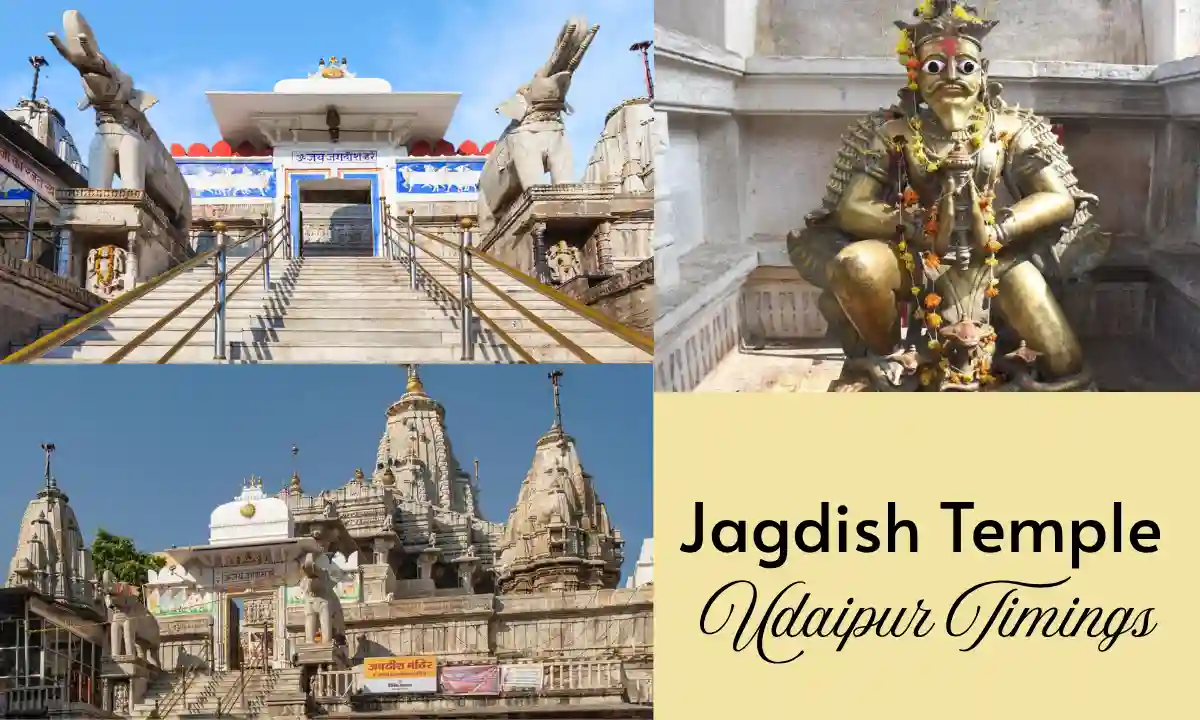
Jagdish Temple is the largest and most popular temple in Udaipur, located a short walk from City Palace. The timings (morning morning slot & evening slot)and when to attend the atmospheric aarti are two things that will be of interest for almost every traveller visiting this place. It is free to enter, and with 32 marble steps leading up to its Indo-Aryan architecture it could be a site in itself. Schedules have slight changes by season and fête, so check locally. This article contains everything from timings to aartis and places you can see.
Jagdish Temple Udaipur Timings: The Short Version
Here is the core of it. Jagdish Temple Udaipur Timing runs in two slots, morning and evening for a free of cost darshan, with several aartis in during daytime. The Lord Vishnu temple in the Old City, adjacent to the City Palace: Timings vary slightly during winter and summer, or on festivals — check locally before you set off.
| Detail | At a glance |
|---|---|
| Morning slot | Commonly around 4:15 to 5:00 AM until about 1:00 to 2:00 PM |
| Evening slot | Commonly around 5:00 PM until about 8:00 to 9:00 PM |
| Aartis | Several daily, from Mangla Aarti to Shyan Aarti |
| Entry fee | Free |
| Dress code | Modest, traditional attire, footwear removed |
| Visit duration | About 30 minutes to 1 hour |
| Location | Old City, about 150 m from the City Palace, Udaipur |
Opening Hours: The Two Daily Slots
The temple opening is organized in two time slots throughout the day, a morning and an evening slot, with some afternoon closure times that vary between summer to winter. The morning slot usually starts at a very early hour like 0415 to 0500 and stretches all the way past lunch, whereas an evening slot would start around five o’clock in your time zone then go until approximately eight or nine PM.
As the exact time varies by season and can differ on festivals and special occasions, consider these as general guidelines for timings but check with locals to know about current timing before you visit especially if visiting for specific aarti. The mornings are serene and the evenings vibrant and bright.
Aarti Schedule: From Mangla to Shyan
Aartis are the core attraction of any visit to Jagdish Temple, during which priests perform hymn recital with lighting of the deity, while devotees sing bhajans and some sway in their devotion. Jagdish Temple organizes different aartis in a day.
- Mangla Aarti: It is the first aarti of the day that takes place in the morning, and it is quite peaceful and inspiring.
- Midday aartis: It is performed throughout the day as a part of rituals done in the temple.
- Shyan Aarti: It is the last aarti of the day performed at night before closing of the temple.
Morning Mangla Aarti is particularly an experience worth remembering for its devout chanting. Times of performing arts vary according to the seasons and festivals, so it is better to check the local timings beforehand and come a bit early.
Entry Fee, Photography and Dress Rules
- The temple is open and easy to go-to with some basic rules for courtesy.
- Free Entry, No tickets required as it is a temple maintained by the state and all are welcome.
- You can take photographs all around the outer prescription, however inside the principal sanctorum amid puja and aarti it might be limited so pursue signs.
- You should wear proper, traditional clothing as this place is still an active house of worship.
- Take off the shoes before entering, shoe stands are available near the entrance.
- Entry is free and these little courtesies ensure that the visit remains dignified, making it an easy stopover on any day of sightseeing in Udaipur.
Architecture and What to See
The Jagdish Temple is a classical Indo-Aryan, Maru-Gurjara-style and much of the pleasure in such places can be had simply by being there.
- The 32 steps of marble: the ascent to what we will then call our main altar, two large elephants in stone mark its mouth.
- The shikhar: this the tallest main spire well over 79ft high which dominates Udaipur skyline, encrusted with decorated images of dancers, elephants and horsemen musicians.
- Brass Garuda: the half-human-half-eagle image of Vishnu’s Mount, watching over you in a shrine facing toward the entrance.
- The pillars are carved: intricately sculpted columns, fifty on the first two floors and beautifully detailed divine images throughout.
The epithet referring to Maharana Jagat Singh is inscribed on a stone slab by its entrance, and the highly intricate carvings are worth long observance.
The Deity and the Four Corner Shrines
The main temple houses Lord Vishnu as Jagannath in a black stone form, and the name of the temple was originally Jagannath Rai Temple, one of the names of Vishnu among the thousand names he has.
In addition to the main temple there are four other smaller temples in each of the four corners of the courtyard, which are temples of the Sun God, Goddess Durga or Shakti, Lord Ganesha and Lord Shiva, thus providing an opportunity for worship of many deities within one complex. This arrangement, with Vishnu at the centre and the four shrines around, is part of what makes the temple both architecturally and spiritually complete.
A Bit of History: Built in 1651
The temple was constructed by Maharana Jagat Singh I in 1651; he ruled Udaipur between 1628 and 1653. Its construction cost was about one and a half million rupees, which was an enormous amount of money in those times. The temple is located right in the center of the old part of the city as the chief Vishnu temple of the Mewar kings.
The temple witnessed several historic events; for instance, its façade was damaged with explosives during Mughal wars led by Aurangzeb. Nevertheless, most of the decoration survived, and the temple, being a state-run temple which is always in use, attracts numerous worshipers at any time of the day.
Best Time to Visit: Aarti and Season
- Early morning, for Mangla Aarti: the most tranquil and spiritual experience.
- Evening, for Aarti and lights: the temple is beautifully lit up and bustling, a nice time for visit.
- October to March: pleasant season of Udaipur, perfect for sightseeing in the old town of the city.
- Mornings, on weekdays: the most tranquil period, out of peak times for tourists.
To have the complete experience, you should come for aarti either in morning or evening, and also explore City Palace and Lake Pichola nearby during cool seasons.
How Jagdish Temple Fits Udaipur’s Heritage Circuit
Since it sits at the centre of the old city, it helps to see how Jagdish Temple fits with Udaipur’s other sights.
| Place | Where | Known for |
|---|---|---|
| Jagdish Temple | Old City, near City Palace | The largest temple, Indo-Aryan architecture, aartis |
| City Palace | About 150 m away | The grand Mewar palace complex on Lake Pichola |
| Lake Pichola and Gangaur Ghat | Nearby | Boat rides, ghats, and the famous lake views |
| Bagore Ki Haveli | Near Gangaur Ghat | A restored haveli and evening cultural show |
Here is the true picture then. The City Palace and Lake Pichola are the main sights to see, and Jagdish Temple is the soul of the old city, close by, and undoubtedly the best temple in Udaipur. All three form a great combination of old city sights which should be seen on foot.
Pros and Cons: An Honest Assessment
Weighing both sides helps set expectations.
The pros:
- Entry to Udaipur’s biggest and the best temple for free.
- Nice examples of Indo-Aryan architecture and delicate carvings.
- Atmospheric aartis, particularly the morning Mangla Aarti
- A centrally located old-city spot just steps from the City Palace and Lake Pichola.
- A temple, active and alive with devotion all day long.
The cons:
- The 32 steps make it less accessible for people with mobility issues.
- Timings change by season and festival, so they require confirmation.
- It gets crowded during peak tourist hours and festivals.
- No photography is allowed inside the garbhagriha while puja or aarti are performed.
- Traffic here is heavy and parking spots are scarce along old-city lanes.
Common Mistakes to Avoid
- Basis fixed timings, that you have switching between summer-winter time and on festivals.
- Avoid visiting early morning Mangla Aarti, the most atmospheric Hour to Visit.
- Fetching during the lunchtime break, in-between morning and evening slots.
- This includes taking pictures inside the sanctum during puja/aarti, which is prohibited
- Dressing too casually for an active worship space.
- Missed out not combining the visit with City Palace and Lake Pichola right next to it.
Is It Worth Visiting? Who It Suits
Yes, one of the places you have to visit in Udaipur is Jagdish Temple and it fits all.
- Great for: visitors to Udaipur as the city’s biggest and best temple, free entry.
- Ideal for: devotees and people who want to see performing morning or evening aarti.
- Best for: Architecture, history buffs and fans of detailed temple carvings.
- Ideal for: sightseers, due to its central position (nearby the City Palace and Lake Pichola.)
One of the most satisfying and authentic experiences for a first time visitor to Udaipur, is spending an hour or two in morning or evening at Jagdish Temple next door with City Palace just minutes walk away.
Accessibility, Facilities and Etiquette
- The main shrine is accessed via 32 marble steps and makes it more difficult for someone who may be unsteady on their feet.
- There is a footwear stand at the entrance and you have to take off your shoes.
- Dress modestly, keep silence and be respectful during aarti and adhere to photography rules.
- Although darshan is free, do carry small cash for offerings.
- While parking spots are rare, the old-city lanes surrounding it should be explored on foot.
How Long to Spend and How to Reach
Most visitors will take 30 minutes to an hour to visit the temple; aarti, architecture and shrines, longer if you loiter over carvings. It’s a quick walk that can easily fit into a longer tour of the old city.
| Mode | Details and distance |
|---|---|
| On foot | About 150 m from the Bada Pol of the City Palace, an easy walk in the old city. |
| By road | Autos, e-rickshaws, and taxis reach the Jagdish Chowk area. |
| By train | Udaipur City railway station is about 3 km away. |
| By air | Maharana Pratap Airport, Dabok, is about 22 to 25 km away. |
The temple is right in the old city, so most visitors reach it on foot from the City Palace or Lake Pichola area, or by a short auto ride, and it is well known to every local.
Nearby Attractions: What to Combine With Your Visit
- City Palace: The grand Mewar palace complex, located approximately 150 m away.
- Pichola Lake & Gangaur Ghat: The famous lake and ghats along with the boat ride.
- Bagore Ki Haveli: The renovated haveli that offers the Dharohar culture show in the evening.
- Jagdish Chowk & Old City Bazaars: The markets located near the temple for shopping and eating.
An old city plan of Udaipur consists of the combination of Jagdish Temple, City Palace, boat ride on Pichola Lake, and the Dharohar show in Bagore Ki Haveli.
Trivia and Lesser-Known Facts: Jagdish Temple
- This is the biggest temple in Udaipur and was constructed in 1651 by Maharana Jagat Singh I.
- It was referred to as the temple of Jagannath Rai, which was another name of Lord Vishnu.
- It has a main spire that measures about 79 feet in height.
- The entrance to the main shrine has 32 marble stairs and is guarded by two elephants on both sides of the stairs.
- There is also an image of Garuda placed outside the entrance of Vishnu’s shrine.
- There are four shrines at each corner for the Sun God, Durga, Ganesha, and Shiva.
Quick Tips: Making Your Jagdish Temple Timings Work
- Come for the morning Mangla Aarti and evening aarti for a complete experience.
- Know the latest timings on location, since they differ according to seasons and festivals.
- Do not visit during the afternoon when there is no activity.
- Dress conservatively, take off your shoes and follow the photography policy inside.
- Travel from the City Palace, only 150 meters away, and walk around the old city.
- Visit from October to March for comfortable weather.
Final Take: Planning Your Jagdish Temple Visit
Jagdish Temple Udaipur opening hours have two time slots, morning hours from approximately 4:15 to 5:00 AM till noon time and evening time slot from approximately 5:00 PM till 8:00 or 9:00 PM, when darshan is free and aarti can be seen through the day, starting from Mangla Aarti at dawn time till Shyan Aarti at night. It should be kept in mind that exact timings vary seasonally and on special days, so it’s better to verify them and see the temple aarti, especially the enchanting Mangla Aarti.
Take a climb up the 32 steps made of marble and take in the Indo-Aryan style of architecture, the 79 ft tall tower, the brass Garuda statue, and the four corners shrines by dressing appropriately and adhering to the photography rules. Being only 150 m away from the City Palace, which is located in the middle of the old city, makes Jagdish Temple complement the visit to the City Palace, Lake Pichola, and Bagore Ki Haveli for a complete tour of the old city. With being the biggest and the best temple in Udaipur, free entry to Jagdish Temple is a must visit place.
Frequently Asked Questions
What are the Jagdish Temple Udaipur timings?
The temple opens in two slots, a morning session commonly from around 4:15 to 5:00 AM until the early afternoon, and an evening session from around 5:00 PM until about 8:00 to 9:00 PM. Times shift a little between summer and winter and on festivals, so confirm locally before you go.
What are the aarti timings at Jagdish Temple?
The temple runs several aartis daily, from the Mangla Aarti in the early morning, the first of the day, to the Shyan Aarti at night, the last. The morning Mangla Aarti is especially atmospheric. Aarti times shift with the season and on festivals, so confirm locally and arrive a little early.
Is there an entry fee for Jagdish Temple Udaipur?
No, entry is free, as it is a state-maintained temple open to all. Photography is generally allowed in the outer premises but may be restricted inside the sanctum during puja and aarti. Dress modestly and remove footwear before entering.
Who built Jagdish Temple and when?
Jagdish Temple was built in 1651 by Maharana Jagat Singh I, who ruled Udaipur from 1628 to 1653, at a cost of around 1.5 million rupees of the time. It is dedicated to Lord Vishnu and is the largest temple in Udaipur, originally known as the temple of Jagannath Rai.
What is the best time to visit Jagdish Temple?
Early morning for the Mangla Aarti is the most peaceful and moving time, and the evening aarti, with the temple lit and lively, is also beautiful. October to March is the pleasant season in Udaipur, and weekday mornings are the calmest for a visit.
What is special about Jagdish Temple’s architecture?
It is a fine example of Indo-Aryan, Maru-Gurjara architecture, with a main spire around 79 feet high covered in carvings, reached up 32 marble steps flanked by stone elephants. A brass Garuda guards the entrance, and there are four corner shrines to the Sun God, Durga, Ganesha, and Shiva.
How long does it take to visit Jagdish Temple?
Most visitors spend about 30 minutes to an hour, taking in an aarti, the architecture, and the shrines, longer if you linger over the intricate carvings. It fits easily into a wider walk around the old city and the nearby City Palace.
How do I reach Jagdish Temple in Udaipur?
The temple is in the old city, about 150 m from the Bada Pol of the City Palace, an easy walk. Autos and e-rickshaws reach the Jagdish Chowk area, Udaipur City railway station is about 3 km away, and the airport at Dabok about 22 to 25 km away.
Also read about: Gopi Cinema Dombivli Show Timings: How to Check Today’s Shows and Book



Leave a Reply