
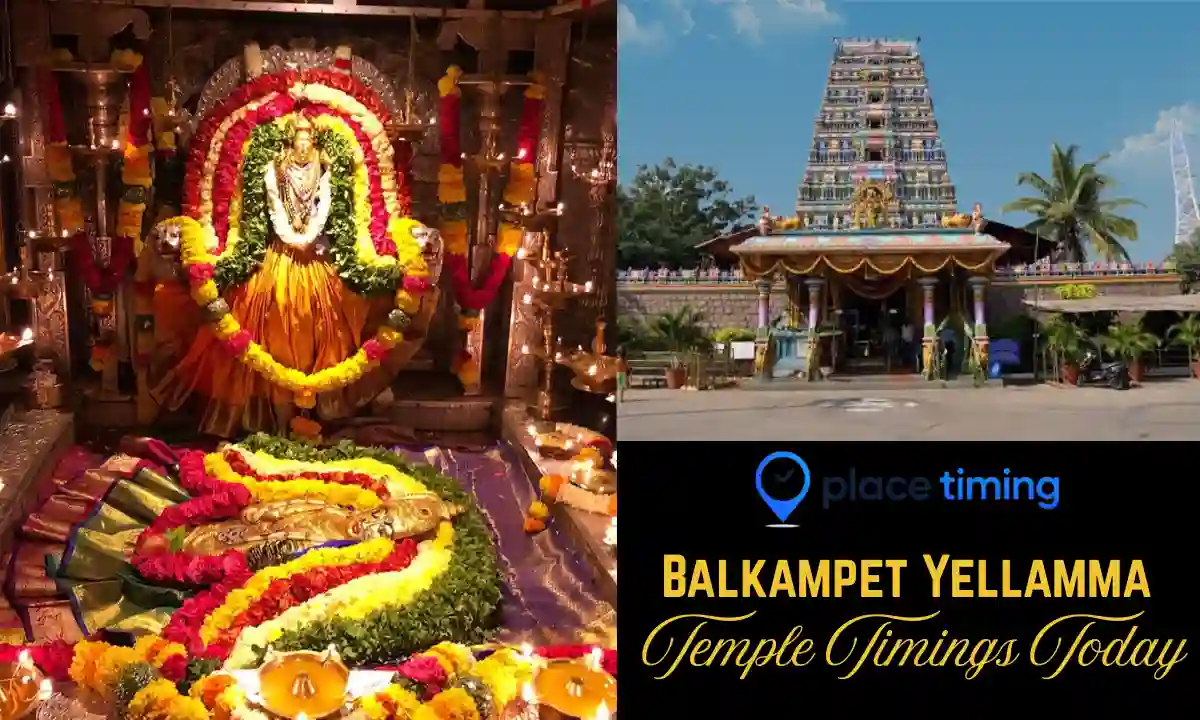
Are you trying to find out the Balkampet Yellamma temple timings for today? Here’s your quick answer: The timings at this temple remain pretty much the same all throughout the week, so for today, it is 6:00 AM to 1:00 PM and 3:00 PM to 8:00 PM, regardless of whichever day of the week you are viewing this article. What varies are the timings of the Abhishekam during Tuesdays and Fridays and also during festivals. This historic temple in Hyderabad is known for one particular reason, and that is the statue of Goddess Yellamma which is located ten feet underground.
Balkampet Yellamma Temple Timings Today: The Short Version
Here is the core of it. Balkampet Yellamma temple timings today are 6 AM to 1 PM and from then 3 PM to and till the end of day, same as regular days follow during which free darshan is provided followed by midday break. A common pattern followed in temples such as the Sri Renuka Yellamma temple at Balkampet, near Ameerpet Hyderabad is here below. Tuesdays, Fridays & festival days are different; verify with the temple.
| Detail | At a glance |
|---|---|
| Open today (all usual days) | 6:00 AM to 1:00 PM and 3:00 PM to 8:00 PM |
| Midday break | 1:00 PM to 3:00 PM |
| Darshan | Free, no entry fee |
| Abhishekam | 6:45 AM on Tuesdays and Fridays, around Rs 300 |
| Kumkumarchana and sevas | About 8:30 AM to 11:30 AM |
| Auspicious days | Tuesday, Friday, and Sunday |
| Location | Balkampet, near Ameerpet and SR Nagar, Hyderabad |
Balkampet Yellamma Temple Timings Today: Are They the Same Every Day?
This is the true answer to what most people want to know. Yes, the timings of the Balkampet Yellamma temple are exactly the same as on other normal days because of the scheduled timetable the temple follows. This means that regardless of whether it is Monday, Wednesday, or Sunday, the temple opens at 6:00 AM, closes for a break from 1:00 PM to 3:00 PM and closes at 8:00 PM.
The timings and the experience change only on a few occasions that you need to take into account.
- Tuesdays and Fridays: same timings, but the Goddess’s days, with the Abhishekam at 6:45 in the morning, and much more busy.
- Sundays: also seen as auspicious for Yellamma, hence more busy.
- Festivals: Bonalu in the Ashada month, June to July, Yellamma Kalyanam in Chaitra, March to April, and Navaratri come with longer and altered timings and massive crowds.
Therefore, for any usual day, the timings as below will apply for today’s timings, and you need to arrange yourself accordingly only in case of Tuesday, Friday, and festivals.
Full Daily Timings and the Midday Break
The day schedule of darshan consists of two periods: one in the morning and another in the evening, with a period in between during which the temple is closed due to rituals.
- Morning period: from 6:00 am to 1:00 pm, beginning with the Suprabhata Seva, which wakes up the Goddess.
- Period in between: from 1:00 pm to 3:00 pm, during which the temple is closed.
- Evening period: from 3:00 pm to 8:00 pm, ending with the evening rituals.
Some sevas, including Kumkumarchana, are conducted in the morning time, at 8:30 am – 11:30 am.
The reported times may differ slightly among sources, with some mentioning the opening a bit earlier or starting the evening period at 4:00 pm.
What Changes on Which Day: Tuesday, Friday and Festivals
Since the temple is otherwise the same daily, these are the specific differences to know.
| Day or occasion | What changes | Note |
|---|---|---|
| Tuesday and Friday | Abhishekam at 6:45 AM, the Goddess’s days | Arrive by 6:15 AM, fills fast |
| Sunday | Same hours, considered auspicious | Busier than a weekday |
| Bonalu (Ashada, Jun to Jul) | Extended timings, the grandest festival | Four to five lakh devotees |
| Yellamma Kalyanam (Chaitra, Mar to Apr) | The divine wedding, changed timings | Special ticket |
On all other days, the standard 6:00 AM to 1:00 PM and 3:00 PM to 8:00 PM schedule holds, so these are the only occasions to plan around specially.
The Underground Deity: Yellamma as Jala Durga
This is what makes the temple special and should be understood in its entirety. What sets this temple apart from all others is that the idol of the Goddess Yellamma in this temple lies approximately ten feet under the ground level. The devotees, therefore, look down at the Goddess instead of looking up at her.
Since the goddess idol is placed under the ground level, and since water automatically collects around her, the goddess is worshiped here as Jala Durga, the Water Goddess. This temple is said to be hundreds of years old. The goddess idol was found lying approximately ten feet below the ground level when a well was being dug here.
The Sacred Water: Believed to Heal
From its own underground location emerges another reason for the uniqueness of this temple. Water naturally accumulates at the bottom of the idol and is dispensed among the devotees as prasadam.
It is believed that this water possesses medicinal powers and devotees use it for their healing. This water, which symbolizes the Goddess in the form of Jala Durga, is one of the main reasons for the reverence of the temple, and thus devotees speak of miracles after visiting it and forgetting about their worries.
Darshan, Abhishekam and Seva Prices
There is no entry fee, and darshan is free, with paid sevas you can book. The figures below are indicative and revised over time, so confirm at the counter.
| Darshan or seva | Approximate cost |
|---|---|
| General darshan | Free |
| Abhishekam (Tuesday and Friday, 6:45 AM) | Around Rs 300 |
| Kumkumarchana | A modest charge, late morning |
| Yellamma Kalyanam (festival) | Around Rs 1,000 |
| Suprabhata Seva and other sevas | Set rates at the counter or online |
The temple administration is handled by the Telangana Endowments Department, and one can book sevas online or offline, which is helpful for those coming from other cities. If you want to witness the Abhishekam on a Tuesday or Friday, try reaching the place by 6:15 AM.
The Deity, the History and the Plague Legend
This is an ancient and legendary temple. Goddess Yellamma is a goddess worshiped here as the divine mother goddess who blesses, heals, and protects. As mentioned earlier, the idol was discovered around ten feet under the ground while digging a well, and thus a temple was constructed around it.
There is an interesting legend associated with the destruction of a plague. It is believed that there was a plague in the area of Hyderabad and Secunderabad, and the devotees worshiped the deity and placed Yellamma temples at Balkampet and elsewhere. The goddess pleased with their devotion put an end to the plague. One of the reasons for celebration of the Bonalu festival, which is a thanksgiving to the goddess, in this temple is due to this legend.
The Pochamma Shrine and Spiritual Benefits
On the south side of the complex, there is a shrine to Pochamma Devi, the protector deity of the temple, and thus it is referred to as the Yellamma-Pochamma Temple. Followers offer prayers to both deities.
- Women’s blessings: Yellamma is prayed to as a protector of women, as they pray for fertility, marital bliss, and familial well-being.
- Healing and consolation: the holy water, as well as the Goddess’s blessing, is sought for healing and consolation from any disease or worry.
- Protection and power: being a powerful form of Shakti, people pray to her for their protection from any evils.
- Prosperity and fulfilment of promises: many come here to fulfill their promise as well as prosperity and peace of mind.
For families and women in particular, a pilgrimage to Balkampet Yellamma is considered very auspicious.
Bonalu and Yellamma Kalyanam: The Great Festivals
Two major festivals of the temple add vibrancy to it with their zeal.
- Bonalu: the folk festival of Telangana, celebrated in the month of Ashada, which extends from June to July, when devotees offer Bonam, the pots full of cooked food offerings to the Goddess. The temple attracts four to five lakhs devotees, mainly during Bonalu Sundays.
- Yellamma Kalyanam: the divine wedding of the Goddess that takes place in the month of Chaitra, from March to April, which is the most celebrated festival of the temple.
- Navratri: celebrated in September to October, with special Poojas and cultural activities.
It is advisable to make prior arrangements about the timing of these festivals, since they attract a very large number of people.
Dress Code and What to Carry
- Wear conservative, traditional clothing, especially during the festival.
- Take along your valid ID card for seva booking if needed.
- Remove your footwear upon entry, leaving all leather goods outside.
- Carry some money in small denominations along with your online booking tickets.
- For Abhishekam on Tuesday or Friday, be there around 6:15 AM to have your spot.
- Protect your valuables from theft amid the crowd, especially on festival days.
How Balkampet Yellamma Compares to Other Shakti Temples
Hyderabad and Telangana have several revered Goddess temples, so it helps to see where Balkampet stands.
| Temple | Where | Known for |
|---|---|---|
| Balkampet Yellamma | Balkampet, Hyderabad | The underground Jala Durga deity and its sacred healing water |
| Golconda Bonalu (Jagadamba) | Golconda Fort | The Bonalu festival’s traditional starting temple |
| Ujjaini Mahankali | Secunderabad | A major Bonalu temple with huge crowds |
| Yadagirigutta | Near Hyderabad | The Narasimha hill temple, a different tradition |
What is true about the matter is that the temples of Golconda and Secunderabad are important parts of the pilgrimage of Bonalu, but it is what makes Balkampet unique is that there is an underground Goddess worshipped as Jala Durga with her sacred water. It is only in Balkampet where one can find Shakti of central Hyderabad.
Pros and Cons: An Honest Assessment
Weighing both sides helps you plan.
The pros:
- A rare and ancient temple, with the deity buried underground.
- Offer free darshan and very reasonably priced sevas.
- Timing is regular and fixed every day, making planning easy.
- Convenient location near Ameerpet and accessible via metro.
- It has an impressive calendar of festivals like Bonalu and Yellamma Kalyanam.
The cons:
- The timing from 1:00 PM to 3:00 PM is a surprise for unprepared visitors.
- Tuesday, Friday, Sunday, and during festivals are quite crowded.
- Abhishekam timing becomes full and requires early arrival.
- Crowded timings during Bonalu festival time with the region being very busy.
Common Mistakes to Avoid
- Coming during the 1:00 PM to 3:00 PM interval when the temple is closed.
- Visiting for the Abhishekam but not arriving before 6:15 AM as it gets crowded quickly.
- Anticipating a faster darshan on a Tuesday, Friday, or on any festival days.
- Having no money for offering and for the prasadam.
- Wearing inappropriate clothes, especially during the festivals.
- Not arranging transport for Bonalu as there will be thousands of devotees.
Is It Worth Visiting? Who It Suits
Yes, Balkampet Yellamma is definitely worth it and may be perfect for some people.
- Perfect for: worshippers of the Goddess, as well as those fascinated by the unusual underground Jala Durga and holy water.
- Ideal for: women and families looking for blessings regarding health, fertility, and marriage.
- Festive for: those visiting during Bonalu or Yellamma Kalyanam Festivals.
- Easy for: any tourist in Hyderabad, since it is conveniently located in the city.
In case of a devout Hindu or tourist in Hyderabad, Balkampet Yellamma is a very special temple to visit, preferably not during festivals but on a weekday morning.
Best Time to Visit and How Long to Spend
Weekday mornings, between around 5:30 and 9:00 AM, are the most peaceful for a peaceful darshan. Tuesday and Friday are good days, but they are hectic due to the Abhishekam. Bonalu and Yellamma Kalyanam are the best and most hectic days. Choose a weekday morning for a peaceful darshan experience, other than a festival day.
Darshan normally takes half an hour to one hour, a little longer on Tuesday, Friday, and festivals. Most people stay less than an hour at the temple.
How to Reach Balkampet Yellamma Temple
The temple is at Balkampet, near Ameerpet and SR Nagar, in central Hyderabad, and easy to reach.
| Mode | Details and distance |
|---|---|
| By metro | SR Nagar and Ameerpet are the nearest stations, with an auto or a short walk of about 1 km onward. |
| By road | On Balkampet Road, reached by autos, app cabs, and buses from across the city. |
| By train | Hyderabad and Secunderabad stations are a cab ride away. |
| By air | Rajiv Gandhi International Airport is about 30 to 35 km away, with taxis onward. |
The metro to SR Nagar, then a short auto or walk, is the easiest way in, especially on busy days when parking is hard. On Bonalu days, take the metro and expect to walk the last stretch.
Nearby Attractions: What to Combine With Your Visit
- Birla Mandir: the white marble hilltop temple, just a short drive from here.
- Hussain Sagar and Lumbini Park: the lake, the Buddha statue, and the laser show at night.
- KBR National Park: the green urban park close to Jubilee Hills.
- Charminar and the old city: the famous monument and the market area.
The most popular itinerary is to visit Balkampet for morning darshan, followed by Birla Mandir and Hussain Sagar area.
Trivia and Lesser-Known Facts: Balkampet Yellamma
- The idol is situated about ten feet under the ground level, which means that the devotees have to bend their heads down to see the Goddess.
- She is worshipped here as Jala Durga, the Water Goddess, with sacred water placed under the idol.
- The idol was discovered while a well was being dug here.
- The temple is connected with the extinction of plague in the mid-eighteenth century.
- This temple is a shrine to Pochamma Devi, hence the name Yellamma Pochamma Temple.
- Bonalu festival of this temple brings about four to five lakh devotees to Ashada.
Quick Tips: Making Your Balkampet Yellamma Timings Work
- Plan to go from 6:00 AM to 1:00 PM and from 3:00 PM to 8:00 PM for an ordinary day, and never during the period 1 to 3 PM.
- Come in the morning of a weekday for the most peaceful darshan experience.
- To attend the Abhishekam ceremony, come either on a Tuesday or Friday and reach the temple before 6:15 AM.
- Have the holy water in the form of prasadam, which is a unique feature of your visit.
- Come in the metro to SR Nagar, particularly on crowded and festival days.
Final Take: Planning Your Balkampet Yellamma Visit
Balkampet Yellamma Temple timings are 6:00 AM – 1:00 PM and 3:00 PM – 8:00 PM, and it is good to note that these timings are constant on any regular day, and therefore one can rely on visiting the temple within the stated timings regardless of the day, keeping in mind the mid-day 1:00 PM – 3:00 PM break. Darshan is free, while the different days are Tuesdays and Fridays with 6:45 AM Abhishekam and the big festivals of Bonalu and Yellamma Kalyanam.
The uniqueness of this temple is its own Goddess who sits some ten feet below the earth as Jala Durga with holy water at her feet offered as healing prasadam, and therefore it is important to take the holy water during your visit. Visit this temple early in the weekday morning, make sure to get there at 6:15 AM in order to have Abhishekam, dress in a modest way, and take the metro to SR Nagar particularly during Bonalu. Easily accessible and central to Hyderabad city, Balkampet Yellamma is one of the most unique temples in Hyderabad.
Frequently Asked Questions
What are the current timings for the Balkampet Yellamma temple?
On any normal day, including today, the temple opens at 6:00 AM until 1:00 PM and from 3:00 PM until 8:00 PM, with an afternoon break from 1:00 PM until 3:00 PM. The timings remain the same each day, with an exception during festival days, when timings get extended, and Tuesdays and Fridays, when there is the early Abhishekam.
Are the Balkampet Yellamma temple timings the same every day?
Yes, the temple keeps the same daily timings, 6:00 AM to 1:00 PM and 3:00 PM to 8:00 PM, on all ordinary days, so today’s timings match any normal day. The exceptions are Tuesdays and Fridays, with the 6:45 AM Abhishekam, and festivals like Bonalu and Yellamma Kalyanam.
Is there an entry fee at Balkampet Yellamma temple?
No, there is no entry fee, and general darshan is free. Paid sevas include the Abhishekam on Tuesdays and Fridays, around Rs 300, Kumkumarchana, and the Yellamma Kalyanam ticket, around Rs 1,000. Sevas can be booked online or at the counter. Prices are revised over time, so confirm.
Why is the Balkampet Yellamma idol below ground?
The idol of Goddess Yellamma sits about ten feet below ground level, so devotees look down at her. It was discovered underground during the digging of a well, and remains below ground, with sacred water collecting at its base, which is why she is worshipped here as Jala Durga, the Water Goddess.
What is special about the Balkampet Yellamma temple water?
Sacred water naturally collects at the base of the underground idol and is given to devotees as prasadam. Many believe it has medicinal and purifying, healing properties, and taking this water is a special part of a visit to the temple.
What time is the Abhishekam at Balkampet Yellamma temple?
The Abhishekam is performed at 6:45 AM on Tuesdays and Fridays, the Goddess’s special days, and costs around Rs 300. It fills up fast, so arrive by about 6:15 AM to secure a place. These are also the busiest days for darshan.
When is Bonalu at Balkampet Yellamma temple?
Bonalu is celebrated in the month of Ashada, June to July, when devotees offer bonam, decorated pots of cooked food, to the Goddess. Balkampet draws four to five lakh devotees, especially on the Bonalu Sundays, with extended timings and huge crowds.
How do I reach Balkampet Yellamma temple?
The temple is at Balkampet, near Ameerpet and SR Nagar, in central Hyderabad. SR Nagar and Ameerpet metro stations are the nearest, with a short walk or an auto ride onward. Autos, cabs, and buses reach it easily, and on busy or Bonalu days, the metro is the best option.
Also read about: Simhachalam Temple Timings Today: Darshan, Sandalwood Deity and Full Guide



Leave a Reply