
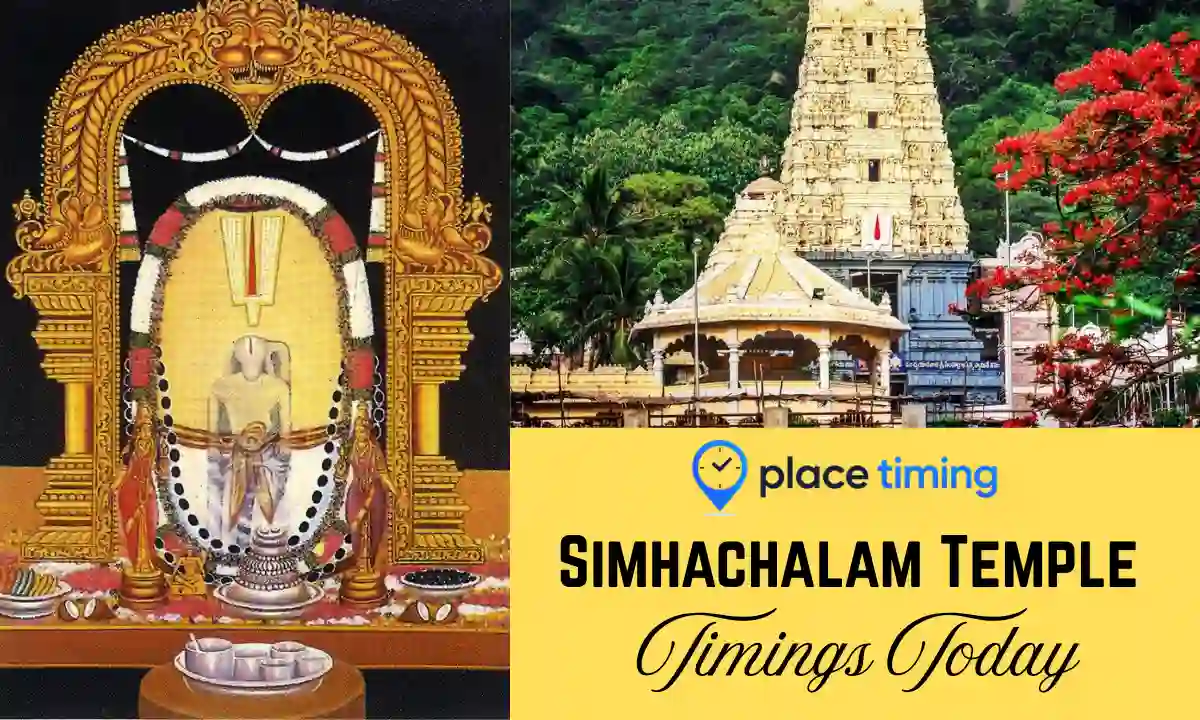
Looking for Simhachalam temple timings for today? Here is the quick response: the timings of this temple remain the same every day except on the Chandanotsavam day when the form of the deity is unveiled. Hence, today’s timings of this hill temple of Lord Varaha Lakshmi Narasimha situated near Visakhapatnam are 7:00 AM to 9:00 PM with a gap in between for some rituals. This temple is famous for its deity smeared with sandalwood throughout the year. This article will provide you information regarding timings, days that witness changes, sandalwood concept, prices and tips.
Simhachalam Temple Timings Today: The Short Version
Here is the core of it. Today simhachalam temple timings are 7:00 AM to 9:00 PM as every other day, the temple would open in the afternoon break free general darshan. This pattern is followed at the Sri Varaha Lakshmi Narasimha Swamy Temple located atop a hill at Simhachalam, 16 km from Visakhapatnam. Saturdays are not the same as festival days and may vary in timing, so check with Devasthanam too.
| Detail | At a glance |
|---|---|
| Open today (all usual days) | 7:00 AM to 9:00 PM |
| Afternoon break | A pause for rituals, commonly in the late afternoon |
| General darshan (Sarva Darshan) | Free |
| Special darshan | Around Rs 50 to Rs 100 per person |
| Busiest day | Saturday, dedicated to Lord Narasimha |
| Once-a-year true form | Chandanotsavam, on Akshaya Tritiya |
| Location | Simhachalam Hill, about 16 km from Visakhapatnam |
Simhachalam Temple Timings Today: Are They the Same Every Day?
- This is the candid response to the query most people have in mind. Yes, the timing of the Simhachalam Temple today is the same as on a regular day as the temple functions according to a daily timetable that does not change. Thus, regardless of whether it is a Monday, Wednesday, or Sunday, the opening time will be 7:00 AM while closing time will be 9:00 PM with an afternoon break for rituals.
- However, the difference in timings occurs only during a limited number of predictable days, which is the actual information you require:
- Saturdays: same timings but devoted to Lord Narasimha, and therefore even busier than usual, with waiting lines that may be several times longer than usual.
- Chandanotsavam on Akshaya Tritiya: once a year when the sandalwood is stripped off and the true image is revealed, from as early as 3:00 AM with special tickets for darshan.
- Festivals: Narasimha Jayanti, Navaratri, and Kama Dahanam are other occasions when timings change.
Thus, on any normal day, the following timings will apply as today’s timings, and you will only need to consider the exceptions when it is Saturday, Chandanotsavam, or any festival.
Full Daily Timings and the Afternoon Break
From 7:00 AM to 9:00 PM, the first thing one should know is the afternoon break, where rituals take place and the offering to God occurs.
- Morning darshan: from 7:00 AM to midday and early afternoon.
- Afternoon break: the temple takes a break in the late afternoon, and hence one can either arrive at the hilltop before the break or stay away till it is over. The time is mentioned by some sources as 4:00 PM to 6:00 PM, and thus one should avoid arriving during this period.
- Evening darshan: starts in the evening and continues up to 9:00 PM.
- Timings mentioned above vary slightly from source to source, and hence the above-mentioned times can be treated as the daily routine of the temple.
The only thing which one needs to remember in this case is that they should not visit the hilltop during the late afternoon.
What Changes on Which Day: Saturday and Festivals
Since the temple is otherwise the same daily, these are the specific differences to know.
| Day or occasion | What changes | Note |
|---|---|---|
| Saturday | Same hours, but dedicated to Narasimha | Queues can be three times longer |
| Chandanotsavam (Akshaya Tritiya) | True form revealed, darshan from about 3:00 AM | Special tickets, lakhs of pilgrims |
| Narasimha Jayanti and Navaratri | Extended and altered timings | Confirm the day’s schedule |
On all other days, the standard 7:00 AM to 9:00 PM schedule with the afternoon break holds, so these are the only occasions to plan around specially.
The Sandalwood Deity: What Makes Simhachalam Unique
This is the highlight of the temple and needs to be comprehended in full. The temple deity, Lord Varaha Lakshmi Narasimha, is a unique incarnation of Lord Vishnu as the combination of the avatars of Varaha, boar, and Narasimha, lion-man, which is unique to this temple only.
The idol in this temple is totally covered with a thick paste of sandalwood known as chandanam all through the year except for a single day. This means that for 364 days in a year, what people see is just the shape of the sandalwood idol and not the stone image inside. It is the thick paste of sandalwood which cools the intense heat generated by Narasimha.
Chandanotsavam: The Once-a-Year True Form
This original appearance of the God, known as Nijaroopa Darshanam, is available for viewing for merely twelve hours every year on Chandanotsavam Day on Akshaya Tritiya in April or May.
- On this one day in a year, the sandalwood layer is stripped off, and the real stone image of Lord Varaha Narasimha is visible to the devotees.
- Several lakhs of devotees visit the temple for this unique darshan, which is considered a once-in-a-lifetime opportunity by many people.
- Darshan on the day of the festival starts at an extremely early hour, from 3:00 AM.
- Nijaroopa Darshanam tickets are available in denominations like Rs 300 and Rs 1,000 within a few days prior to the event and usually sell out quickly.
- The exact dates may vary in different sources; you need to check the Chandanotsavam date from the Simhachalam Devasthanam beforehand to make your plan for visiting the festival.
If your primary purpose of visiting the event is to witness the true form of the Lord, then you need to plan much in advance and be ready for the huge crowd.
Darshan Types and Prices
General darshan is free, with a paid option for quicker entry. The figures below are indicative and revised over time, so confirm at the counter or on the AP Temples portal.
| Darshan or item | Approximate cost |
|---|---|
| Sarva Darshan (general) | Free |
| Special or VIP darshan | Around Rs 50 to Rs 100 per person |
| Nijaroopa Darshanam (Chandanotsavam) | Around Rs 300 and Rs 1,000 tiers |
| Sevas (Kalyanotsavam, Abhishekam, etc.) | Set rates at the counter or online |
| Online booking | Through the AP Temples official website |
Special darshan tickets and sevas can be purchased through the AP Temples website, providing you with a QR ticket that you need to display at the entry point on top of the hill. Cash should be carried along with your bookings.
Sevas and Offerings: What You Can Book
- Swarnapushparchana & Archana: Offering services to the god through name.
- Kalyanotsavam: Ceremony of god marriage.
- Abhishekam & Tomala Seva: Offerings done to the lord.
- Chandana Samarpana: Offering related to sandalwood tradition of temple.
Offering services generally require ID proof and can be arranged either online or at the temple. Anna Prasadam and prasadam are available and also Devasthanam arranges guest houses for devotees near the temple.
The Deity, Legend and the Kappa Stambham
This temple is very old and is associated with many legends. It is related to Prahlada, the devout son of the demon Hiranyakashipu, who is said to have erected the initial temple after Lord Narasimha destroyed his father and saved him. The existing temple was constructed in the Kalinga style, having beautiful stone sculptures, in the period of the Eastern Ganga dynasty, around the thirteenth century.
One unique feature of this temple is the Kappa Stambham, the pillar in the temple that is hugged by the devotees, which fulfills their wishes and alleviates them of any disease. It is located on a hill at an elevation of 300 meters from Visakhapatnam.
Spiritual Benefits: What Devotees Seek
- Protection and Courage: As Narasimha, the Lord who protects and eliminates evil, is prayed to for protection and courage.
- Elimination of Obstacles: Praying here is said to remove obstacles that hinder their way.
- Relief from Diseases: Adorning Kappa Stambham is thought to relieve from diseases and fulfill wishes.
- Good Fortune and Well-Being: Blessings for good health, prosperity, and overall well-being of the family along with worshiping Goddess Lakshmi.
- Wish Fulfillment: A lot of people visit for fulfilling their family’s wish or for expressing gratitude.
The special Nijaroopa Darshan during Chandanotsavam is believed to have special powers, and hence the reason for waiting for it all year.
Practical Tips: Monkeys, the Ghat Road and the Break
A few local facts should be known before you head there, as they determine your experience there.
- The monkeys are infamous, and they can steal plastic bags, glasses, and even mobiles, so wear a zippered backpack to keep everything else inside till you enter the sanctum.
- The road leading uphill is really steep and has sharp hairpin turns, so if you don’t like driving on mountain roads, better take the Devasthanam bus from Simhachalam Junction at the foot of the hill.
- It’s better to not arrive in the late afternoon because the temple is closed during that period.
- Weekends and holidays are marked by long queues, so weekday mornings are less crowded.
- The sun is harsh even uphill in summer, so you need to take some water and a hat.
Dress Code and What to Carry
- Wear conservative clothing, as is required at the temple.
- Keep your identification with you, for instance, Aadhaar, to make darshan and seva reservations.
- Take off your footwear before going inside and do not wear leather.
- Pack your things in a zippered bag, because of the monkeys, and also take water during summers.
- Carry some cash along with your online reservations.
How Simhachalam Compares to Other Narasimha Temples
If you are on a Narasimha pilgrimage, it helps to see where Simhachalam stands among the famous shrines.
| Temple | Where | Known for |
|---|---|---|
| Simhachalam | Visakhapatnam | The Varaha-Narasimha form, covered in sandalwood all year |
| Ahobilam | Nandyal district | The Nava Narasimha, nine forms across the hills |
| Yadagirigutta | Near Hyderabad | The five forms, a grand government-built complex |
| Mangalagiri | Near Vijayawada | The panakam, jaggery water, miracle |
So what is the true picture? Ahobilam, with its nine shrines, is the most comprehensive Narasimha shrine, while Yadagirigutta and Mangalagiri have their own well-known versions and practices. What sets Simhachalam apart is the Varaha-Narasimha that is made from sandalwood paste and seen once in a year. This Narasimha temple in Visakhapatnam is absolutely mandatory for those around there.
Pros and Cons: An Honest Assessment
Weighing both sides helps you plan.
The pros:
- An exclusive temple with a deity not found anywhere else in India.
- Fixed timings every day for easy planning.
- No cost of darshan and also a special darshan facility at low cost.
- The temple is located on a hill facing Visakhapatnam with Kalinga style architecture.
- Very close to Vizag which makes it easy to visit along with other places of Vizag.
The cons:
- The afternoon break gets all those people trapped who come late.
- Saturdays and festivals are very crowded, with long lines.
- The tough ghat road is difficult for those who are not accustomed to driving on mountains.
- The monkeys will steal bags, spectacles, and even mobiles.
- The real form is visible once a year during Chandanotsavam.
Common Mistakes to Avoid
- Reaching the hill top in the evening, right in the midst of the ritual break.
- Waiting to see the form of the god on a normal day, since it happens only during Chandanotsavam.
- Visiting on Saturday, hoping for quick darshan since the lines tend to be very long.
- Carrying plastic bags and loose valuables, which are prey for the monkeys.
- Driving the winding ghat road without being accustomed to the curves, since the Devasthanam bus is more safe.
- Not reserving Chandanotsavam tickets the minute they come up for sale, since they tend to get sold out quickly.
Is It Worth Visiting? Who It Suits
Yes, the Simhachalam Temple is definitely worth visiting, and will suit some visitors better than others.
- Perfect for: Narasimha followers and everyone who loves the unusual sandal wood-decorated god.
- Fantastic for: travelers in Visakhapatnam, as it is very easily combined into a visit.
- A once-in-a-lifetime experience for: those who visit during Chandanotsavam to see the unusual real shape.
- Special for: admirers of historic temple architecture and hilltop temples.
Simhachalam is an extraordinary temple for any Vizag traveler and Narasimha follower.
Best Time to Visit and How Long to Spend
Early mornings of the week are the most quiet times, and October to March is the most pleasant time of year. Saturday and festivals are the busiest times, while Chandanotsavam, although the most sacred one, witnesses lakhs of devotees. If you desire a more tranquil darshan experience, the best time is a weekday morning without festivals; otherwise, consider Chandanotsavam for an authentic experience.
The darshan generally lasts about an hour, sometimes even longer on weekends or festivals and extremely long during Chandanotsavam. On average, people visit this place for an hour or two, easily combined with other sites of Visakhapatnam.
How to Reach Simhachalam Temple
The temple is on Simhachalam Hill, about 16 km from Visakhapatnam, well connected by air, rail, and road.
| Mode | Details and distance |
|---|---|
| By air | Visakhapatnam airport is about 20 km away, with taxis onward. |
| By train | Visakhapatnam Junction is the nearest major station, about 16 km off. |
| By road | APSRTC buses, taxis, and autos run from across Visakhapatnam to the foothills and hilltop. |
| Up the hill | The Devasthanam bus from Simhachalam Junction is the safest way up the steep ghat road. |
From Visakhapatnam it is a short trip to the foothills, from where the Devasthanam bus or a taxi takes you up the winding hill road to the temple.
Nearby Places to Combine With Your Visit
- Kailasagiri: the park atop a hill with huge statues of Shiva-Parvati and a view of the city.
- RK Beach and Visakhapatnam coastline: the beaches in the city.
- Submarine Museum (INS Kursura): the retired submarine at the beach.
- Araku Valley and Borra Caves: the hill valley and caves, respectively.
It is not uncommon that a visitor might spend his/her morning at Simhachalam and follow it up by visiting Kailasagiri and Vizag beaches or take it up till Araku Valley.
Trivia and Lesser-Known Facts: Simhachalam
- The image of God is smeared with sandalwood paste for 364 days, while the actual image is revealed on Chandanotsavam.
- Lord Varaha Lakshmi Narasimha is one of the few boar and lion forms of Lord Vishnu in India.
- The temple is related to Prahlada, who is considered to be the founder of this temple.
- The temple was constructed in Kalinga style during the reign of the Eastern Ganga dynasty in the thirteenth century.
- Kappa Stambham is a pillar which is worshipped by pilgrims for their wishes and diseases.
- Simhachalam is named after the lion, and this temple is located at a height of 300 meters above Visakhapatnam.
Quick Tips: Making Your Simhachalam Timings Work
- For any normal day, arrange timings between 7:00 am and 9:00 pm, with same daily timings, and no afternoon breaks.
- Arrive at a week-day morning time for the most peaceful darshan, as Saturday will be the busiest time.
- For the rarest real darshan, make arrangements for Chandanotsavam and book the tickets right away when it opens.
- Carry your luggage in zip bags to save your things from monkeys.
- Take Devasthanam bus from ghat road if you are not used to driving through mountains.
- Wear traditional clothes along with your ID.
Final Take: Planning Your Simhachalam Temple Visit
The timings of Simhachalam temple are from 7:00 AM to 9:00 PM, and the best thing is that the timings are the same on any ordinary day, so you can plan according to that time on any day without worrying about afternoons’ rituals where the temple is closed, so you should not visit the temple late in the day on any ordinary day. The general darshan cost nothing, but the special darshan would be around Rs 50 to Rs 100. The busiest days are Saturdays, and the only different day is Chandanotsavam, where the true form of the deity will be visible.
The charm of the temple is its unique Lord Varaha Narasimha, who stays covered in sandalwood paste throughout the year and whose true form will be seen on the Chandanotsavam, so you can time your visit to the temple depending on which you want to see. Always carry a zipped bag to keep off the monkeys, always prefer taking the Devasthanam bus to reach the top of the steep hill, always wear traditional clothes, and visit Simhachalam Temple along with Kailasagiri and the beaches of Vizag.
Frequently Asked Questions
When are the timings of Simhachalam temple?
The timings of the Simhachalam temple on any regular day, like today, would be from 7:00 AM to 9:00 PM, except that there will be a break in the middle of the day during rituals, when darshan is not allowed. These timings remain the same every day, except for festival days like Chandanotsavam.
Is the timing of Simhachalam temple the same everyday?
Yes, the timings of the temple on all regular days like today remain the same everyday. However, the timings differ in Chandanotsavam and other festival days.
Why is the Simhachalam deity covered in sandalwood?
The idol of Lord Varaha Lakshmi Narasimha is covered with thick sandalwood paste for 364 days a year, believed to cool the fierce energy of Narasimha. Devotees see the fragrant sandalwood shape, not the stone deity, whose true form is revealed only on Chandanotsavam.
When is Chandanotsavam at Simhachalam?
Chandanotsavam, the Nijaroopa Darshanam, falls on Akshaya Tritiya, usually in April or May, when the sandalwood is removed and the true form revealed for about twelve hours. The exact date can differ across sources, so confirm with the Simhachalam Devasthanam before planning festival travel.
Is darshan free at Simhachalam temple?
Yes, Sarva Darshan, general darshan, is free. Special or VIP darshan for quicker entry is around Rs 50 to Rs 100 per person, and sevas carry their own charges. During Chandanotsavam, special Nijaroopa Darshanam tickets, around Rs 300 and Rs 1,000, are sold. Book via the AP Temples portal.
What time does the Simhachalam afternoon break happen?
The temple pauses for rituals in the late afternoon, with some sources citing a break around 4:00 PM to 6:00 PM. If you reach the hilltop then, you may have to wait for the doors to reopen, so plan to arrive well before or after the break.
How do I reach Simhachalam temple from Visakhapatnam?
The temple is about 16 km from Visakhapatnam on Simhachalam Hill. The airport is about 20 km and Visakhapatnam Junction about 16 km away. APSRTC buses, taxis, and autos reach the foothills, and the Devasthanam bus from Simhachalam Junction is the safest way up the steep ghat road.
What should I watch out for at Simhachalam temple?
Watch out for the monkeys, which snatch plastic bags, glasses, and phones, so use a zipped bag. The ghat road is steep with hairpin bends, so take the Devasthanam bus if unused to mountain driving, avoid the afternoon break, and expect long queues on Saturdays and festivals.
Also read about: Padmavathi Temple Tirupati Timings Today: Darshan, Sevas and Full Guide



Leave a Reply