
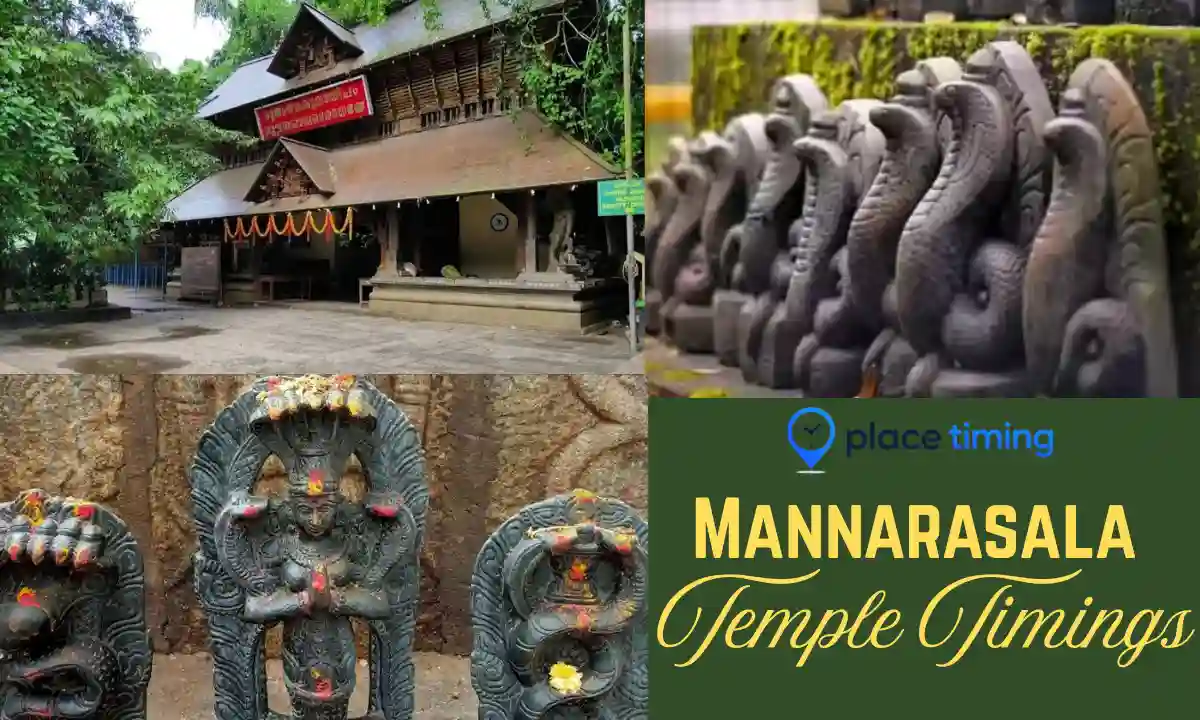
Mannarasala Temple is quite unique in the way it is different from any other temple in India. Firstly, this temple’s rituals are conducted not by the male priest but by the Mannarasala Amma, while the premises and grove have more than thirty thousand idols of the serpents. The temple attracts visitors from various parts of India because of one ritual only – the Uruli Kamazhthal ritual, which childless couples perform to get their children. The present guide deals with the timing of the temple, the offerings and their prices, the amazing miracles and legends, and some honest details.
Mannarasala Temple Timings: The Short Version
Here is the core of it. Mannarasala temple timings work in a long morning session and short evening session, devotees can have free general darshan and the serving of meals (or Nawa Bhojanam) is provided for free daily. For instance, the one at Mannarasala Sree Nagaraja Temple in Kerala’s Alappuzha district follows this pattern. Confirm the timings with the temple before you plan your visit as it varies in festival days.
| Detail | At a glance |
|---|---|
| Morning (Mon to Sat) | About 7:00 AM to 11:00 AM |
| Evening (Mon to Sat) | About 5:30 PM to 7:00 PM |
| Sunday | About 7:00 AM to 12:00 noon and 5:30 PM to 7:00 PM |
| Free Annadanam (meal) | From about 11:30 AM daily |
| Entry | Free general darshan, paid offerings and poojas |
| Famous for | Uruli Kamazhthal, the fertility ritual for childless couples |
| Location | Mannarasala, Haripad, Alappuzha district, Kerala |
Opening Hours: Morning and Evening Sessions
The temple maintains a lengthy morning session between seven in the morning till eleven and a shorter evening session between half past five and seven in the evening. The morning session continues a bit longer on Sundays, up to noon time. There is usually a gap between the two sessions during which the temple remains closed, as usual in most temples of Kerala.
One beautiful aspect of the temple is that free Annadanam is provided to all devotees between half past eleven daily. Devotees can obtain a ticket for Annadanam and enjoy a meal which is part of nivedyam of Sree Nagaraja.
The Woman Priestess: What Makes Mannarasala Unique
One thing that is most unique about Mannarasala is that the poojas and rituals conducted here are presided over by a woman, the esteemed Priestess of the temple, who is affectionately called the Mannarasala Amma or Valia Amma by devotees. This is quite unusual because in Hindu temple practices, priesthood is mostly male-oriented.
The practice is supposed to have originated by the divine instruction of Nagaraja himself, and is handed down through generations in the Illam, the Brahmin family associated with the temple. The Amma who has been serving the temple for many years, Umayamma Antharjanam who was serving since 1993, passed away in 2023 and Savithri Antharjanam now serves as the Priestess. The special ritual of the Uruli Kamazhthal for childless couples is performed by the Amma herself.
The Deities and the 30,000 Serpent Images
Mannarasala is the biggest temple for serpent worship in Kerala, and walking around the temple premises is an experience in itself.
- Sree Nagaraja: the king of serpents, also the presiding deity, who is worshipped in his Anantha (the aspect of Vishnu) and Vasuki (the aspect of Shiva) forms.
- Sree Sarpayakshi: the female form of the snake god who is worshipped along with Sree Nagaraja.
- Nagayakshi and other serpent gods: the larger group of snake gods who are worshipped in the temple.
- Over thirty thousand snake idols: idol forms of snakes of different sizes are worshipped throughout the temple and Kavu premises.
The Kavu premises of the temple, where nature reigns supreme, contains all these thousands of snake idols and is considered sacred.
Offerings and Poojas: The Full List
This place has some of the most abundant offerings, almost all associated with serpent worship and blessings for the family. The offerings can be listed as follows.
- Uruli Kamazhthal: the most popular offering at the temple for childless couples, elaborated in another section below.
- Noorum Palum: the classical offering of serpent of rice flour and milk, along with turmeric and other ingredients.
- Sarpabali: the ritual of serpent worship to free oneself from the doshas related to serpent worship.
- Muzhukkappu, Arakkappu and Mukhakkappu: sandal paste decoration of the deity, which can be total, partial or limited to face only.
- Enna and Ney Abhishekam: bathing the deity with oil/ghee and offering oil/ghee lamps as a vow.
- Chuttuvilakku: offering lighted lamps all around the temple; a spectacular sight in the evening time.
- Sarpasukta Archana, Ashta Naga Pooja and Nilavara Payasam available in the sacred Nilavara chamber.
- Thulabharam: offering bananas, milk and jaggery equivalent to one’s body weight.
The principle followed in this temple is that anything offered devoutly to Sree Nagaraja will be accepted.
Offering and Ticket Prices: What Each Costs
General Darshan is free of charge. All the other activities such as the offerings and poojas are scheduled and paid for at the temple counter. The following figures are indicative, and the actual costs are determined by the temple and are updated from time to time.
| Offering | Approximate cost |
|---|---|
| General darshan | Free |
| Annadanam (community meal) | Free, with a coupon |
| Noorum Palum | A modest offering charge |
| Archana and lamp offerings | From small nominal amounts |
| Abhishekam and adornment poojas | Set rates at the counter |
| Uruli Kamazhthal and Uruli Nivarppu | Booked with the temple, rate on enquiry |
| Thulabharam | The cost of the goods offered by weight |
Mannarasala does not release a complete fixed price card across platforms and itself, the temple is to confirm current rates so heading over there would be ideal while counters or the temple office can direct you in booking an offering on need basis. Carry cash, as counters may not be able to reliably accept cards.
Uruli Kamazhthal: The Fertility Ritual Explained
That is why people go on pilgrimage to Mannarasala. Uruli Kamazhthal is a two-step ritual that is done by the couples who wish to be blessed with a child.
Step one includes the couple taking the uruli (a vessel) and placing it vertically before the temple with prayer as guided by the poojari. Mannarasala Amma will then do a ritual to invert this vessel, place it upside down, and put it inside Nilavara where many vessels lie.
The next step is after they have been blessed with a child, they come back to the temple and do a ritual called Uruli Nivarppu, which means placing the inverted uruli in its right position and showing thankfulness to Sree Nagaraja and Sarpayakshi. Some other rituals that may also be performed include the Annaprasam (offering the baby its first rice). Thousands of couples from generation to generation are thankful for this ritual for bringing their children into this world.
Miracles and Legends: The Stories Behind the Temple
Miracle stories abound in Mannarasala and form an important part of why devotees worship this place with such veneration.
- The miracle of the origin: According to folklore, during the creation of Kerala out of the ocean by Parasurama, the land was highly poisonous in nature and hence Parasurama worshiped Nagaraja at this place in order to make the land fertile.
- The serpent son: One of the most important legends of the temple relates to the birth of two sons to a devoted couple of the Illam, one of whom is said to be a divine five-hooded serpent that still resides in the Nilavara chamber and protects the family and devotees.
- Presence of the serpent deity in the Nilavara: It is believed that the serpent deity still exists in the sealed Nilavara and his blessings are felt by everyone present in Nilavara, which can only be entered by the Amma.
- Countless fertility miracles: Childless couples for generations attribute the grant of children to them by Uruli Kamazhthal, the living miracle that brings people to the shrine every day.
In whichever way you choose to interpret them, the above miracle stories provide great reverence to Mannarasala.
Spiritual and Astrological Benefits: What Devotees Seek
- Blessings for children: most importantly, the Uruli Kamazhthal for couples desiring a child, the signature prayer offered at the temple.
- Naga Dosha and Kala Sarpa Dosha: prayers done at the temple are said to cure people of their Naga Doshas and Kala Sarpa Doshas.
- Sins related to harming serpents: individuals who have knowingly or unknowingly committed any sins against serpents visit the temple.
- Good health, wealth, and prosperity: the general blessings bestowed upon worshippers from the serpent gods.
- Skin diseases and illnesses: some people visit the temple praying for curing themselves of skin problems related to the worship of serpents.
In case an individual has Naga Dosha or Kala Sarpa Dosha in their horoscope, Mannarasala Temple is one of the most important temples in India.
Festivals: The Mannarasala Ayilyam
The great festival of the temple is Mannarasala Ayilyam which happens on the day of ayilyam asterism in Kanni and Thulam months in Malayalam Calendar, usually between september to october along with another major Ayurvedic celebrations held during other month as part of an Ayyilliam.
The highlight is a grand procession whereby all the serpent symbols from both temple as well as sacred grove are brought to Illam, family house of an ancestor with the Amma giving Noorum Palum, kuruthi (a red mixture made out of turmeric and lime) and cooked rice. The most thrilling and spiritual period of Mannarasala is this festival endowing its extreme significance among the devotees.
How Mannarasala Compares to Other Serpent Temples
Mannarasala is the best known of India’s Naga temples, but it helps to see it alongside the others, especially if you are choosing where to perform serpent worship.
| Temple | Where | Known for |
|---|---|---|
| Mannarasala, Kerala | Haripad, Alappuzha | Woman priestess, Uruli Kamazhthal for children, 30,000 snake images |
| Kukke Subramanya, Karnataka | Subramanya | The great Sarpa Samskara and Ashlesha Bali for Naga Dosha |
| Nagaraja Temple, Nagercoil | Tamil Nadu | An ancient serpent temple giving the town its name |
| Sri Kalahasti, Andhra Pradesh | Near Tirupati | Rahu-Ketu and Kala Sarpa Dosha poojas |
Hence, the honest reality is this. Among the Naga dosha and Kala Sarpa Dosha remedy, Kukke Subramanya is popular whereas Mannarasala serves as the only place for interested couples to perform Uruli Kamazhthal, a blessing through giving birth with traditional woman lead worship. However, most of the devotees performing snake remedies visit at least two or more temples.
Pros and Cons: An Honest Assessment
Both sides of Mannarasala visit weighing helps to plan well.
The pros:
- An utterly unique temple, with a woman priest and thousands of snakes like nowhere else in the world.
- Open general darshan and Free daily community meal
- The worshipped Uruli Kamazhthal, which is a go-to option for multiple couples across India.
- An atmosphere which is tranquil, green in hue and feels like a sacred-grove to many!
- In the heart of Kerala’s traditions for Naga Dosha and remedy.
The cons:
- Darshan windows are short because the temple is closed between morning and evening sessions.
- As there is no published price list for offerings, you need to ask at the counter.
- Very busy during Ayilyam with lots of lines and traveling.
- Located rather off the beaten path, requiring short drive from Haripad.
- For rituals like Uruli Kamazhthal need to be enquired and at times they require waiting not walk-in.
Common Mistakes to Avoid
- Arriving during the period between morning and evening ceremonies, when the temple is locked up. Schedule yourself in one of these periods.
- Thinking that you can just walk into the temple and start the Uruli Kamazhthal ceremony, while this needs to be planned with the temple.
- Missing out on the Annadanam because you arrive either too late or too early for the midday meal.
- Wearing very casual clothes, while this temple expects more traditional and modest clothing.
- Not having any money on you, since the counters will probably not accept card payments.
- Disturbing the grove and the serpents’ figures, which are considered to be sacred.
Is It Worth Visiting? Who It Suits
Absolutely, Mannarasala is definitely worth visiting, and it is perfect for some people in particular.
- It is a must for: couples without children looking for the Uruli Kamazhthal blessing, and people performing Naga Dosha or anything snake-related.
- It is great for: people interested in something different because of the female priestess, the sacred forest, and the amount of snakes.
- It is interesting for: pilgrims making a Kerala temple tour, and for the ones who prefer spirituality to a monumental temple.
Mannarasala is an unforgettable place to visit for a general tourist visiting central Kerala, and a very important temple for a devotee with a special prayer.
Dress Code and What to Carry
- Maintain traditional and conservative attire. The males usually wear a mundu or dhoti, and the females wear saree or salwar that will be highly regarded.
- Take money for the donations, poojas, and counter as credit cards may not be accepted.
- Take off your shoes at the entrance, and make use of the shoe racks.
- Keep yourself hydrated; especially during the humid period, although free Annadanam lunch is served late in the morning.
- In case you are visiting for Uruli Kamazhthal or a particular pooja, inform the temple beforehand about the procedure and guidelines.
- Also, maintain respect towards the holy grove, remain silent, and refrain from touching the serpentine statues.
Best Time to Visit: Time of Day and Season
- Morning, shortly after 7:00 am: calm and cool, the perfect time for darshan and the lunch of the day.
- Weekdays than weekends: there will be fewer crowds because weekends attract more worshippers.
- The period of Ayilyam, September to October: the most important and the most spectacular but most crowded period of all.
Kerala can be visited anytime between October and February because it is pleasant to visit during this time of the year.
How Long to Spend: Planning Your Visit
A darshan at the holy grove will take around one to two hours; this duration may be extended depending on whether you want to conduct any rituals or eat during the Annadanam meal.
Mannarasala is often a stopover in many pilgrim circuits of central Kerala; as such, you may either spend half a day there or combine it with your tour of backwaters and other temples in the vicinity.
How to Reach Mannarasala Temple: Air, Rail and Road
The temple is near Haripad in Alappuzha district, well connected within Kerala.
| Mode | Details and distance |
|---|---|
| By train | Haripad railway station is about 3 km away, the nearest railhead, with autos onward. |
| By air | Trivandrum airport is about 100 km and Cochin airport about 120 km, with taxis and buses onward. |
| By road | Mannarasala is a few km off the NH 66 near Haripad, with buses and taxis from Alappuzha, Kollam, and beyond. |
| Local transport | Autos and taxis reach the temple easily from Haripad town and the railway station. |
Haripad, on the main coastal route, makes the temple an easy stop between Alappuzha and Kollam, and autos from the station cover the last short stretch.
Nearby Places to Combine With Your Visit
Mannarasala is actually right inside the backwater belt of Kerala, and therefore, it goes well with the rest of the attractions of this part.
- Alappuzha (Alleppey) backwaters: famous for the house boats and canals, around 35 km from here.
- Haripad Subramanya Swamy Temple: a significant nearby temple in the town of Haripad.
- Kollam & Ashtamudi Lake: Backwater town and lake to the south.
- Krishnapuram Palace: heritage palace known for its murals, near Kayamkulam.
The usual combination of visit to Mannarasala and Alleppey backwaters is one of the most popular ones in Kerala.
Trivia and Lesser-Known Facts: Mannarasala
- It has the biggest snake worship temple in Kerala and has around thirty thousand figures of snakes.
- In this temple, the rituals performed are done by women alone; Mannarasala Amma, which is very uncommon in Hinduism.
- This temple is said to be associated with Parasurama, who installed Nagaraja to eliminate poisons from Kerala.
- This temple houses five hoods of serpents, which is said to be alive in the Nilavara cave.
- Annadanam (free food) is provided for all devotees in this temple every day, along with the offerings of the deity.
- Uruli Kamazhthal ritual of this temple has been responsible for the childbirth for many couples.
Quick Tips: Making Your Mannarasala Timings Work
- Darshan should be planned either during the morning or the evening periods as the temple is closed in between.
- Plan your visit in late morning to enjoy the free Annadanam food around 11:30 AM.
- Contact the temple beforehand if you plan to participate in Uruli Kamazhthal or any other Pooja ceremony.
- Carry cash in your pocket as the counters might not accept cards.
- Dress yourself up traditionally and respect the holy groves and images of snakes.
- Visit on weekdays for peaceful experience, or on Ayilyam for grand festival time.
Final Take: Planning Your Mannarasala Visit
Mannarasala is open in a morning session from around 7:00 AM to 11:00 AM and an evening session from around 5:30 PM to 7:00 PM, with extended mornings on Sundays, and darshan is free as well as an annadanam that is provided everyday. The unique feature of this place is unmatched, having a woman priest in charge of a temple that houses more than thirty thousand serpent icons, and most importantly performing the Uruli Kamazhthal ritual which is considered a guarantee to have offspring to childless couples.
Book a darshan for yourself in a session, bring cash for offerings, and contact the temple in advance if you would like to participate in a Uruli Kamazhthal ritual or any particular pooja as they do not offer any kind of walk-in services. Wear traditional clothes, maintain the sanctity of the grove, and try to visit during late mornings if possible to avail yourself of a free meal. No matter whether it is for blessings of fertility, Naga Dosha or just because of its uniqueness, Mannarasala is definitely worth visiting, especially when you are at the Alleppey backwaters.
Frequently Asked Questions
What are the Mannarasala temple timings?
The temple is open from about 7:00 AM to 11:00 AM in the morning and 5:30 PM to 7:00 PM in the evening, Monday to Saturday. On Sundays the morning session runs until about noon. It closes between the two sessions, and a free Annadanam meal is served from about 11:30 AM.
What is the entry fee at Mannarasala temple?
General darshan is free, and a free community meal is served daily. Offerings and poojas carry charges set by the temple, booked at the counters. Mannarasala does not widely publish a fixed price card, so confirm current rates at the temple. Carry cash, as cards may not be accepted.
What is Uruli Kamazhthal at Mannarasala?
Uruli Kamazhthal is the temple’s famous fertility ritual for childless couples. The couple places a bronze uruli vessel upright, the Mannarasala Amma inverts it and keeps it in the sacred Nilavara chamber, and when a child is born, the couple returns to turn it upright in the Uruli Nivarppu ritual of thanks.
Why is Mannarasala temple famous?
It is the largest serpent-worship temple in Kerala, with over thirty thousand snake images, its rituals are uniquely led by a woman priestess, the Mannarasala Amma, and it is renowned for the Uruli Kamazhthal fertility ritual and for remedies for Naga Dosha and Kala Sarpa Dosha.
What miracles is Mannarasala known for?
Legend holds that Nagaraja rid Kerala of poison at Parasurama’s request, making the land habitable, and that a divine five-hooded serpent son of the temple family still lives in the sealed Nilavara. Countless childless couples credit the Uruli Kamazhthal ritual with the birth of their children.
Who performs the poojas at Mannarasala temple?
Uniquely, the poojas and rituals are led by a woman, the temple’s priestess, whom devotees call the Mannarasala Amma or Valia Amma. The role passes down through the temple’s Brahmin family, and the current Amma is Savithri Antharjanam.
What are the main offerings at Mannarasala?
Key offerings include Uruli Kamazhthal for children, Noorum Palum of rice flour and milk, Sarpabali, sandal-paste adornments, oil and ghee abhishekams and lamps, Chuttuvilakku, Nilavara Payasam, and Thulabharam. Sree Nagaraja is believed to accept anything offered with devotion.
How do I reach Mannarasala temple?
The temple is near Haripad in Alappuzha district. Haripad railway station is about 3 km away, Trivandrum airport about 100 km and Cochin about 120 km. It sits just off NH 66, with autos and taxis from Haripad covering the last stretch, and pairs well with the Alleppey backwaters.
Also read about: Yadagirigutta Temple Timings: Darshan, Seva Prices and Complete Guide



Leave a Reply