
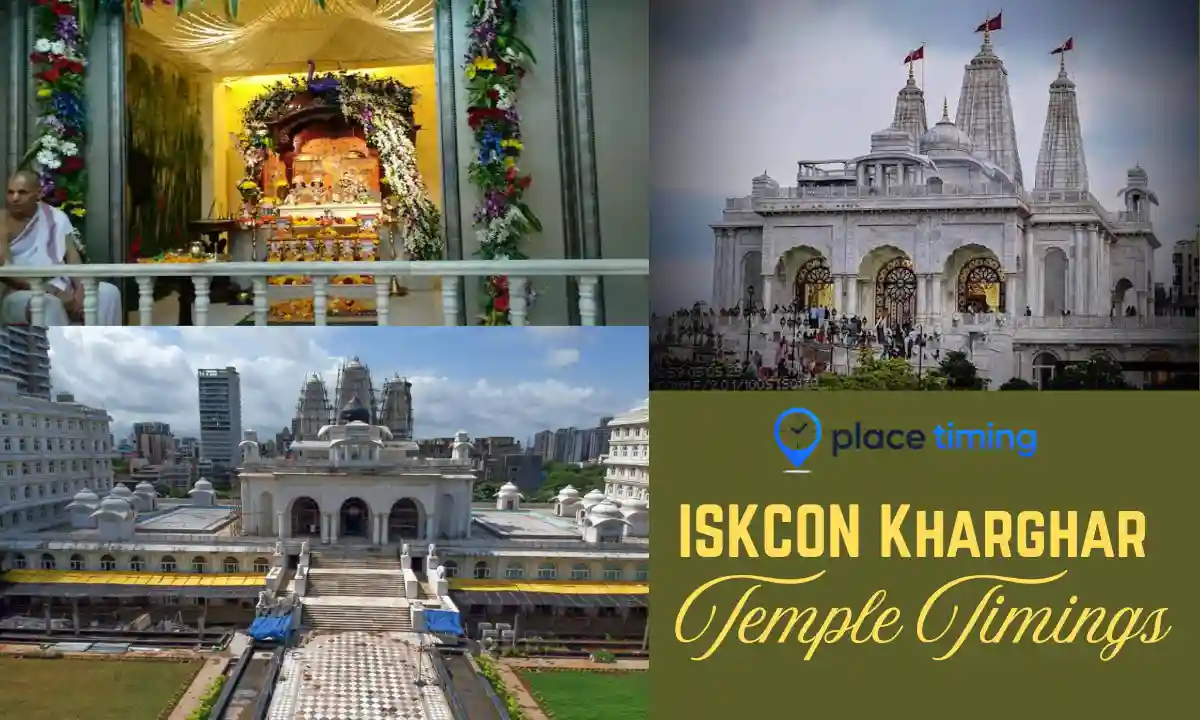
ISKCON Kharghar deceives you only once when it locks itself during noon time. You try to visit the temple by reaching there at two in the afternoon, but you find out that the doors are shut, irrespective of how far you have traveled. The temple runs in two sessions – morning session and evening session, which follow an order of aartis; and the order of aartis plays an important role in deciding how long you remain there to offer your respects. Below is the entire schedule, aarti-wise and otherwise.
ISKCON Kharghar Temple Timings: The Short Version
Here is the core of it. The ISKCON Kharghar temple timings are divided into a morning session and an evening session, along with a long break in between, but entry is always free. The Sri Sri Radha Madan Mohan Temple in Sector 23, Kharghar, Navi Mumbai, follows the pattern below. Do check the gym on that day, as Durga Puja day timings are changed at times & confirm from the official ISKCON Navi Mumbai site.
| Detail | At a glance |
|---|---|
| Morning session | About 4:30 AM to 1:00 PM |
| Midday closure | Roughly 1:00 PM to 4:30 PM |
| Evening session | About 4:30 PM to 9:00 PM |
| Open | Every day of the week |
| Entry fee | Free, no ticket and no compulsory donation |
| Best time to go | Mangala Aarti at dawn, or the evening aarti around 7:00 PM |
| Location | Hare Krishna Land, Sector 23, Central Park Road, Kharghar |
Opening Hours and the Midday Closure: The Basics
The temple opens very early in the morning, at around 4:30 a.m., and the morning hours stretch till about 1 p.m. After that, there is a break of about 3.5 hours when the gods have some rest; the temple will open again at about 4:30 p.m. and work till 9 p.m.
This break in the middle of the day is one of the most crucial things to keep in mind, as this is the time when the majority of guests arrive. The temple operates daily, and there is no weekly break; admission to the temple is free at all times. In case of holidays, like Janmashtami and Ekadashi, the schedule varies.
Aarti and Darshan Schedule: The Full Day
ISKCON temples follow a precise daily sequence of worship, and Kharghar is no exception. Knowing roughly when each aarti and class falls lets you time your visit to catch the moments that matter most.
| Programme | Approximate time | What it is |
|---|---|---|
| Temple opens, Mangala Aarti | Around 4:30 AM to 4:45 AM | The first and most sacred aarti of the day, at dawn |
| Narasimha prayers | Around 4:55 AM | Protective prayers following Mangala Aarti |
| Tulasi Aarti | Around 5:00 AM | Worship of the sacred Tulasi plant |
| Japa and mantra meditation | Around 5:30 AM | Quiet chanting session, open to visitors |
| Sringar Darshan | Around 7:15 AM | The deities revealed in fresh dress and ornaments |
| Guru Puja | Around 7:30 AM | Honouring the founder-acharya, with kirtan |
| Srimad Bhagavatam class | Around 8:00 AM | The daily scriptural discourse |
| Sandhya or Gaura Aarti | Around 7:00 PM | The main evening aarti, the liveliest of the day |
The aartis that most visitors come to see are Mangala Aarti, early in the morning when it is most peaceful, and the Gaura Aarti in the evening at seven when it is most vibrant, with all kirtan and a huge crowd. The timings differ by a minute or two here and there, but these are just rough estimates.
Entry and Costs: What You Pay
There is no money you need to spend to be there. The entry and darshan at ISKCON Kharghar are free of cost.
| Item | Cost |
|---|---|
| Temple entry and darshan | Free |
| Attending any aarti or class | Free |
| Donations | Voluntary, entirely at your discretion |
| Prasadam at the restaurant | Charged, at modest cafeteria rates |
| Guest house accommodation | Charged, booked through the temple |
| Parking | Available on the premises |
The only things you pay for are optional extras such as a meal at the prasadam restaurant, items from the gift and book stall, or a room at the guest house.
How to Make Offerings and Donations
There are multiple formal means of making offerings in ISKCON, all voluntary. If you would like to make an offering, here are the official ways to do so.
- Donation counters and boxes: donations may be offered at the counters within the complex, receiving a receipt for large amounts.
- Online donation: official ISKCON Navi Mumbai website accepts donations electronically, which is the easiest way from a distance.
- Anna Daan and food distribution: making prasadam distribution, one of the main activities in ISKCON, happen is one of the most popular ways of offering.
- Deity seva: sponsoring the flowers, garlands, dresses, or specific seva for the deities, organised at the temple office.
- Sponsoring festivals: making donations for big events like Janmashtami and Rath Yatra.
- Life membership and temple development: long-term contribution to the building, education and outreach work of the temple.
Offering should be made only at the official counters or on the temple website, asking at the temple office if you would like to make a donation for a certain service.
Best Time to Visit: Crowds, Aartis and Season
Timing plays a critical role in how your experience will be, since the temple is built on two distinct atmospheres.
- Morning period for Mangala Aarti: This is the quietest and the most meditative time, with hardly anyone at the temple, creating an extremely relaxed environment. Suitable for both first-time and meditation-oriented visits.
- Evening, around 7:00 PM aarti: This is the most lively time, where there is a full kirtan and congregation, along with the music. Suitable for visitors looking for a high-energy environment.
- Weekdays compared to weekends: Significantly more peaceful due to the large amount of family gatherings at weekends and during holidays from Navi Mumbai and Mumbai.
- October to February: The most comfortable season to make the visit due to the humidity in the city the other seasons.
Ekadashi is a steady group of devotees who are active yet not chaotic, whereas the largest event of the year, Janmashtami, sees the most number of people visiting.
What to Carry: A Practical Checklist
- Comfortable, easy-to-take-off footwear since the shoes are taken off before entry and stands are provided.
- Modest dressing with covering of shoulders and knees, as a sign of respect.
- Money in smaller denomination for prasadam, book stalls or any donations, although the restaurant might accept online payments.
- Drinking water since you will be attending a longer program or visiting during summer months.
- A small shawl or cover for morning aarti which could get chilly in open halls.
- A cloth bag for carrying back the books or prasadam.
What Not to Carry and the Rules to Follow
The etiquette here is not as strict as in many large temples, but there are a few important things.
- Do not bring in Leather items where possible as is customary with temples, and remove footwear when entering the halls.
- Non-vegetarian food, alcohol, and tobacco are not allowed inside.
- Photography is not allowed in the temple halls, especially during aarti; so adhere to signs and volunteers.
- When in aartis/class/kirtan keep phones on silent and no conversations inside the main hall
- Leave large bags or luggage in the cloakroom, as space is restricted in the halls during programmes.
You can wear everyday clothing like kurtas, trousers, and simple salwar (worn in parts of India), but there is no stringent dress code; however, respectful dress is expected from all.
The Deities and What to See Inside
The presiding deities are Sri Sri Radha Madan Mohanji in the main sanctum and there are many other shrines also constructed on the complex.
- Sri Sri Radha Madan Mohanji: the presiding deities of temple on the centerpiece of the main altar.
- Sri Sri Gaur Nitai: The forms of Chaitanya Mahaprabhu and Nityananda–these deities are the central focus of worship within the Gaudiya Vaishnava path.
- Sri Sri Vithal Rukminiji: These are the beloved Maharashtrian forms of Krishna and his consort.
- Sri Sri Sita Ram Laxman Hanumanji: Deities of the Ramayana, all worshipped together.
Apart from the altar space, the whole campus itself should be explored. Extending over around eight acres of land near the foothills of the Sahyadri range, the white campus-like temple complex is planned as a campus of spirituality rather than one temple.
Prasadam and the Restaurant: Eating at the Temple
Prasadam, holy vegetarian food, plays an important role in the tradition of ISKCON, and the Kharghar temple has an acclaimed restaurant and canteen that serve a good assortment of foods at low prices.
It is not just a matter of convenience but something that forms part of the visit itself. Holistic prasadam is served at other events too, and food donations form one of the most popular contributions that people make towards the activities of the temple.
Facilities: Auditorium, Library and Guest House
The complex is constructed not only as a temple but also as an educational and cultural complex, which differentiates it from an ordinary shrine.
- Bhaktivedanta Auditorium: a place for lectures, cultural activities, and festivals.
- Bhaktivedanta Library: a library containing Vedic texts and devotion literature for the purpose of study and reading.
- Bhaktivedanta Guest House: accommodation within the premises meant for devotees and pilgrims staying at the temple.
- Vedic Education Centre: classes conducted on the Bhagavad Gita and other religious books everyday.
- Gift and Book Stall: devotional literature and worship items.
Festivals: Janmashtami, Rath Yatra and Beyond
The temple’s schedule is packed, and the festival periods are the times that the temple comes to life.
- Janmashtami: the birthday of Lord Krishna and the biggest festival during the year at the temple, celebrated during midnight and attended by large numbers of people.
- Radha Ashtami: the appearance day of Srimati Radharani, involving special rituals.
- Gaura Purnima: the appearance day of Chaitanya Mahaprabhu, which is important in the tradition.
- Rath Yatra: the chariot festival, during which the temple goes on the street parade.
- Ekadashi: performed twice a month, resulting in an attendance that performs rituals with devotion.
Schedule changes for major holidays, thus, always check the temple’s schedule if you plan your visit depending on such a holiday.
History: When ISKCON Kharghar Was Built
Kharghar ISKCON temple, which was initiated somewhere in the beginning of the 2000s, was envisioned to be a large ISKCON center for Navi Mumbai area and was called Glory of Maharashtra Project. It took more than ten years to build and required hundreds of crores for its construction. Now, it operates as one of the most recently constructed and largest ISKCON temples in the entire family of more than two hundred temples in the world.
It is often referred to as one of the largest ISKCON temples in Asia. The temple complex occupies approximately eight acres of land located at the base of Sahyadri hills opposite to the Kharghar golf course and close to Central Park. It was planned as the campus, which includes not only the temple but also cultural and Vedic educational center, auditorium, and guest rooms.
How ISKCON Kharghar Compares to Mumbai’s Other ISKCON Temples
Mumbai has several ISKCON centres, and they differ considerably in age, size, and character. If you are choosing between them, the table below helps.
| Temple | Character | Best for |
|---|---|---|
| ISKCON Kharghar, Navi Mumbai | The newest and largest, a planned 8-acre campus below the Sahyadris | Space, architecture, and a full campus experience |
| ISKCON Juhu, Mumbai | The famous original, established in the 1970s, in a busy suburb | Heritage, and the best-known ISKCON address in India |
| ISKCON Chowpatty, Girgaon | A compact, community-centred temple in south Mumbai | Strong local congregation and regular classes |
| ISKCON Mira Road | A large temple serving the northern suburbs | Convenience for those in the north of the city |
The truth of the matter is that Juhu is the historic flagship, whereas Kharghar is the modern and larger temple that offers you space, landscaping, and the view of the hills that cannot be seen in the older city temples. If you require large-scale and peace, then Kharghar beats Juhu. But if you want the classic experience of ISKCON Mumbai, then Juhu is the place for you.
How to Reach ISKCON Kharghar and What It Costs
The temple sits in Sector 23, Kharghar, opposite the golf course and next to Central Park, and is straightforward to reach from across Mumbai and Navi Mumbai.
| Mode | Details | Approximate cost |
|---|---|---|
| By train | Kharghar station on the Harbour Line is the nearest railhead | Auto from station around Rs 50 to Rs 150 |
| By metro | Navi Mumbai Metro serves the Kharghar corridor | Auto or cab for the last stretch, modest |
| By bus | NMMT and other buses run through Kharghar | Cheapest option, though less frequent |
| By road | Well connected via the Sion-Panvel Highway, with Central Park as the landmark | App cab from Mumbai varies by distance |
| By air | Chhatrapati Shivaji Maharaj International Airport is about 40 to 45 km away | Cab, around an hour or more depending on traffic |
Autos from Kharghar station are the most common last-mile option, though fares can be negotiated rather than metered, so agree the amount before you set off. Parking is available on the premises for those driving.
Nearby Places to Combine With Your Visit
Kharghar has many places to visit near the temple so that you can make your day interesting.
- Central Park of Kharghar: One of the biggest parks around, near to the temple, which is good for a walk.
- Pandavkada Falls: A seasonal waterfall in the hills of Kharghar, most beautiful when it rains.
- Kharghar Hills and the valley point: The sunrise/sunset point and a short ride on the hill road.
- Utsav Chowk: Landmark point of Kharghar.
- Karnala Bird Sanctuary and Panvel: A little distance away from the above places for bird watching.
For those looking for a more extensive pilgrimage tour, the Ballaleshwar temple at Pali is one of the eight Ashtavinayak temples dedicated to Lord Ganesh and can be reached by car within a short drive towards Konkan.
Trivia and Lesser-Known Facts: ISKCON Kharghar
- This temple is devoted to Sri Sri Radha Madan Mohanji and the project is known as “Glory of Maharashtra” project.
- The campus has spread over an area of approximately eight acres near the base of the Sahyadri hills, on the other side of the Kharghar golf course.
- This project had begun from about the year 2000 and took more than a decade for its completion.
- This temple has been regarded as one of the biggest ISKCON temples of Asia.
- This is part of a global ISKCON family consisting of more than two hundred temples.
- Apart from the deities, there are shrines for Gaur Nitai, Vithal Rukmini, and Sita Ram Laxman Hanuman.
Quick Tips: Making Your ISKCON Kharghar Visit Work
- Steer clear of the afternoon break, between 1:00 PM and 4:30 PM, during which the temple is closed.
- Go for the dawn Mangala Aarti for tranquility and the aarti at night around 7:00 PM for vigor.
- Entry is not charged, so never be misled by anyone telling you otherwise.
- Dress decently, take off your shoes at the stand, and ensure mobile phones are switched off during programs.
- Have your meal at the prasadam restaurant, which is part of the event itself.
- Negotiate the auto fare from Kharghar station beforehand because that is what people usually do.
Final Take: Planning Your ISKCON Kharghar Visit
ISKCON Kharghar operates between approximately 4:30 AM to 1:00 PM and 4:30 PM to 9:00 PM daily with zero cost of entry. The thing to keep away from is showing up in the middle of the day when ISKCON will be closed. Pick the time depending upon whether you wish to have Mangala Aarti during the morning hours for a tranquil experience or Gaura Aarti that takes place at 7 in the evening to take part in kirtan and meet many people.
Make sure you dress decently, keep some money with you, and allocate time to walk around the 8-acre complex and dine in the prasadam restaurant because this is a spiritual campus and not a temple. Donations here are entirely optional and are preferably to be made in the counters available or at their official website. You may combine your visit to ISKCON with nearby places such as Central Park or Kharghar hills and make sure of the timings on the official website if visiting during Janmashtami or other festival times.
Frequently Asked Questions
What are the ISKCON Kharghar temple timings?
The temple is open from about 4:30 AM to 1:00 PM in the morning and from about 4:30 PM to 9:00 PM in the evening, every day, with a midday closure in between. Timings are extended and adjusted on major festival days.
Is ISKCON Kharghar closed in the afternoon?
Yes. The temple closes for roughly three and a half hours in the middle of the day, from about 1:00 PM to 4:30 PM, while the deities rest. Plan your visit for the morning or evening session.
Is there an entry fee at ISKCON Kharghar?
No. Entry and darshan are completely free, with no ticket, no booking, and no compulsory donation. You only pay for optional extras such as a meal at the prasadam restaurant, books, or guest house accommodation.
What are the aarti timings at ISKCON Kharghar?
Mangala Aarti is around 4:30 AM to 4:45 AM, followed by Narasimha prayers and Tulasi Aarti, with Sringar Darshan around 7:15 AM, Guru Puja around 7:30 AM, and the Bhagavatam class around 8:00 AM. The main evening Gaura Aarti is around 7:00 PM.
What is the best time to visit ISKCON Kharghar?
Mangala Aarti at dawn is the quietest and most meditative, while the evening aarti around 7:00 PM is the liveliest, with full kirtan. Weekdays are calmer than weekends, and October to February is the most comfortable season.
How do I make an offering at ISKCON Kharghar?
Donations are voluntary and can be made at the official counters inside the complex, or online through the temple’s website. Popular options include sponsoring prasadam distribution, deity seva such as flowers or dress, and festival sponsorship.
How do I reach ISKCON Kharghar and what does it cost?
Kharghar station on the Harbour Line is the nearest railhead, with an auto to the temple costing roughly Rs 50 to Rs 150. The Navi Mumbai Metro serves the corridor, buses run through Kharghar, and the airport is about 40 to 45 km away. Agree on auto fares before starting.
When was ISKCON Kharghar built?
The project began around the year 2000 as the Glory of Maharashtra project and took well over a decade to complete. Spread across roughly eight acres below the Sahyadri hills, it is widely described as one of the largest ISKCON temples in Asia.
Also read about: Shirdi Darshan Timings: Aarti Schedule, Passes, Offerings and Travel Guide



Leave a Reply